

A defect does not stay a QA problem for long. It becomes a support ticket. Then an angry customer. Then a line in next quarter’s budget. The CTO owns that line. So does the CIO, the CISO, and the VP of Engineering. That is why the decision to bring in managed testing services never belongs to one person. It touches cost. It touches security. It touches release dates. It touches audits. Treat it like a QA hire, and you miss what is really being decided.
The market keeps growing to match those stakes. Mordor Intelligence sizes the global managed testing services market at USD 328.85 billion in 2025, growing at a CAGR of 8.70% to USD 499.05 billion by 2030. That growth bets on one thing: that handing testing to someone else actually works. It does not always work. Whether it works for you depends less on a provider’s pitch deck, and more on five decisions most leadership teams never write down.
Cost exposure and budget predictability
Look at how the contract prices, not just the discount on the cover page. Staff-augmentation contracts bill for hours. You still carry the guesswork, because nothing ties spend to results. Outcome-based managed testing services move that risk to the provider. But only if the contract says what ‘done’ means. Coverage. Defect limits. Release dates. Spell them out, or the risk stays yours.
Budgets blow up from costs nobody priced first. TestingXperts lists them plainly: tools, licenses, servers, hiring, training, and the slow drag of running QA in-house. A real managed provider owns those costs. A weak one passes them back to you later, as change orders.
Get this wrong, and the damage is not abstract. It is a mid-year budget meeting nobody wanted. It is a hiring freeze that was not supposed to happen. A properly scoped managed testing services engagement prices these costs up front. It does not wait for the first change order to reveal them.
Vendor lock-in and switching cost
Most RFPs skip the real question: who owns the test assets when the contract ends? Hexaware’s engineering team draws the line clearly. In a true managed model, the provider owns the whole process, including automation and reporting, under an SLA that holds no matter what. Staff augmentation does not carry that ownership. That sounds safer. It is not. No one owns the outcome, so no one improves it.
But ownership cuts both ways. A provider who owns everything is efficient, right up until you want to leave. If your automation code and your defect history live only inside their tools, switching providers does not mean negotiating a new rate. It means starting over.
Here is the honest comparison. Not features. Risk.
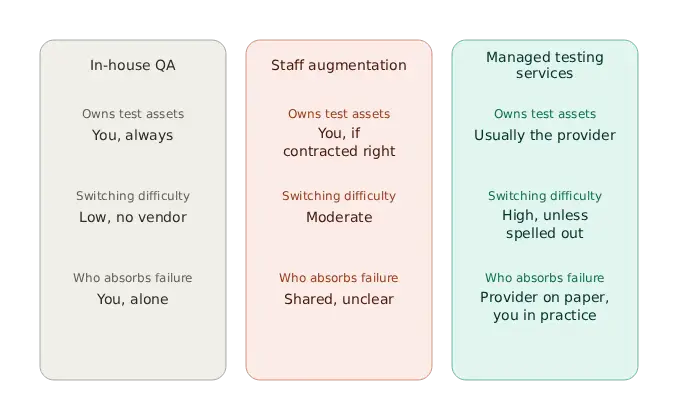
Skip this negotiation, and the cost shows up at renewal. That is the moment the provider knows exactly how much it would hurt you to walk. They will price accordingly.
Business continuity and downtime risk
Downtime here is not about server uptime. It is about whether testing keeps working when something breaks. TestingXperts treats this as governance, not comfort. A real managed engagement has SLAs. Named KPIs. A set cadence for review. Escalation paths that fire on their own, not ones that wait for someone to notice.
Multi-timezone testing is the tool most companies ignore. Run tests across regions, and cycles get shorter. You also get a backup: if one delivery center goes down, testing does not stop. Ask providers a direct question: what happens to my testing if your main office loses power mid-release? A vague answer is the answer.
Get the continuity terms wrong, and it shows up on launch day. A defined SLA breach becomes a missed launch window. Customers do not read your contract. They only see that the app did not work, and no credit clause fixes that.
Speed to market vs. competitors
Speed is what every pitch promises. It is also the promise with the fewest hard numbers behind it. The real lever is simple: how much of your testing runs inside CI/CD as code, and how much still waits in a manual queue for a human. Hexaware’s engineering group calls this shift-left. Catch a defect early, and it costs little. Catch it late, and it costs a launch date.
Ask for automation coverage by application, not by portfolio average. An average hides the old system nobody wants to touch. That is the one carrying the most risk. Ask how the provider handles a release spike, too. If the answer involves a change order, they cannot flex, and you will feel it exactly when speed matters most.
Get the automation commitment wrong, and the cost is not a slower sprint. It is a competitor’s product live in the app store while yours sits in a manual test queue, waiting for a tester with time to spare.

Compliance and audit liability
This decision cuts the deepest, and most contracts leave it vague. Regulated industries such as banks, hospitals, and insurers need proof. Proof that testing happened. Proof it covered the requirements. Proof someone signed off. TestingXperts’ delivery team is blunt about this: a real managed provider builds that proof in from day one. A weak one produces it after the auditor asks, which is too late.
Here is the harder question. Real customer data such as names, card numbers, and medical records often ends up in a test environment to make testing realistic. If that environment leaks, who is liable? By default, you are, unless the contract says otherwise. It rarely does, and usually by accident, not by design. Data masking and access limits need to be written down and checked. Not assumed.
Get this wrong, and the cost is not a testing gap. It is a stranger’s medical record on the wrong server. It is a customer’s card number in a breach headline. A real person pays for a decision nobody wrote into the contract.
The actual scope of a managed testing services decision
None of these five decisions sit inside QA alone. That is exactly why contracts leave them vague. Budget predictability is a finance decision. Lock-in is a legal and architecture decision. Continuity and compliance are risk decisions with technical teeth. Speed is the metric everyone wants, and the one most often left without a number attached.
A managed testing services engagement built around these five decisions, not a generic list of testing tasks, is the difference between a vendor you can manage and one you explain to the board after it breaks. That discipline is worth demanding from any provider, Calsoft included. Talk to Calsoft’s team about scoping these five decisions before your next renewal, not after your next outage.
FAQ's
What are managed testing services?
Managed testing services hand your software testing to an outside team. They own the strategy, the automation, the defect tracking, and the reporting. You do not manage testers day to day. They do.
What is the difference between managed testing and QA outsourcing?
QA outsourcing usually means staff augmentation. You still own the strategy and the outcome. You just borrow people. Managed testing services shift ownership of the outcome itself to the provider, usually under an SLA.
What types of testing are included in managed testing services?
Most engagements cover functional, regression, performance, security, integration, and automated testing across web, mobile, and desktop platforms. The exact list should be written into the contract, application by application. Do not assume it from a sales deck.