
Containers are revolutionizing application development by packaging all dependencies required to run applications. Kubernetes has emerged as the preferred choice among developers as it helps manage containerized workloads effectively, enhancing scalability and performance. Its growing adoption across enterprises highlights its critical role in modern technology ecosystems.
In the history of open-source software, Kubernetes stands out as one of the fastest-growing projects—second only to Linux. According to Statista, Kubernetes is projected to grow at a CAGR of 23.4% by 2031, with around 60% of companies already using it. This surge is driven by Kubernetes’ ability to streamline business operations and enable scalable infrastructure management.
Kubernetes—also known as K8s or Kube—is an open-source container orchestration platform that automates deploying, managing, and scaling containerized applications. The combination of containerization and Kubernetes is transforming the way businesses develop and manage applications. This blog explores the essentials of Kubernetes and its architecture in detail.
Why is it named “Kubernetes”?
The name “Kubernetes” comes from the Greek word for “helmsman” or “pilot.” The abbreviation K8s replaces the eight letters between “K” and “s.” Interestingly, the Kubernetes logo—a seven-spoked wheel—symbolizes control and navigation, just like a ship’s helm steering Docker containers.
Kubernetes and Docker – The Logo Connection
 |
If we observe the Docker logo, we can see that it features a ship carrying containers. |
 |
The Kubernetes logo features a seven-spoked wheel—a helm representing control and direction. |
Why do we need Kubernetes?
Earlier, applications followed a monolithic architecture. Today, microservices architecture has replaced it, where each service operates independently. Containers enable multiple microservices to run efficiently on the same server, optimizing resource utilization. However, managing multiple containers introduces challenges such as communication, autoscaling, and load balancing—this is where Kubernetes steps in.
Kubernetes automates deployment, scaling, and management of containerized applications. Developed by Google in the Go language, it serves as a container orchestration platform capable of managing large clusters of containers across networks.
Key Kubernetes Concepts
Containers: Independent software units containing everything required to run—code, libraries, and dependencies—ensuring consistent behavior across environments.
Clusters: A Kubernetes cluster consists of nodes running containerized applications. It includes a master node and multiple worker nodes (physical or virtual) for scalable management.
Pods: The smallest deployable unit in Kubernetes, consisting of one or more containers sharing resources and runtime specifications.
Services: Abstractions that define logical sets of pods and provide stable networking endpoints for accessing them.
Namespaces: Logical partitions within a cluster that organize resources and support multi-team environments.
Volumes: Persistent storage directories accessible to containers within pods. Volumes exist as long as their associated pods do.
Kubernetes Architecture Overview
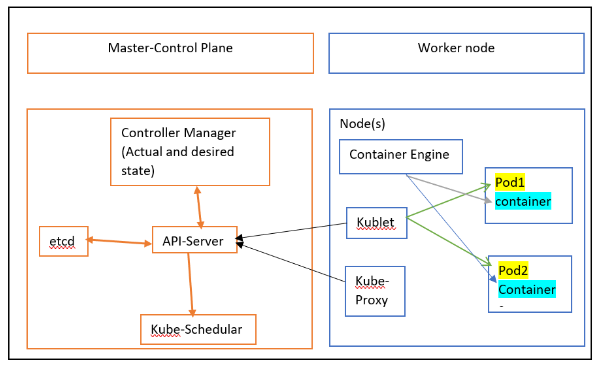
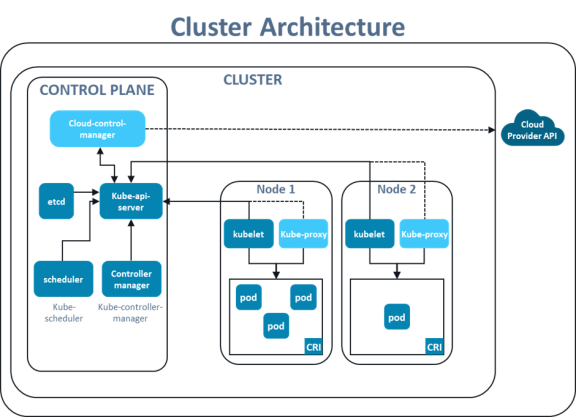
Kubernetes follows a master–worker (server–client) architecture. The Control Plane (Master) manages the cluster, while Worker Nodes execute workloads. Each node runs one or more Pods, and each Pod typically hosts a single container.
Control Plane Components
- API Server: The entry point for all cluster interactions, exposing the Kubernetes API.
- etcd: A distributed key-value store maintaining cluster state and configuration.
- Controller Manager: Ensures the actual state of the cluster matches the desired state.
- Kube Scheduler: Assigns newly created pods to appropriate worker nodes based on resource availability.
Worker Node Components
- Pod: The smallest Kubernetes unit that runs containers.
- Kube-Proxy: Manages network routing and load balancing for pods.
- Kubelet: Agent running on each node, ensuring containers are healthy and in sync with desired configurations.
- Container Engine: The runtime responsible for running containers (e.g., Docker, Podman).
Key Features of Kubernetes
- Autoscaling: Adjusts resources automatically (horizontal and vertical scaling).
- Load Balancing: Distributes traffic across nodes and pods to maintain performance.
- Fault Tolerance: Automatically reschedules pods when nodes fail to maintain service availability.
- Platform Independence: Supports physical, virtual, and cloud environments.
- Automated Rollouts & Rollbacks: Seamlessly deploys updates and reverts to stable versions if needed.
- Batch Execution: Supports one-time, sequential, or parallel job execution.
- Health Monitoring: Continuously checks container health and restarts failed pods.
- Self-Healing: Detects and replaces failed containers automatically.
Cloud-based Kubernetes Services:
- Google Kubernetes Engine (GKE)
- Azure Kubernetes Service (AKS)
- Amazon Elastic Kubernetes Service (EKS)
Interesting Facts about Kubernetes
- It is fully open-source.
- Everything in Kubernetes is managed as code.
- It enables cloud-native development.
- It can be used on a single machine for development.
- It supports persistent volumes for stateful applications.
Parting Thoughts
Kubernetes is a powerful platform for developing and running cloud-native applications. With its automation, scalability, and fault-tolerance capabilities, it simplifies modern software deployment and management.
Calsoft brings over two decades of experience in technology-driven solutions. Our Kubernetes engineering services help businesses accelerate their digital transformation journeys.