

Artificial intelligence is shifting from a tool that simply responds to instructions to a partner that can work on its own. While traditional AI waits for prompts and follows set rules, Agentic AI can set its own goals, plan several steps ahead, and adjust as needed—acting more like a teammate who understands the bigger picture.
This shift is not theoretical. According to Campus Technology (April 2025), 50% of enterprises are already deploying AI agents, with another 32% planning to do so within the next year. The age of autonomous systems is moving quickly from pilot to production.
What is Agentic AI? Definition & key differences from traditional AI
At its core, Agentic AI refers to systems that act independently within defined parameters, capable of interpreting goals, decomposing tasks, executing them across tools or APIs, and learning from outcomes.
Unlike generative AI, which only responds to prompts, Agentic AI takes initiative. For example, instead of waiting for a support engineer to ask for a report, an AI agent might spot a system issue on its own, investigate the cause, open a ticket, and suggest a fix—all without human intervention.
According to eMarketer’s 2025 forecast, one-third of enterprise applications will include Agentic AI by 2028, up from less than 1% in 2024.
Traditional AI vs. Agentic AI: What’s the difference?
|
Feature |
Traditional AI |
Agentic AI |
|
Operation |
Responds to prompts |
Acts autonomously |
|
Planning |
Single-step execution |
Multi-step planning |
|
Adaptability |
Fixed rules |
Learns from feedback |
|
Decision Making |
Human-dependent |
Independent within guardrails |
|
Example |
Chatbot answering FAQs |
AI agent resolving IT incidents end-to-end |
How does Agentic AI work? Architecture & core components explained
Agentic AI combines the flexibility of large language models (LLMs) with structured reasoning and execution systems. According to McKinsey’s 2025 analysis, this new class of AI integrates planning engines, memory modules, orchestration frameworks, and feedback loops.
Here’s how the architecture typically functions:
- Goal Setting — The system defines objectives like reducing downtime or optimizing delivery routes
- Task Decomposition — Goals are broken into actionable sub-tasks across multiple systems
- Planning & Execution — The agent decides actions, executes them, and adjusts as conditions change
- Feedback & Learning — Continuous feedback refines performance over time
- Governance & Oversight — Human-in-the-loop mechanisms ensure reliability and compliance
A 2025 IBM study found that 86% of executives expect workflow automation to improve through AI agents by 2027, highlighting growing confidence in autonomous systems.
7 real-world Agentic AI use cases transforming enterprises in 2025
1. Customer Service Automation
In contact centers, Agentic AI manages full customer workflows—gathering context, executing resolutions, and escalating only when human judgment is needed.
According to Gartner (March 2025), 80% of common service issues will be resolved autonomously by 2029, leading to 30% cost reduction. Cisco projects that 68% of tech vendor interactions will be handled by agentic systems by 2028.
Explore Calsoft’s AI solutions for customer service automation.
2. IT operations and DevOps automation
Agentic AI acts as a force multiplier for DevOps teams. Agents detect anomalies, restart services, adjust resources, or trigger CI/CD pipelines without human intervention, dramatically reducing mean-time-to-resolution (MTTR).
Research from Jellyfish (2025) found that adoption in engineering teams rose from 51% to 82% within five months, driven by measurable gains in deployment speed and uptime reliability.
3. Supply chain and logistics optimization
In logistics, Agentic AI brings real-time adaptability. Agents monitor supply disruptions, update inventory projections, reroute shipments, and communicate with partners autonomously.
Ernst & Young’s 2025 insights show companies using agentic systems saw up to 20% improvement in forecasting accuracy and fewer delays from external shocks.
Read our Digital Twin in Supply Chain guide for optimization strategies.
4. Cybersecurity and threat response
Agentic AI enables real-time threat detection, containment, and recovery—guided by predefined governance policies.
A 2025 IBM survey revealed that 69% of executives cite faster decision-making and improved resilience as top benefits. Axios (March 2025) reported companies like Microsoft and CrowdStrike actively deploying autonomous agents for incident response.
Explore Calsoft’s cloud solutions for zero-trust architectures.
5. Financial services and insurance automation
From underwriting to claims management, Agentic AI transforms how financial institutions process complex tasks.
According to Salesforce’s 2025 study, insurers report 30-40% faster claim cycles and improved fraud detection accuracy with agentic systems.
6. Workplace and productivity automation
Agentic AI acts as a “digital worker”—triaging emails, scheduling meetings, summarizing conversations, and coordinating across departments.
A Blue Prism 2025 survey found that 29% of organizations already use agentic AI for automation, with 44% planning adoption within a year.
7. Healthcare and patient management
Healthcare providers pilot Agentic AI to monitor patient data, optimize staff allocation, and recommend interventions in real time.
A 2025 report from Converge Technology Solutions outlines deployments where agents detect anomalies in patient vitals and trigger alerts before deterioration occurs.
Why Agentic AI matters for enterprises
Enterprises adopting Agentic AI report measurable gains:
- Productivity: 66% see measurable increases (PwC’s 2025 Survey)
- Cost Efficiency: 57% cite operational savings (PwC, 2025)
- Market Growth: U.S. Agentic AI market expected to grow from $769.5 million (2024) to $6.55 billion (2030)—a 43.6% CAGR (Grand View Research, 2025)
However, Gartner’s June 2025 analysis warns that 40% of agentic AI projects could be cancelled by 2027 due to unclear ROI and inadequate governance. Success demands structure and oversight.
Challenges and the path forward
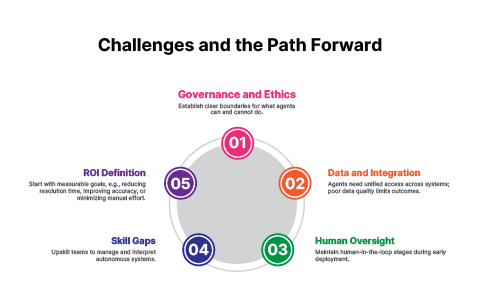
Implementing Agentic AI responsibly requires:
- Governance and Ethics — Establish clear boundaries for agent actions and escalation protocols
- Data and Integration — Agents need unified access across systems; poor data quality limits outcomes
- Human Oversight — Maintain human-in-the-loop mechanisms during early deployment
- Skill Development — Upskill teams to manage autonomous systems
- ROI Definition — Start with measurable goals like reducing resolution time or improving accuracy
As McKinsey notes, success isn’t about adopting a tool—it’s about redesigning workflows so agents operate safely and effectively.
Looking ahead: The future of Agentic AI
Over the next few years, expect:
- Enterprises moving from pilots to production-scale AI orchestration
- Emergence of “AgentOps” teams dedicated to monitoring and optimizing AI agents
- Expansion into regulated industries like healthcare, finance, and government
- Multimodal agents processing text, images, voice, and video
- Cross-enterprise agent collaboration for complex workflows
- Growing emphasis on explainability and accountability
According to McKinsey’s 2025 research, goal-driven AI systems will become a standard infrastructure layer by the decade’s end.
Calsoft perspective
Calsoft partners with enterprises to design, build, and operationalize AI-driven systems that integrate safely with existing storage, virtualization, networking, and cloud ecosystems.
If you’re exploring where Agentic AI can accelerate your enterprise workflows, our experts can help you assess readiness and create a scalable roadmap.
FAQ's
Q: What is Agentic AI and how is it different from traditional AI?
Agentic AI goes beyond responding to prompts—it takes initiative. Unlike traditional AI that waits for human input, Agentic AI systems can define goals, plan multi-step actions, execute across tools or APIs, and learn from outcomes. This autonomy allows them to handle complex workflows like IT operations, customer service, and supply chain management with minimal human oversight.
Q: How does Agentic AI actually work inside an enterprise system?
Agentic AI combines large language models (LLMs) with planning engines, memory modules, orchestration frameworks, and feedback loops. Together, these components allow an agent to interpret context, make decisions, act autonomously, and adapt based on results. According to McKinsey’s 2025 analysis, this layered architecture enables goal-driven, adaptive behavior across enterprise environments.
Q: What are the biggest benefits and challenges of deploying Agentic AI?
Key benefits include faster decision-making, improved productivity (66% of adopters report measurable gains per PwC 2025), and reduced operational costs (30-40% in some use cases). Challenges include governance, data integration, and defining clear ROI. Enterprises that implement strong oversight frameworks and pilot measurable use cases see the highest success rates.