

When a single delayed shipment in Shenzhen can stall a product launch in San Francisco, visibility alone isn’t enough. Supply chain leaders today don’t just need to see what’s happening; they need to predict what comes next.
That’s where digital twin technology comes to the fore.
A digital twin isn’t another analytics dashboard or visualization tool. It’s an AI powered bi-directional, virtual model for your entire supply chain, warehouses, logistics flows, inventory levels, and IoT-enabled machinery, all synchronized in real time. It doesn’t just describe reality; it simulates and optimizes it.
For product and engineering leaders evaluating digital twin solutions, the opportunity is clear:
-
Run what-if scenarios without disrupting operations.
-
Use AI for autonomous decision loops.
-
Gain upstream visibility into disruptions before they cascade.
But building a supply chain digital twin isn’t plug-and-play. It involves architectural trade-offs, data governance challenges, and design choices that determine whether the twin becomes a strategic advantage or a maintenance burden.
Here’s what we’ll explore:
-
What a supply chain digital twin actually is (beyond the buzz)
-
Core use cases and AI integrations that drive value
-
Key metrics and benchmarks to track performance
-
Architectural challenges and trade-offs
-
A practical roadmap to get started
What Is a Supply Chain Digital Twin?
A supply chain digital twin is a dynamic, data-driven replica of your physical operations. It continuously ingests live signals from ERP systems, IoT sensors, RFID tags, and telematics, and mirrors them in a real-time simulation.
According to Coupa, a digital twin “virtually simulates the physical supply chain by unifying data across multiple systems into one decision environment.”
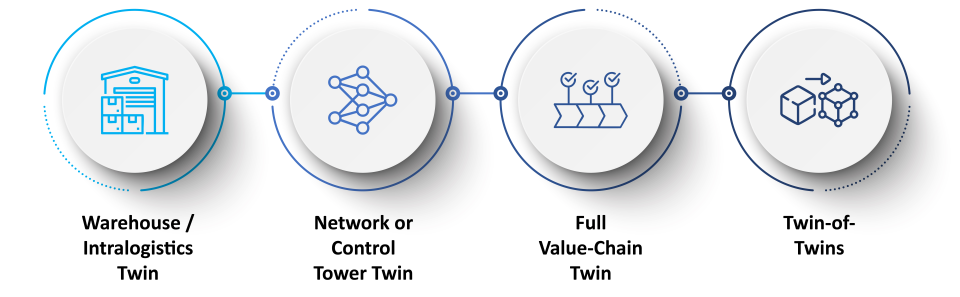
Depending on the scope, digital twins can operate at several layers:
-
Warehouse / Intralogistics Twin: Simulates robot movements, shelf stocking, and conveyor flows to identify bottlenecks or optimize layouts.
-
Network or Control Tower Twin: Models suppliers, distribution centers, and transport lanes for visibility and coordination.
-
Full Value-Chain Twin: Extends across procurement, manufacturing, logistics, and returns, helping organizations forecast and plan holistically (McKinsey & Company).
-
Twin-of-Twins: Connects multiple digital twins across partners for collaborative simulations across ecosystems.
Ultimately, the digital twin isn’t just a 3D visualization; it’s an operational nerve center for testing strategies, forecasting outcomes, and automating decisions before they affect the physical world.
Also Read: How Organizations Can Secure Our World Through Practical, Scalable Security Measures
Digital Twin Use Cases in Supply Chain: From Simulation to Optimization
When implemented effectively, a supply chain digital twin becomes a continuous intelligence platform that unites simulation, AI, and automation.
1. Scenario Simulation & What-If Testing
“What if demand surges 50% next month? What if a port closes for a week?”
Digital twins let teams stress-test such scenarios virtually, without risking real-world disruption.
Within the twin, organizations can design and execute Design of Experiments (DoE) frameworks to systematically explore multiple “what-if” conditions. DoE helps structure variable combinations like lead time, demand rate, labor availability, and equipment utilization, so teams can measure interactions and outcomes efficiently.
By embedding DoE logic directly into the twin’s simulation environment, enterprises can automatically generate and evaluate thousands of scenario permutations. The result: data-backed decision boundaries that reveal not just what might happen but why—and which levers are most sensitive to change.
2. Real-Time Monitoring & Visibility
Live heatmaps expose congestion points in aisles, inventory imbalances, and equipment anomalies, all mapped back to the warehouse floor.
3. Autonomous Decision Loops
AI agents trained within the twin can orchestrate robotic paths, reroute shipments, and trigger predictive maintenance, all in real time. Metrics like agent orchestration latency and sensor fusion rate become vital indicators of how effectively AI is rounding off on the perception to action loop.
4. Forecasting and Inventory Optimization
Instead of relying solely on historical data, the twin combines predictive analytics with live inputs. Boston Consulting Group notes that early adopters of digital twins have improved forecast accuracy by 20–30% and cut downtime by up to 80%.
5. Resilience Planning
Whether it’s geopolitical tension, supplier failure, or climate impact, disruptions can be modeled and mitigated proactively.
6. Continuous Optimization
Over time, the twin evolves through reinforcement learning, where AI agents continuously refine their actions based on feedback from both simulated and real-world outcomes. This allows the system to dynamically recommend layout changes, labor reallocation, or replenishment adjustments that maximize throughput and minimize downtime.
A Quick Example
A global retail chain implemented a warehouse digital twin using NVIDIA Omniverse to simulate peak-season demand. Using AI-driven path planning and multi-agent coordination, the system optimized robot movement schedules and reduced idle time through dynamic task allocation.
Within two months, the twin delivered:
-
15% reduction in robot idle time (achieved through reinforcement learning-based task balancing)
-
12% improvement in replenishment speed (via real-time reorder threshold tuning)
-
8% lower operational costs, saving roughly 1,200 man-hours per quarter
These improvements weren’t theoretical; they translated directly into measurable cost savings and higher on-time fulfillment.
The market is noticing: the global supply chain digital twin market reached $2.49 billion in 2022 and is projected to grow at nearly 12% CAGR through 2030 (Grand View Research).
Key Metrics and Benchmarks for Digital Twin Performance
A digital twin is only as good as the signals it consumes and the responsiveness it achieves. For engineering leaders, these are the metrics that matter:
-
Simulation Throughput (FPS or updates/sec): Indicates rendering efficiency at scale (thousands of agents, racks, and sensors).
-
AI Agent Orchestration Latency: Measures thoroughly the end-to-end spectrum starting with perception / contextual understanding to co-ordination & planning to outcomes / actions for all the robotic or automated decisions.
-
Sensor Fusion Ingestion Rate: Tracks how many multimodal sensor streams (vision, RFID, lidar) are processed per second.
-
Inference Latency (ms per batch): Key for predictive AI models in replenishment and demand forecasting.
-
Consistency / Divergence Delta: Quantifies how far the digital model drifts from physical reality, critical for trustworthiness.
-
Business KPIs: Inventory turnover, order fill rate, cycle time, cost per shipment, and downtime reduction.
Monitoring these benchmarks helps organizations balance fidelity, cost, and computational performance.
Digital Twin Architecture Challenges: Data, Scale, and Cost Trade-Offs
Building and maintaining a digital twin is a systems engineering challenge. Here’s what typically keeps architects awake:
1. Data Integration & Governance
Integrating data from ERP, WMS, MES, IoT sensors, and telematics requires robust pipelines and schema governance. Surgere highlights data interoperability as one of the biggest roadblocks to successful twin deployment.
2. Scalability vs. Performance
High-fidelity simulation demands GPU-intensive compute power. Partitioning and load balancing are essential to maintain frame rates and inference latency.
3. Real-Time vs. Batch Processing
Some processes, like robot rerouting, require millisecond responses, while seasonal inventory planning can run asynchronously. Architect for both.
4. Model Drift & Simulation Accuracy
Physical conditions change over time. If your twin doesn’t retrain or recalibrate, divergence grows and reliability declines.
5. Security & Data Privacy
Continuous streaming between cloud, edge, and factory networks raises attack surfaces. Strong encryption, role-based access, and monitoring are non-negotiable.
6. Organizational Change Management
Digital twins alter workflows across operations, IT, and analytics. Teams need training and a clear governance framework for adoption.
7. ROI and Cost Control
Full-scale twins can be expensive to run. Prioritize incremental ROI, measure improvements in throughput, utilization, and responsiveness before scaling.
Why Digital Twin Adoption Matters Now
-
Complexity and volatility in supply chains continue to rise.
-
Traditional analytics lack the feedback loop needed for adaptive decisions.
-
AI, simulation platforms, and GPU compute have matured to make real-time modeling viable.
-
Results are measurable: BCG reports up to 30% forecast improvement and 80% downtime reduction for early adopters.
-
Market growth is accelerating, validating long-term value (Grand View Research).
In short, digital twins are moving from pilot to production, and the competitive gap between adopters and laggards will widen quickly.
How to Build a Digital Twin Roadmap for Your Supply Chain
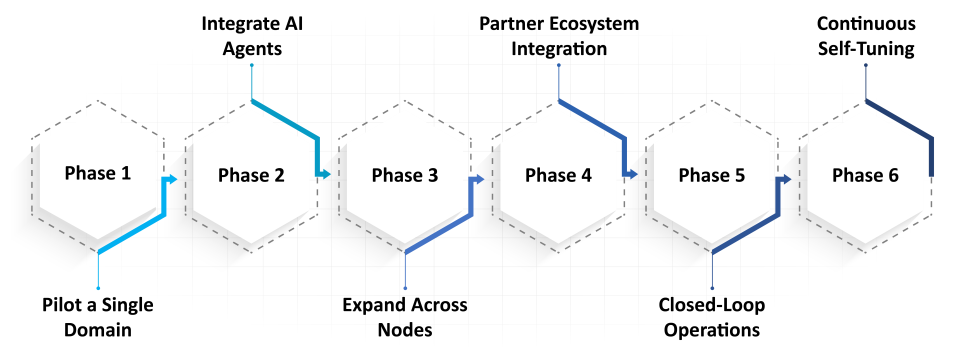
If you’re starting your digital twin journey, this phased roadmap can help you move from proof of concept to production:
Phase 1: Pilot a Single Domain
Select one warehouse or transport lane with strong sensor coverage. Build a focused twin for movement and stock flow. Measure latency, simulation fidelity, and data accuracy.
Phase 2: Integrate AI Agents
Automate basic loops, robot path planning, reorder thresholds, anomaly alerts, and benchmark against manual baselines.
Phase 3: Expand Across Nodes
Add adjacent sites or logistics nodes to enable network-level simulation and stress testing.
Phase 4: Partner Ecosystem Integration
Include upstream suppliers and carriers to test end-to-end resilience and collaboration.
Phase 5: Closed-Loop Operations
Move from recommendations to live control, within safety guardrails.
Phase 6: Continuous Self-Tuning
Implement reinforcement learning and A/B testing for ongoing calibration.
Each phase should produce measurable gains, reduced downtime, improved utilization, and faster response cycles to justify scale-up.
Pitfalls to Avoid
-
Starting with a high-fidelity, high-cost model before proving ROI
-
Overlooking integration complexity and data quality issues
-
Neglecting model retraining, leading to drift
-
Failing to align Ops, IT, and AI ownership
-
Locking into proprietary ecosystems that limit interoperability
Conclusion: From Reactive to Predictive
The digital twin is more than a technology; it’s a mindset shift. It transforms supply chains from reactive systems into predictive, adaptive networks that can sense, simulate, and self-correct.
As an engineering or product leader, remember:
-
Treat the twin as a living system, not a one-time project.
-
Prioritize fidelity only after you’ve proven ROI.
-
Track technical and business metrics together.
-
Scale gradually, data maturity first, automation second.
-
Build organizational alignment from the start.
At Calsoft, our AI/ML and Digital Engineering teams help enterprises design scalable digital twin architectures that integrate simulation, data engineering, and AI-driven optimization. The insights are consistent: the future of supply chain excellence will be simulated before it’s executed.
Digital twins won’t just make operations efficient; they’ll make them intelligent.
And in a world of constant disruption, foresight beats hindsight every time.
FAQs
1. What is a Digital Twin in supply chain management?
A digital twin in supply chain management is a real-time virtual replica of physical assets, processes, and networks. It integrates live data from IoT sensors, ERP systems, and logistics platforms to mirror, simulate, and optimize real-world operations—helping organizations make faster, data-driven decisions.
2. How does a Digital Twin differ from traditional simulation or analytics tools?
Traditional analytics rely on static or historical data, while digital twins are bi-directional and dynamic. They continuously update using live data streams and can simulate scenarios, test strategies, and even automate responses through AI and reinforcement learning.
3. What role does AI play in Digital Twin systems?
AI enables predictive and prescriptive intelligence within a digital twin. Machine learning models help forecast demand, detect anomalies, and optimize decisions. Reinforcement learning allows AI agents to learn from simulated feedback loops, improving accuracy and efficiency over time.