

AIOps Planning Services for Intelligent IT Operations
Transforms reactive ops into predictive, autonomous ecosystems through scalable, observable, business-aligned AIOps.

Why AIOps planning matters
Noise ≠ Insight
Automation ≠ Intelligence
Jumping into AIOps with tools alone leads to alert fatigue, rule sprawl, and misplaced trust in automation.

Misaligned thresholds and baselines

Fragmented telemetry

No feedback loop between operations and ML models

Lack of business impact correlation
Design for closed-loop
Think in events, not alerts
We design AIOps as a feedback loop with real outcomes—not just another monitoring stack.
Our AIOps planning framework includes:
(metrics, logs, traces, configs)
(events ↔ impact ↔ action)
Modular architecture
Don’t retrofit. Architect.
We build flexible AIOps blueprints tailored to your existing systems—cloud, hybrid, or edge.
Modules include:
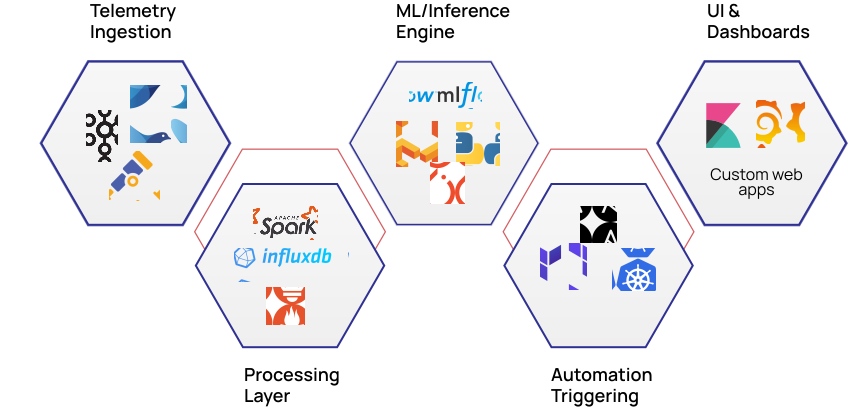
Detect anomalies 3x faster with AIOps.
Use cases that matter
Not all alerts need AI. Some actions must.
Strategic AIOps Use Cases We Enable:

- Root cause prediction via ML from telemetry patterns
- Predictive scaling for compute/storage/network
- Proactive SLA breach mitigation
- Resource hog detection in containers
- Infrastructure drift detection
- Time-series anomaly prediction for uptime KPIs
Real-world impact
Quantified gains from Calsoft-led AIOps strategy
| Metric | Outcome |
|---|---|
| Time to detect anomalies | ↓ 78% |
| Manual triage workload | ↓ 65% |
| False positive alerts | ↓ 91% |
| SLA breaches from infra faults | ↓ 58% |
| AI model retraining overhead | ↓ 40% |
How to start
From observability to operability

Telemetry Gap Audit
Identify missing, duplicated, or noisy data sources.

Business-KPI Mapping
Prioritize which systems’ health most affects real outcomes.

Feedback Loop Design
Define auto-remediation paths for known incidents with fail-safes.

Toolchain Alignment
Map existing tools with AIOps stack and ML pipeline support.

Pilot Use Case Rollout
Start with high-impact, low-risk closed-loop automation.
