
.jpg)
From the Industrial Revolution to the digital transformation age, the modernization of industries always been powered by technology, especially the introduction of the Internet of Things (IoT). Technological advancement, particularly with the integration and use of Artificial Intelligence (AI) and its subset, Generative AI (Gen AI), has intensified and magnified this trend even further.
Although Generative AI was conceptualized decades ago, its recent advancements—especially with models like ChatGPT—have rapidly transformed its potential across industries. What started as a creative tool is now at the core of enterprise AI strategies, enabling intelligent decision-making and seamless automation.
Generative AI has officially outgrown the pilot stage. What began in 2023 as scattered experiments with chatbots and copilots has, by 2026, become a board-level line item measured in ROI. Gartner projects that more than 80% of enterprises will run GenAI-enabled applications in production this year, up from under 5% just three years ago. The market reflects that shift too — generative AI is valued at roughly $67 billion in 2026 and is on track toward $1.3 trillion by 2032.
On what side of the Spectrum would your Enterprise like to be?
According to Statista, the AI market size is expected to show an annual growth rate (CAGR 2024-2030) of 28.46%, resulting in a market volume of US$826.70bn by 2030.
The Generative AI market worldwide is projected to grow by 46.47% (2024-2030), resulting in a market volume of US$356.10bn by 2030.
Top Generative AI Trends
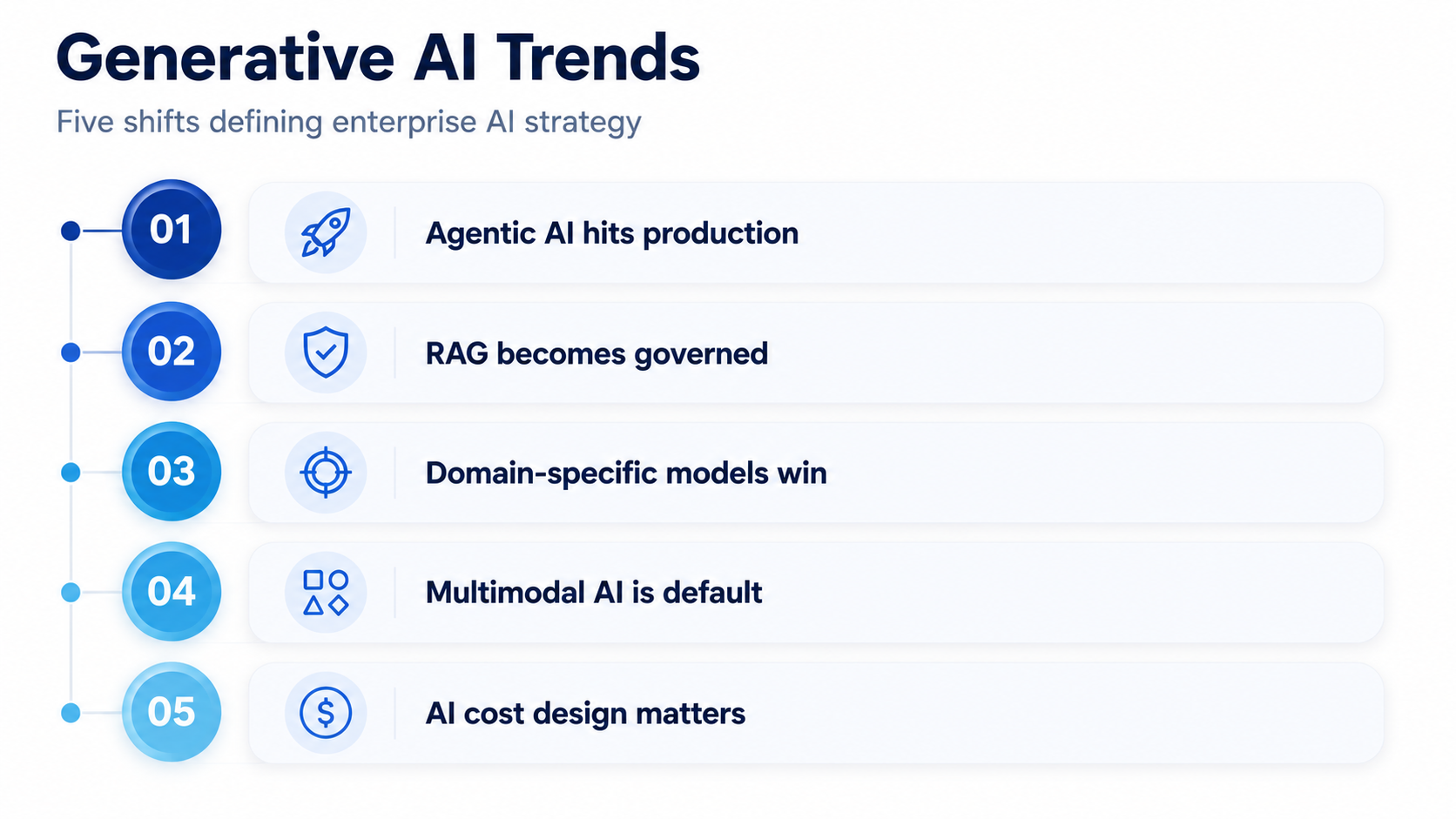
1. Agentic AI Moves From Pilot to Production: The biggest shift this year is from generative AI that answers questions to agentic AI that gets things done. These systems plan, use tools, coordinate with other agents, and complete multi-step workflows with minimal supervision. It's paying off: a 2025 Google Cloud study found 88% of early agentic AI adopters reported positive ROI, versus 74% for generative AI more broadly. Enterprises are now tying agent deployments directly to hours saved and cycle times cut.
2. Retrieval Becomes Governed: Ungrounded models create trust problems fast. In 2026, Retrieval-Augmented Generation (RAG) is evolving into a governed knowledge fabric — curated sources, access permissions, freshness rules, and evaluation metrics tied to real business outcomes. This is where responsible AI stops being a policy document and starts being a product requirement: what your knowledge layer allows in is what the model is allowed to say.
3. Domain-Specific Models Outperform General Ones: General-purpose models are giving ground to smaller, domain-specific AI models fine-tuned on specialized enterprise data. In regulated or technical domains — telecom, healthcare, storage infrastructure — these models consistently deliver better accuracy and compliance than one-size-fits-all LLMs, and cost less to run at scale.
4. Multimodal AI Becomes the Default: Enterprise data was never just text — it's documents, images, audio, sensor feeds, and code. Multimodal AI that processes all of this together, rather than through separate pipelines, is becoming standard, unlocking use cases in manufacturing, retail, and healthcare that text-only models couldn't reach.
5. Cost-Aware AI Design: As agentic workflows scale, so do token and compute costs. Leading enterprises now treat AI spend as an engineering variable, not an afterthought — instrumenting usage, right-sizing models per task, and weighing performance against ROI. Organizations without a formal AI cost strategy are already losing ground to competitors who built one in from day one.
The following section focuses on how Gen AI will transform specific domains where Calsoft’s expertise supports our customers and clients. The practical application of Generative AI in enterprises resolves business challenges and constraints, enabling enhanced operations, increasing efficiency, productivity, and profitability
Domain-Specific Impact of Generative AI
With over 27 years of expertise in software product engineering, Calsoft helps accelerate product development—from ideation to market analysis—through intelligent automation and optimization. Our integrated approach to engineering and digital transformation empowers ISVs, product companies, and digital enterprises to boost agility and reduce time to market.
With a strong focus on Generative AI services, Calsoft is ready to support your innovation journey.
AI in Storage
As data generation scales, AI in storage is optimizing how we store, classify, and retrieve information:
- Predictive storage scaling & cost-efficient tiering
- Intelligent data deduplication and compression
- AI-powered metadata tagging for fast access
- Enhanced data management through real-time insights
AI in Networking
Networking needs resilience, and Generative AI is stepping up:
- Simulating and optimizing network traffic flow
- Automating network configuration and issue resolution
- Predictive failure detection for proactive recovery
- Energy optimization and sustainable traffic routing
AI in Cybersecurity
With rising cyber threats, AI in cybersecurity offers proactive defense:
- Anomaly detection in real-time
- Synthetic attack simulation for testing
- Automated recovery & zero-trust policy enforcement
- Predictive hardware failure mitigation
AI in Cloud & Virtualization
Gen AI is redefining cloud computing and virtualization with smarter workload allocation, digital twins for testing, and synthetic data for training environments.
- Resource optimization via AI
- Voice/NLP-based interaction with virtualized systems
- Predictive workload distribution across edge-cloud setups
AI and Sustainability
With growing focus on green IT, AI and sustainability are becoming deeply interconnected:
- Optimizing power usage in data centers and networks
- Promoting longer hardware life and reducing e-waste
- Prioritizing the use of renewable energy through AI orchestration
Final Thoughts
In the coming years, Generative AI will be embedded into the core of digital infrastructure. It will not only shape how we manage data, build systems, and deliver services, but also how enterprises achieve sustainability, resilience, and scalability. As organizations continue integrating Gen AI applications across domains, the key to success will lie in choosing the right partners, platforms, and priorities.
FAQ’s
Q1: What's the biggest generative AI trend in 2026?A. The shift from single-turn generative AI to agentic AI — systems that plan and execute multi-step tasks autonomously, under governance.
Q2: How is Gen AI changing enterprise IT?A. Gen AI helps manage data better, predict demand, optimize network traffic, and detect threats faster—all while improving efficiency and sustainability.
Q3: How should enterprises prepare for these AI trends?A. Start with governed data (a knowledge fabric), pick domain-specific models where accuracy matters most, and build a cost model before scaling agents.