

Live Discussion: Future-Proof Your OT Infrastructure
Secure. Comply. Save.
Transforming OT Resilience into a Business Advantage
Date: September 24, 2025
Time: 11:00 AM PDT | 2:00 PM EDT | 10:30 PM IST
The key pillar of digital transformation lies in secure communication and data exchange between Information Technology (IT) and Operational Technology (OT). However, these environments differ significantly in architecture, protocols, and security requirements. To enable reliable and secure data exchange, enterprises must address the unique challenges of industrial networks, IoT devices, and enterprise IT systems.
Over the past decade, OT systems have become increasingly IP-connected—making them more vulnerable to cyberattacks. As a result, enterprises must integrate OT cybersecurity into their overall risk management and digital resilience strategy.
Nearly 70% of industrial firms experienced an OT cyberattack last year. According to ABI Research, industrial organizations need an integrated and cyber-resilient IT-OT framework to address today’s increasingly sophisticated threat landscape.
As industrial operations become more connected, risks in OT and IoT environments rise sharply. These vulnerabilities often result in operational shutdowns and financial losses. In addition, modern technologies such as AI in cybersecurity, robotic automation, cloud security, and 5G networks introduce new challenges that must be managed through zero-trust architectures and collaboration with providers experienced in both OT and IT ecosystems.
Continue reading to explore OT, its importance, how it differs from IT, the role of IoT in OT, and key distinctions between OT and IoT security.
What Is Operational Technology (OT)?
Operational Technology (OT) refers to the hardware and software systems that control or monitor physical assets and processes. This includes traditional Industrial Control Systems (ICS) and modern Internet of Things (IoT) devices. Common OT technologies include Supervisory Control and Data Acquisition (SCADA) systems, Programmable Logic Controllers (PLCs), and Distributed Control Systems (DCS).
OT plays a crucial role in industries such as manufacturing, energy, utilities, and transportation. While OT was once limited to factories or grids, it now spans HVAC systems, elevators, drones, cranes, and even autonomous robots—all part of today’s connected OT landscape.
Integrating OT with IT infrastructure brings benefits such as improved data utilization, efficiency, automation, and cost savings. However, this convergence also exposes OT systems to the same cyber threats that affect IT networks.
Calsoft and SmartHub.ai have joined forces to deliver an integrated edge solution that enhances visibility, automation, and resilience across OT infrastructures—from factory floors to large campuses—addressing rising cyber threats, compliance demands, and downtime costs.
What Is OT Security and Why Is It Important?
OT systems are often safety-critical, where even minor delays can lead to significant operational issues or hazards. Therefore, cybersecurity measures in OT must be designed to ensure both security and uninterrupted operation.
OT security involves safeguarding systems such as SCADA and ICS from unauthorized access and cyber threats while maintaining operational continuity. Strong security frameworks are essential to prevent disruptions and protect industrial assets.
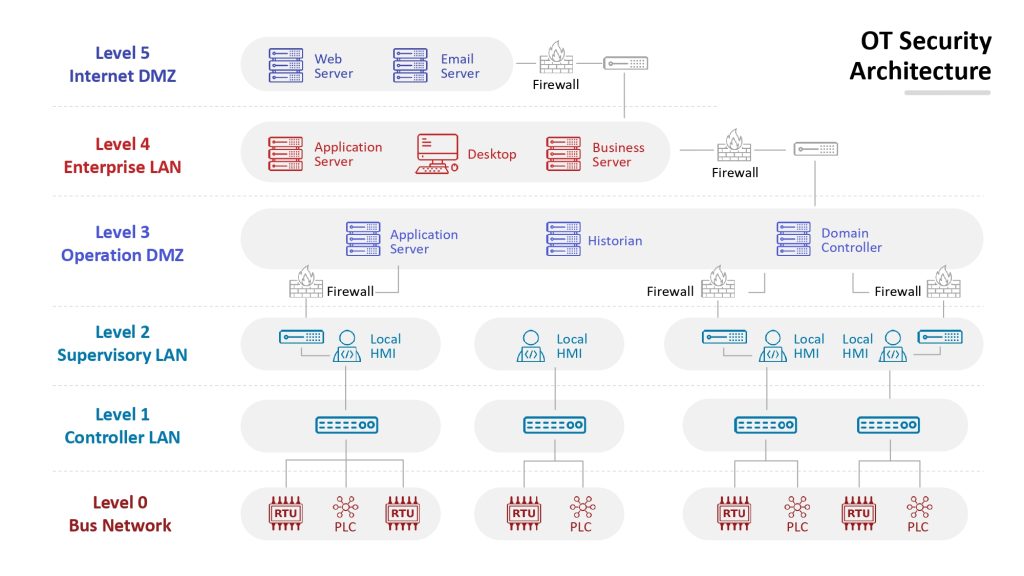
Key vulnerabilities of OT systems include:
- Increased openness of OT networks
- Lack of cybersecurity consideration in OT component design
- IoT and IIoT-driven connectivity increasing attack surfaces
- Limited cybersecurity awareness among OT operators
While OT and IT security intersect in some areas, OT’s unique operational demands require a specialized industrial security approach.
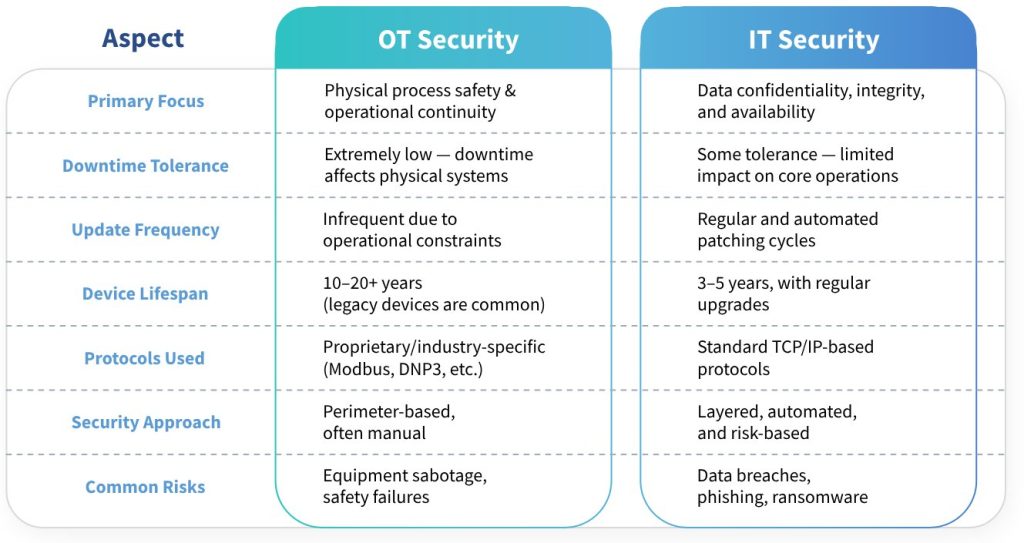
OT Security vs. IT Security
Emerging Technologies Impacting OT Security
Several technologies are transforming OT environments—offering benefits but also introducing new risks:
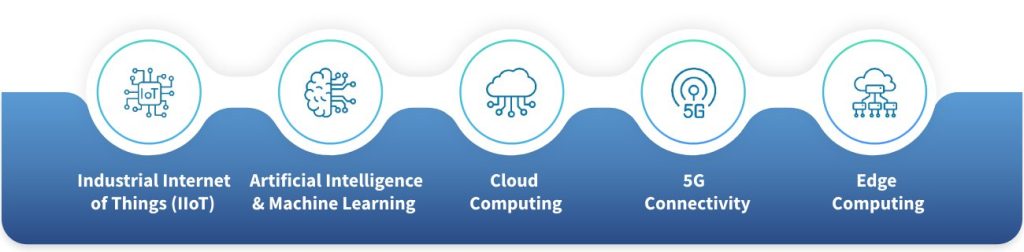
- Industrial Internet of Things (IIoT): Expands connectivity but widens the attack surface.
- AI & Machine Learning in OT Security: Enables anomaly detection and predictive maintenance but depends on secure, high-quality data.
- Cloud Computing Security: Centralizes management yet raises data transfer and storage concerns.
- 5G Connectivity: Boosts real-time control and monitoring but introduces latency risks.
- Edge Computing Security: Improves local processing yet requires strong endpoint protection.
Key Strategies for Robust OT Security
To ensure resilience and compliance, organizations should adopt these best practices:
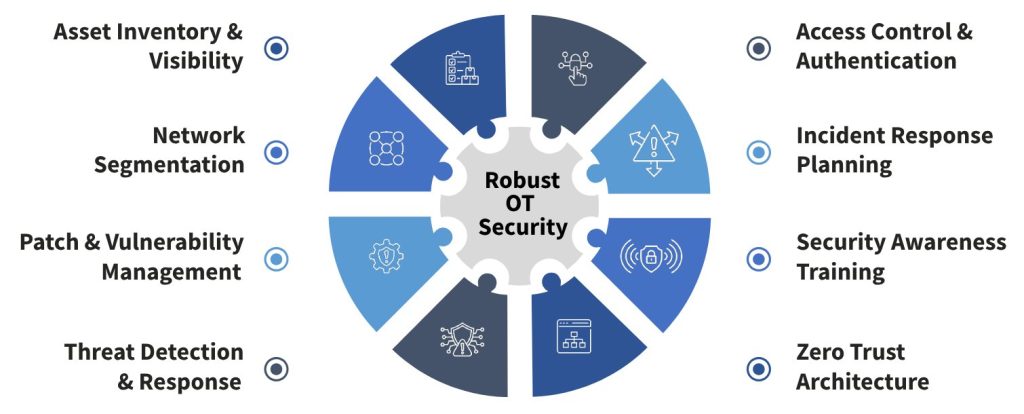
- Asset Inventory & Visibility: Maintain an updated inventory of all OT devices, firmware, and configurations.
- Network Segmentation: Separate OT and IT networks using VLANs, DMZs, and firewalls.
- Patch & Vulnerability Management: Apply vendor-approved patches or use virtual patching for legacy systems.
- Threat Detection & Response: Deploy behavior-based monitoring and OT-specific threat intelligence.
- Access Control & Authentication: Implement least privilege, MFA, and role-based access control.
- Incident Response Planning: Develop and test OT-specific response playbooks regularly.
- Security Awareness Training: Educate OT personnel on cyber hygiene and threat detection.
- Zero Trust Architecture: Ensure every device and user continuously validates trust before access.
Conclusion: It’s Time to Prioritize OT Security
As digital transformation drives IT-OT convergence, traditional boundaries are fading. While this fosters innovation and efficiency, it also introduces new cybersecurity challenges for OT and IoT systems.
By implementing a robust, adaptive OT security framework—grounded in best practices and supported by emerging technologies—organizations can safeguard operations, ensure compliance, and build long-term resilience.
FAQs
Q1: What makes OT security different from IT security?A: OT security prioritizes system uptime and physical safety, while IT security focuses on data confidentiality and integrity. OT systems can’t tolerate downtime, requiring tailored security approaches.
Q2: Why is OT becoming more vulnerable to cyberattacks?A: Increased connectivity through IoT/IIoT, legacy equipment, and lack of built-in protections make OT systems more susceptible to modern cyber threats.
Q3: Can IT security tools be applied to OT systems?A: Not always. Many IT tools can disrupt OT operations or introduce latency. Use OT-specific solutions designed for industrial control systems.
Q4: What does Zero Trust mean for OT?A: It means verifying every user, device, and action—regardless of network location—and granting access only when absolutely necessary.
Q5: How can organizations start improving OT security?A: Begin with a full asset inventory, risk assessment, segmentation, and a tested OT incident response plan.