

In the dynamic realm of software development, staying competitive means embracing cutting-edge technologies. One such innovation transforming the industry today is Generative Artificial Intelligence (GenAI). Its integration into the Software Development Lifecycle (SDLC) holds immense potential. As software products grow more complex, the demand for efficient, accurate, and intelligent testing methods has never been higher.
Traditionally, software testing consumed a lot of time and often required multiple revisions due to human errors. Manual test case creation, execution, and analysis could become bottlenecks, slowing down the release of high-quality software.
Generative AI is now revolutionizing this process by automating and optimizing several testing activities to accelerate the software development lifecycle.
According to Grand View Research, the global AI-enabled testing market is expected to grow at a CAGR of 18.4% from 2023 to 2030.
Let’s explore how you can leverage Generative AI in software testing to enhance efficiency and speed up delivery.
What is Generative AI?
Generative AI is a subset of Artificial Intelligence (AI) that focuses on creating new and high-quality content such as code, text, images, audio, videos, and simulations. Unlike rule-based systems, Generative AI models learn from vast datasets and use Large Language Models (LLMs) to generate original outputs through advanced predictive algorithms.
These models are trained on large amounts of unlabeled data, enabling them to adapt to diverse tasks through fine-tuning. Developing such models involves complex computations and significant computing resources, but the payoff is immense in terms of adaptability and creativity.
A Brief History of QA and the Evolution of Testing Practices
The evolution from manual testing to AI-driven solutions has redefined how organizations ensure software quality and reliability. Generative AI learns from existing data to generate new, high-quality test cases, predict defects, and enhance coverage — addressing long-standing issues of slow, repetitive, and error-prone manual testing.
Here’s an overview of how testing practices evolved over time:
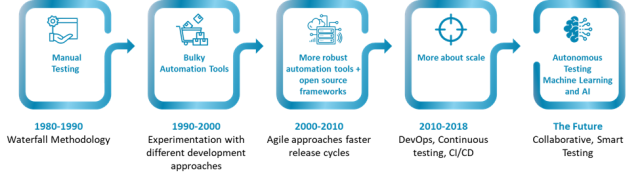
Manual Testing
Early software testing relied entirely on manual methods — testers manually developed and executed test cases to identify bugs. While this offered deep insights, it was time-consuming and prone to human error.
Scripted Automation
Scripted automation brought consistency by enabling repeatable test executions through automation scripts. However, maintaining these scripts became tedious and they lacked flexibility when applications evolved.
Data-Driven Testing
This approach allowed testers to use different data sets to generate multiple test scenarios from a single script. It improved efficiency but still required manual data management and lacked adaptability.
Generative AI in Testing
Generative AI now automates the creation of test cases, test data, and even documentation. It generates context-aware scenarios, adapts to application changes, and continuously improves accuracy — drastically reducing manual effort and time.

Generative AI significantly lowers testing time and cost, automating repetitive processes while keeping test scripts updated with application changes. This leads to faster releases and improved product quality.
Benefits and Challenges of Generative AI in QA
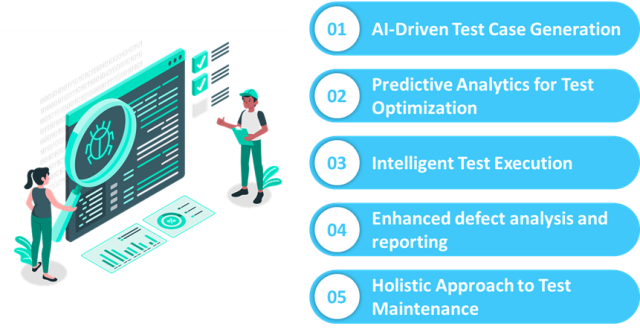
Benefits
- Accelerated Testing: Automates repetitive tasks, reducing manual effort.
- Enhanced Test Scenarios: Generates diverse and complex test cases automatically.
- Early Bug Detection: Predicts defects by analyzing code and data patterns. AI enhances test reporting and analysis by automating report generation, identifying trends, and improving accuracy.
- Improved Fault Isolation: Identifies root causes faster for better resolution.
- Predictive Analytics: Anticipates defect-prone areas using historical data.
- Better Focus on Complex Testing: Frees testers to handle critical test cases requiring human judgment.
Challenges
- Data Quality: Poor-quality training data can result in inaccurate or biased test results.
- Data Privacy: Handling sensitive information during training must adhere to privacy regulations.
- Unintended Bias: AI can inherit biases from the training dataset, impacting fairness.
- Computational Demands: Requires high-performance hardware for training and inference.
Balancing AI capabilities with human expertise is crucial for accurate, unbiased, and ethical results in QA.
Types of Generative AI Models in Software Testing
Several Generative AI models are being leveraged for testing. Here are the key ones:
Generative Adversarial Networks (GANs)
GANs create realistic test cases by using two competing neural networks (generator and discriminator). They enhance coverage by generating diverse, real-world-like scenarios.
Transformers
Transformers like GPT use attention mechanisms to interpret context and generate relevant test cases based on code descriptions or requirements.
Diffusion Models
These models generate synthetic test data by transforming simple distributions into complex, realistic datasets — valuable for varied testing conditions.
Variational Autoencoders (VAEs)
VAEs compress data into latent space to generate new variations of test cases. They’re ideal for synthetic data creation and scenario exploration.
Flow-Based Models
Flow-based models learn data distributions and generate new samples with similar statistical characteristics, providing efficiency and interpretability.
Recurrent Neural Networks (RNNs)
RNNs use memory of past inputs to predict outcomes, suitable for sequential data analysis such as time-series or NLP-based testing scenarios.
Integrating Generative AI with Other Technologies
Integrating Generative AI with complementary technologies enhances testing accuracy and adaptability.
Reinforcement Learning (RL)
RL adds a learning layer to the testing process, improving through trial and feedback loops — ideal for dynamic or interactive systems.
Computer Vision
Combining Generative AI with computer vision enables visual testing for UI-rich applications using image recognition and object detection.
Collaboration with Other AI Models
Integrating Generative AI with NLP and Machine Learning enhances QA efficiency. NLP helps in generating test cases from requirements, while ML aids in analysis and optimization.
How to Develop a QA Strategy with Generative AI
Implementing Generative AI requires a structured, step-by-step approach:
- Step 1: Define Clear Objectives – Identify your goals (e.g., better coverage, reduced manual effort).
- Step 2: Assess Testing Needs – Determine where AI adds maximum value based on complexity and data.
- Step 3: Prepare Infrastructure – Ensure availability of computing resources and skilled professionals.
- Step 4: Select Suitable Tools – Choose AI frameworks and platforms aligned with your goals.
- Step 5: Train Your Team – Upskill testers to work with AI-powered tools and interpret outputs.
- Step 6: Implement and Monitor – Gradually deploy AI, monitor results, and fine-tune continuously.
High-quality training data and continuous model evaluation are key to sustaining long-term accuracy and reliability.
Use Cases of Generative AI in QA
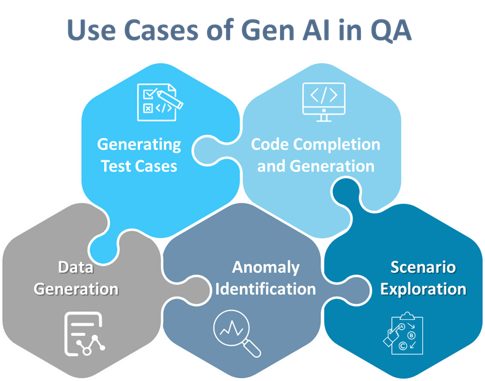
Key Use Cases
- Test Case Generation: Automatically creates test cases for maximum coverage.
- Code Completion: Suggests or generates complete test scripts for efficiency.
- Scenario Exploration: Simulates realistic user behaviors to uncover hidden vulnerabilities. AI use cases in software testing include test data generation, automated script creation, and real-time result analysis for improved efficiency.
- Anomaly Detection: Identifies irregularities in code or data through pattern recognition.
- Data Generation: Produces realistic test data for model training and stress testing.
Final Thoughts
Generative AI is reshaping software testing by automating test creation, accelerating bug detection, and enhancing accuracy. As AI and ML continue to evolve, QA teams adopting GenAI will enjoy faster delivery cycles, higher-quality releases, and significant cost reductions.
Calsoft, a technology-first partner, provides end-to-end software testing services using AI-driven approaches. With 25+ years of experience and a global team of 1,500+ experts, Calsoft empowers enterprises to build robust, high-performing digital solutions.