

Most QA conversations happen at the wrong level. A test plan gets reviewed. A coverage number gets reported. Everyone nods. The meeting ends.
But the real decisions sit underneath that test plan. When do you pay for a bug, before it ships, or after a customer finds it? Which vendor can you actually leave? How much regression testing stands between your app and an outage? These aren't QA manager decisions. They belong to the CTO, the CIO, the CISO, and the VP of Engineering. Most of the time, nobody names them out loud.
This isn't a primer on test types or the QA testing lifecycle. It's five decisions your organization is already making inside its QA testing process. Treat software QA testing as a purely technical task, and these choices get made by default, usually the easy way, not the safe way. And the person who feels it first isn't in the room. It's the customer on the other end of your app, waiting for a page to load, trusting you with their data, hoping it doesn't crash at checkout.
Cost exposure: Are you paying for defects before or after they ship?
Every company pays for bugs. The only question is when.
Catch one in code review, and it costs an afternoon. Catch one after a customer hits it, and it costs an incident call, a hotfix, a support ticket, maybe a refund.
Most leadership teams treat quality assurance testing like a cost to trim. It looks that way on a budget sheet. But skip it, and the bill doesn't disappear. It moves. It lands on support. It lands on customer trust. It lands on the person who paid for your product and got a broken checkout page instead.
The real decision isn't how much to spend on testing. It's which budget absorbs that cost, and how predictable you want the number to be. A QA line item is a number you can plan for. A production outage is not. Ask your finance team, they hate surprises. So does the customer stuck on hold. This question belongs in the same conversation as your broader software testing process, not off to the side of it.
Get this wrong, and you can't forecast engineering cost at all. Your real QA budget is hiding inside your incident response spend, and your customers are the ones absorbing the delay while you find it.
Vendor lock-in: Which testing approach can you actually walk away from?
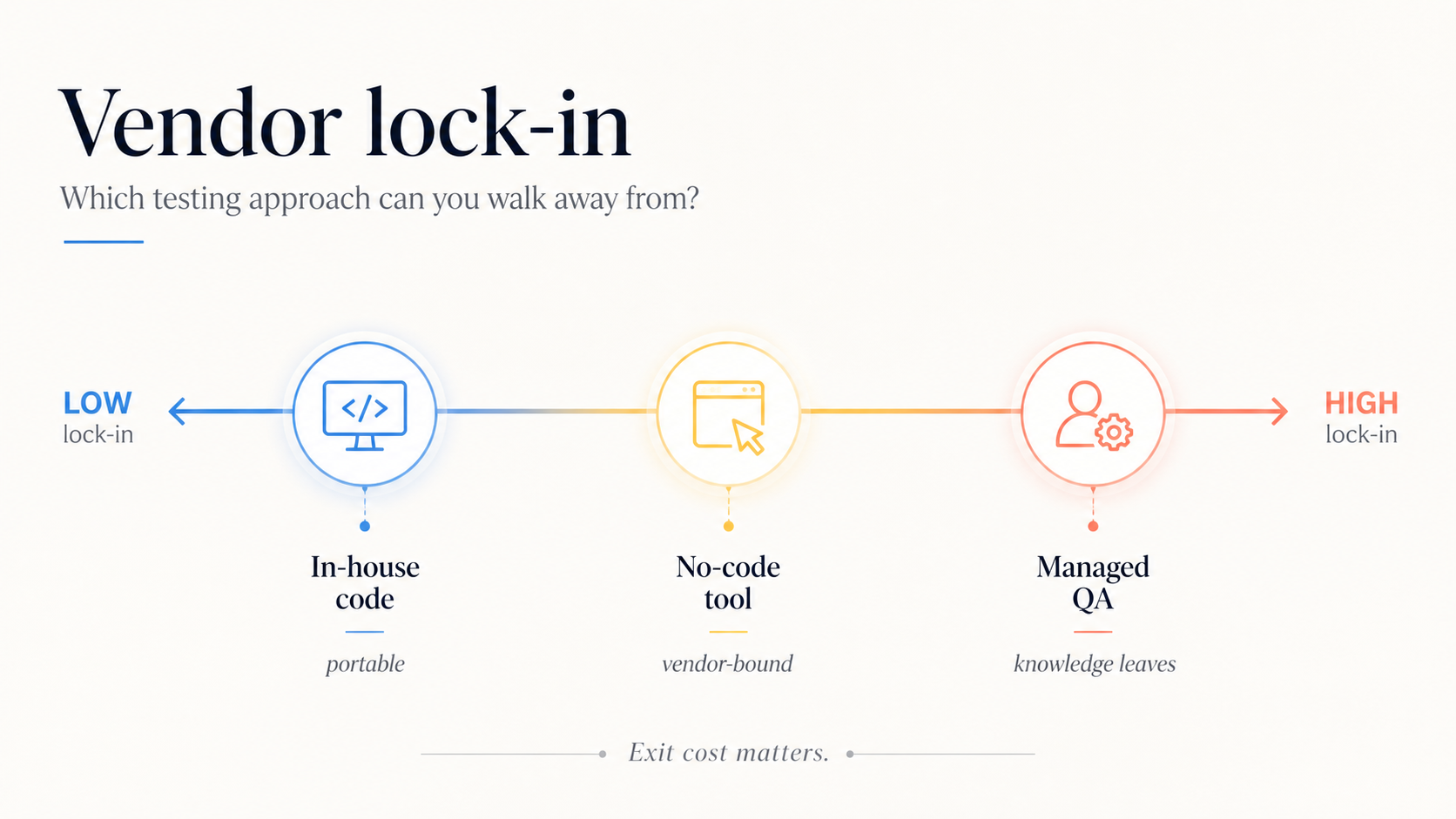
When leaders pick a testing tool, they look at features and price. They should look at exit cost.
Not every automation choice is easy to reverse. Some lock you in fast.
Think of your options on a simple scale. Each one hands over a different kind of control.
- In-house, code-based automation. Built on frameworks like Playwright or Selenium. Your engineers own the code. It takes more work to set up. But nothing about it is proprietary. Move teams, tools, or vendors, and the tests come with you.
- No-code or record-and-replay tools. Fast to start. But the test logic lives inside the vendor's format. QA Wolf's engineering team has noted this approach can be slower and less consistent to maintain than code-based testing. Worse for a CIO: switch vendors, and you leave your tests behind.
- Managed or outsourced QA services. They take maintenance off your plate. But they also take your team's product knowledge with them. Leave, and you start over, teaching a new provider what the old one already knew.
Every test automation decision sits somewhere on this line. So does the choice to keep manual testing for the parts of your app that don't need automation yet.
None of these is wrong on its own. The mistake is choosing without knowing what you just gave up: speed, portability, or institutional memory. You won't feel the cost until you try to leave. And when you leave, your users feel it too, in slower releases and stalled fixes while your team rebuilds what it lost.
Get this wrong, and switching vendors two years from now isn't a procurement task. It's a re-platforming project. Your test coverage sits frozen the whole time, and real users hit the bugs nobody's watching for.

Business continuity: How much regression coverage stands between you and an outage?
Every release is a bet. It bets that yesterday's features still work today.
Regression testing is what backs that bet. Skip it, thin it out, let it go stale as your product grows, and you're shipping on faith, not evidence.
The real question isn't whether to run regression tests. Most teams already do. The question is where the release gate sits, and who can override it under deadline pressure.
A stale regression suite still passes. It just isn't testing what your customers actually use anymore. That gap stays invisible until it isn't. It usually shows up during your busiest hour, not a quiet Tuesday. That's the hour a real person needed your app to work, and it didn't.
Release testing has to look at load and failure together, not just features in isolation. One tells you it works. The other tells you it stays up.
Get this wrong, and the outage stops being a QA problem. It becomes a trust problem for every customer locked out, and an SLA problem your contracts already price by the minute.
Download our CI/CD-Driven QAOps one pager and understand how Calsoft integrates QA seamlessly into CI/CD pipelines for faster, smarter releases.
Speed to market: Is QA a gate or an engine?
In most companies, QA sits at the end of the line. Last checkpoint before release. That makes it the easiest thing to cut when a deadline closes in. That's backwards.
The QA testing best practices that actually move release velocity come down to two moves. Test earlier, alongside development, not after it. And automate the repetitive parts.
Together, these change what QA is. Instead of a sequential step development waits on, it becomes a parallel, continuous testing process that keeps pace. This is the piece of Agile QA testing most teams skip: automated regression running inside every sprint, not tacked onto the end of one.
Automated testing pushes the same shift further down, into infrastructure. Run a whole suite across many machines at once instead of one after another, and a testing phase that used to eat hours barely shows up on the release clock.
The real competitive question isn't can you test thoroughly. Most mature teams can. It's can you test thoroughly at the speed you want to ship. If QA can't keep up, your release cadence slows to match it, whether you chose that or not. Meanwhile, your users are comparing you to whoever ships the fix first.
Get this wrong, and a competitor with an equally reliable, faster release cycle takes the market window. Your team is still running manual regression. Your users have already moved on.
Compliance and audit liability: Who owns the evidence trail?
Security testing and user acceptance testing get filed under quality. In a regulated industry, or in front of an enterprise buyer's risk team, they're something else. They're evidence.
An auditor doesn't want to hear your process is good. They want to see it. The test case. The defect log. The sign-off. The date.
This is where QA ownership stops being a technical question, and where your QA strategy has to account for who reads the evidence, not just who produces it.
If a security gap slips through undocumented, that's not just an engineering miss. It's a liability question. Increasingly, it lands on the CISO who signed the compliance attestation, not the QA lead who ran the test. The same goes for UAT. If a broken workflow touches customer data or access controls, "the test passed" means nothing without a record of what got tested, and by whom.
Behind every one of these test cases is a real person's data, a real person's account, a real person's trust that your systems handle it correctly.
Decide now: is audit-readiness built into testing as it happens, or rebuilt after the fact when a regulator calls? One is an afternoon of pulling logs. The other is a scramble that starts with "we think we tested that."
Get this wrong, and the exposure isn't a failed audit. It's not being able to prove you protected the people whose data you hold.
The shared decision
None of these five decisions belongs to one role. Cost exposure touches the CTO's forecast and the CFO's patience. Vendor lock-in is a procurement call with an engineering blast radius. Continuity risk falls on whoever's on call, and whoever signed the SLA. Speed to market is a fight between product and engineering. Compliance liability increasingly carries the CISO's name, whether or not they sat in on the test plan.
The organizations that get this right don't have the most test cases. They have clear ownership of these five decisions. And they remember who's on the other end of every release: a person trying to check out, log in, or trust your app with something that matters to them. That's what QA process improvement actually means at this level. Not a better test plan. Clearer ownership of the risk the test plan is supposed to catch.
FAQ
What is a QA testing process?
It’s more than a checklist. It’s the set of decisions that determine when you catch a defect, what that costs, and who answers for the risk left over. The test cases are the tool. The decisions above are the substance.
Why is the QA testing process important to business leadership, not just engineering?
Because the cost of getting it wrong doesn’t stay in engineering. Budget overruns, vendor lock-in, downtime, missed release windows, compliance exposure — these land on the CTO, the CIO, the CISO, and the VP of Engineering. And before any of them feel it, your customer does.
How can you improve your QA testing process?
Start with the decision, not the tool. Decide where QA spend sits in the budget. Decide which vendor you can leave without a re-platforming project. Decide how much regression coverage your release gate really needs. Decide whether QA runs alongside development or behind it. Decide who owns the audit trail. Tools follow those decisions, not the other way around.
What are the best practices for software QA testing?
Test earlier in the cycle. Automate regression so it runs every sprint, not at the end of one. Keep ownership explicit — don’t let it default to developers by accident. Build audit-ready records into the process instead of rebuilding them under pressure.
What is the difference between QA and software testing?
Software testing is the activity: running cases, logging bugs, checking fixes. QA, sometimes called software quality assurance, is the process behind it — how, when, and by whom that activity happens, and what it protects against. Testing without QA still finds bugs. It just can’t tell you what they cost, or who’s exposed.
How does test automation improve the QA testing process?
It doesn’t just run tests faster. It moves QA from a gate at the end of the line to a check that runs alongside development. That shift protects your release timeline. Speed is the byproduct, not the point.