

Every CXO today is chasing the same paradox: move faster on cloud-native architecture while keeping customer experience strong. Cloud migration and microservices deliver speed and scale — but they also multiply dependencies, failure points, and operational blind spots. The result? Leadership finds out about reliability problems the same way customers do, after something breaks.
Speed alone is no longer a competitive advantage; organizations must deliver predictable digital experiences while continuously innovating.
DevOps accelerates software delivery, and cloud platforms improve scalability, but neither defines how reliable customer experiences should be. As applications become more interconnected, leaders need an engineering discipline that balances innovation with operational stability. This is the gap Site Reliability Engineering (SRE) was built to close.
When SRE Becomes a CXO Priority
For CXOs, the question is not whether cloud-native applications are technically modern. The real question is whether they can scale reliably under business pressure.
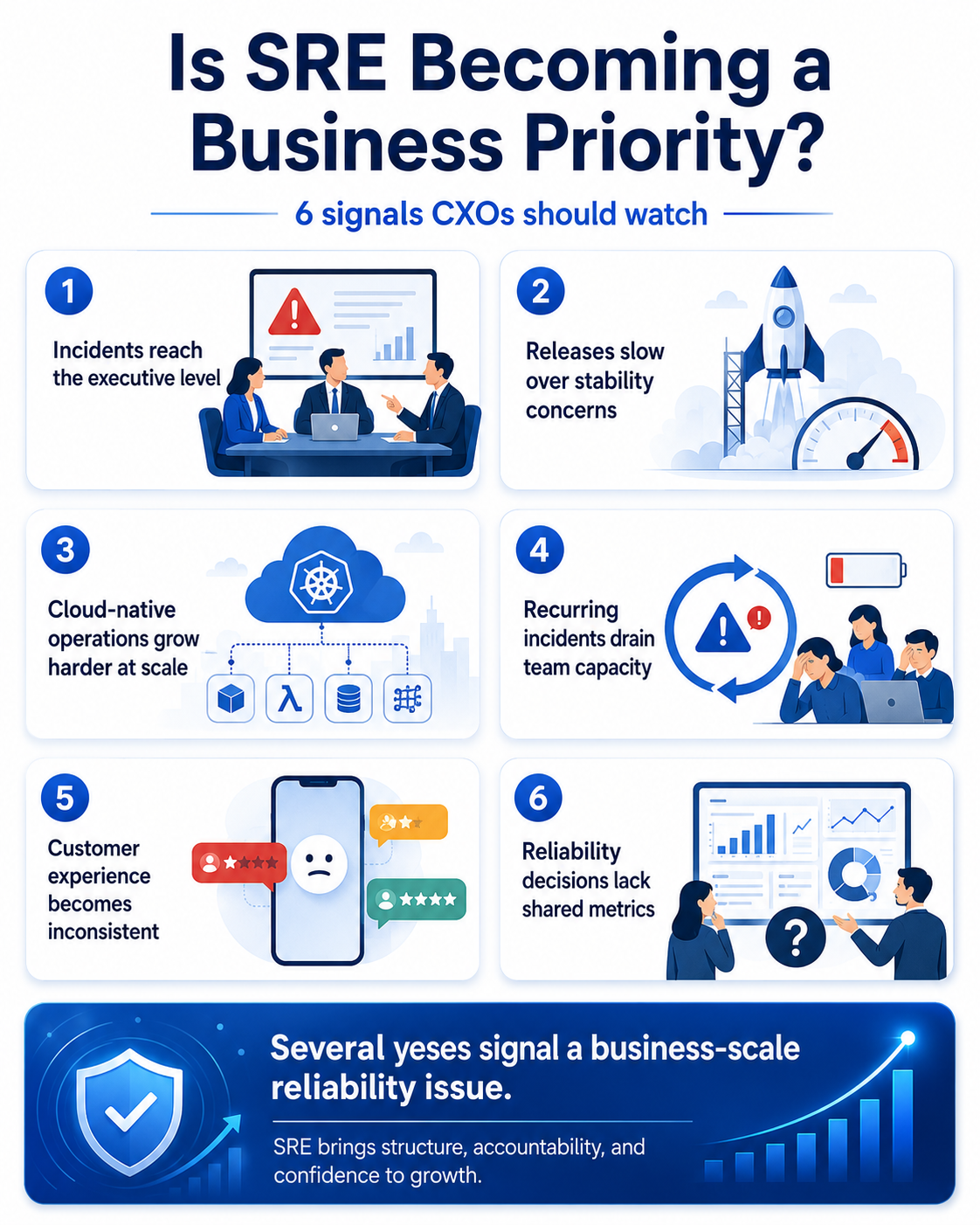
SRE becomes a leadership priority when reliability starts influencing customer experience, release confidence, operating cost, and business continuity. A few signals make the case clear:
- Are customer-impacting incidents reaching executive discussions?
- Are teams slowing releases because production stability feels uncertain?
- Are cloud-native systems becoming harder to operate as they scale?
- Are recurring incidents consuming engineering and support capacity?
- Is customer experience inconsistent during peak demand, across regions, or after new releases?
- Are reliability decisions still based on escalation and opinion rather than shared metrics?
Done right, SRE is not a new team layer or a slower delivery process. It's an operating discipline built on five practices: customer-aligned reliability objectives, explicit tolerance for failure, shared accountability across product and engineering, automation-led operations, and blameless incident learning.
How SRE changes the conversation
SRE treats reliability as a measurable business outcome. Using Service Level Objectives (SLOs), observability, automation, error budgets, and disciplined incident management, SRE helps engineering teams innovate while protecting production environments.
Just as Minimum Viable Product (MVP) defines the smallest feature set needed to prove customer value, Minimum Viable Reliability (MVR) defines the baseline availability, responsiveness, and consistency required for that product to be trusted in real use. Most organizations never make this explicit — reliability expectations stay implicit until an outage forces the conversation.
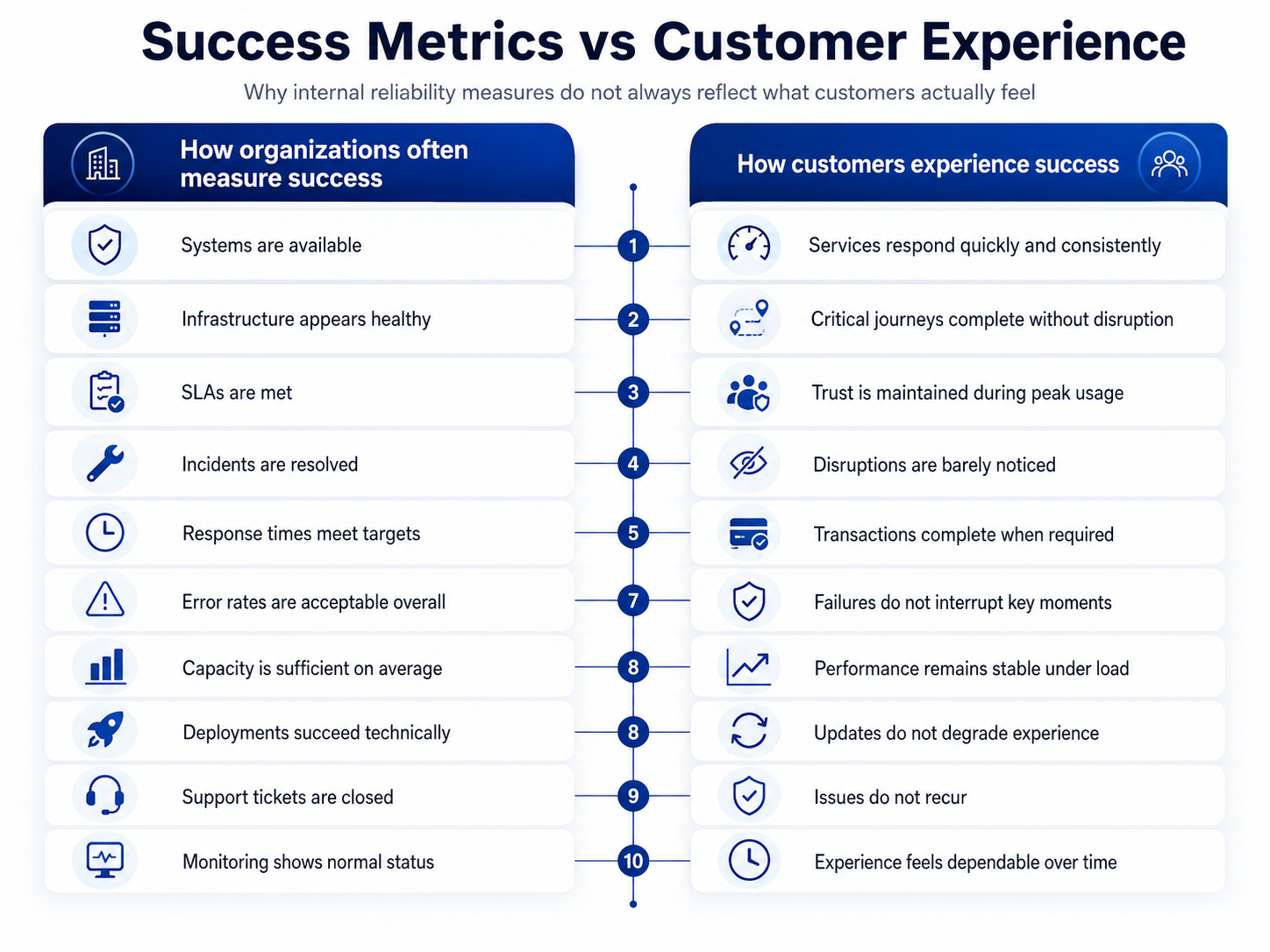
MVR turns reliability into a leadership decision made upfront, not a technical afterthought discovered during a postmortem. SRE is the discipline that keeps that intent alive as architectures evolve, ownership shifts, and systems scale.
Adopting SRE often raises leadership concerns around organizational change, new roles, or disruption to ongoing delivery. But SRE does not need to begin as a large-scale transformation. The most effective adoption starts with focused scope. Instead of applying reliability practices across every system at once, organizations begin where reliability has clear business impact. A practical starting point is one critical customer journey or service where downtime, slow performance, or recurring incidents affect trust, revenue, or operational credibility. This focused approach reduces disruption, aligns business and technology teams, and helps build confidence through visible outcomes.
Calsoft SRE: Building Reliability That CXOs Can Measure
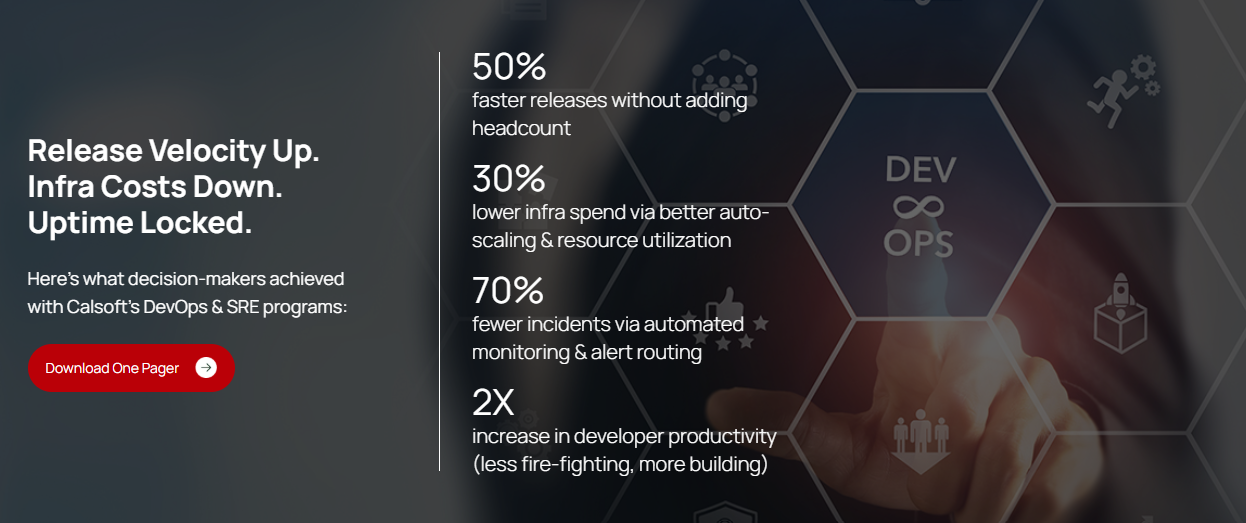
Calsoft helps enterprises build reliable, always-on digital systems by combining automation, observability, incident readiness, and cloud-native reliability practices. Its SRE capabilities include CI/CD pipeline setup, infrastructure as code, environment provisioning, centralized monitoring and logging, auto-healing, and incident management across cloud, hybrid, and edge environments.
Calsoft also supports mission-critical applications with auto-remediation, alert routing, on-call logic, SLI/SLO identification, reliability scorecards, and phased SRE rollout planning. The approach is designed to improve uptime, reduce incident volume, accelerate releases, and help teams move from reactive firefighting to predictable operations.
SRE adoption works best as a phased, low-risk approach. Organizations get the most value by starting narrow, picking one customer journey where reliability directly impacts revenue or trust, defining clear reliability objectives for it, applying SRE practices selectively, and expanding once the approach proves itself. This makes SRE a natural fit within cloud migration and application modernization programs, acting as a guardrail that keeps delivery moving forward.
SRE helps leaders manage reliability risk as a business priority, align teams around clear metrics, and keep modernizing without putting customer trust at risk.