

A VP of Engineering accelerates go-to-market (GTM) by aligning engineering priorities with customer needs, removing delivery bottlenecks, and making product releases reliable and repeatable.
Modern engineering leadership isn't measured by how much code ships. It's measured by how quickly a validated idea reaches customers and how fast the organization learns from what happens next.
As Jeff Bezos once wrote, yesterday's "wow" becomes today's ordinary fast, customers have endless alternatives, and they won't wait for a slow release cycle. Most companies now build software products from ideation to release in roughly 4 to 9 months, and GTM itself has stopped being a one-time event. It's a continuous loop of shipping, measuring, and adjusting.
For VP Engineering go-to-market success, modern engineering leadership must balance speed, quality, and business value. The most effective approach is to reduce time-to-market while building the engineering capabilities needed for sustainable product growth. At Calsoft, we help Independent Software Vendors (ISVs) and software companies execute their go-to-market strategy through hands-on product engineering support, from ideation, design, and software product development, through QA and testing, to deployment.

What does Go-to-Market mean for engineering leaders?
For engineering leaders, go-to-market isn't a marketing handoff at the end of a build cycle; it's a shared responsibility that starts the moment a customer problem is identified. Go-to-market is the coordinated process of bringing a product or feature to its intended customers and helping them adopt it. Engineering-led GTM means aligning technical decisions and delivery processes with product, customer, and commercial goals.
Engineering owns the technical path to launch, while product, sales, marketing, and customer success contribute to the broader go-to-market strategy.
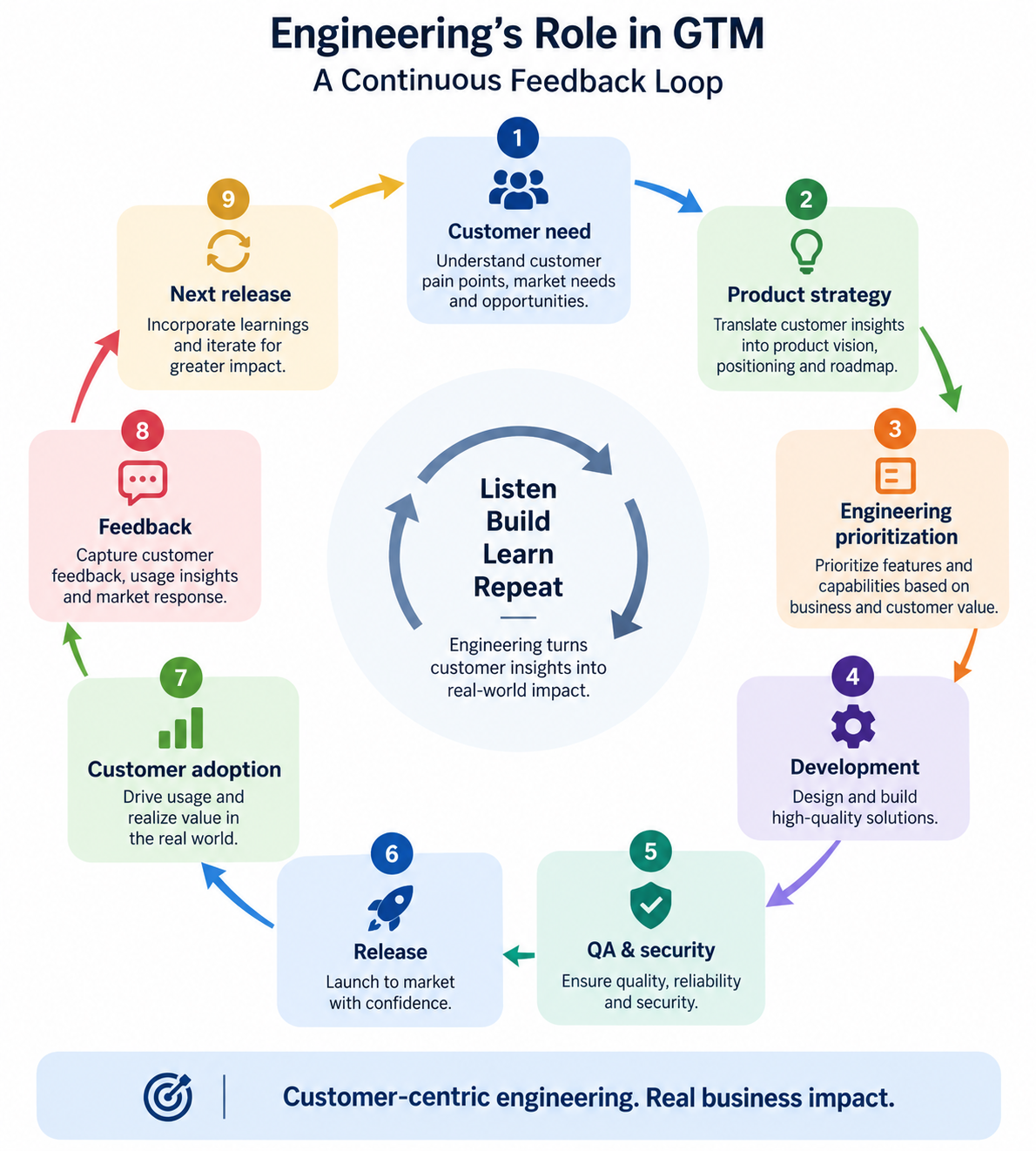
Engineering’s role in GTM is a continuous feedback loop.
7 Ways VPs of Engineering Can Accelerate Go-to-Market
Build and validate an MVP Faster
A minimum viable product (MVP) should test the most important customer value proposition with the smallest, most useful scope. Prioritize the problem to solve, define success criteria, and release to a suitable customer group. Avoid treating the MVP as a miniature version of every planned feature. It's recommended to agree on the essential workflow with product and customer-facing teams before development begins. Measure time from approved idea to first usable release, then use adoption and feedback to decide what to build next. This helps reduce time-to-market without sacrificing learning.
Remove development bottlenecks and improve engineering productivity
Engineering productivity improves when teams spend less time waiting for environments, approvals, reviews, and dependencies. Map the delivery workflow to identify where work accumulates. Developer productivity should be assessed through the ability to complete valuable work, not lines of code or individual commit counts. Platform engineering can provide reusable development environments, self-service infrastructure, and standardized delivery workflows. Start with the most frequent source of friction and measure whether the improvement reduces waiting time or increases successful task completion. Modern engineering is about making the right work easier to deliver.
Choose architecture for speed and scale
Architecture should support the product’s current requirements and expected evolution. A modular monolith may be the fastest and simplest option for an early product, while microservices can help when independent deployment, team autonomy, or scaling requirements justify their additional operational complexity.
Use cloud engineering, cloud-native development, and application modernization selectively. Do not make modernization the goal itself. Evaluate whether an architectural change reduces coupling, improves reliability, or removes a measurable delivery constraint. Reserve capacity for technical debt that creates recurring defects, slow builds, or difficult releases.

Automate testing, CI/CD, and release processes
CI/CD connects code integration, automated checks, and deployment into a repeatable delivery workflow. Release automation can reduce manual handoffs and make smaller changes easier to deliver. Combine automated testing with security checks, appropriate approvals, monitoring, and rollback or recovery procedures. DevOps practices bring development, QA, security, and operations into shared ownership of delivery outcomes. Begin by automating a stable, high-value workflow rather than automating a broken process. Measure change lead time, deployment frequency, and release failures to determine whether the investment improves both speed and reliability.
Use AI-Assisted development to increase engineering leverage
AI-assisted development can help engineers draft code, generate tests, explain unfamiliar code, and prepare documentation. AI agents may also support bounded tasks such as issue triage or routine maintenance. These capabilities can reduce repetitive work, but generated output still requires appropriate validation. Establish AI governance for approved tools, data access, intellectual property, security, and human review. Start with a defined use case, compare results against a baseline, and measure the full workflow—including review and rework—not only the time spent generating code.
Align engineering priorities with product and GTM goals
Cross-functional collaboration is essential to a successful product launch. Engineering, product, sales, marketing, and customer success should agree on the target customer, launch scope, readiness criteria, and feedback mechanism. Engineering leadership should make trade-offs visible when a requested feature threatens reliability or delays a more valuable release. A shared launch plan should include technical readiness, documentation, support preparation, and adoption goals. Use customer evidence to prioritize software product development rather than allowing the backlog to become a collection of disconnected requests.
Measure and optimize Time-to-Market
Measure the complete journey from an approved product idea to customer availability, not only the coding phase. Review where work waits, how often releases fail, and whether customers adopt the delivered capability. Use these findings to improve the system of delivery rather than to rank individual engineers.
A useful leadership question is: “Which constraint, if removed, would shorten the next valuable release without increasing customer risk?” Establish a baseline, make one improvement, and review the result with product and engineering together.
Engineering metrics that influence GTM
DORA metrics help assess software delivery performance, while product and business measures show whether delivery creates value. The current DORA model includes five metrics; use them at the application or service level and interpret them in context.
|
Metric |
What It Measures |
Why It Matters for GTM |
|
Deployment Frequency |
How often code ships to production |
Higher frequency = faster feedback loops and quicker launches |
|
Lead Time for Changes |
Time from commit to production |
Shorter lead time directly compresses time-to-market |
|
Change Failure Rate |
% of releases causing incidents |
Low failure rate protects launch credibility and adoption |
|
Mean Time to Recovery |
Time to restore service after a failure |
Fast recovery reduces risk of aggressive release schedules |
|
Cycle Time |
Time from work start to delivery |
Reveals bottlenecks slowing engineering productivity |
Use the DORA measures alongside adoption and customer outcomes. A higher deployment frequency is not automatically a better business result.
Common mistakes that slow down engineering-led GTM
Over-engineering the first release: Build only what is needed to validate the initial value proposition.
Building without customer validation: Test assumptions before committing to a large feature set.
Treating architecture modernization as the goal: Modernize when it solves a business or delivery constraint.
Measuring output instead of outcomes: Connect engineering productivity to delivery quality and customer value.
Automating broken processes: Simplify and stabilize the workflow before automating it.
Ignoring technical debt: Address debt that repeatedly slows delivery or increases risk.
Disconnecting engineering from customer feedback: Create a regular feedback loop with product, sales, and customer success.
How AI is changing engineering-led Go-to-Market
AI can increase engineering leverage across coding, testing, documentation, and selected operational workflows. Its value depends on whether it improves the entire delivery process. Faster code generation may simply move the bottleneck to review, integration, security, or release if those stages are not prepared.
For example, a team might use AI to draft unit tests for a well-understood service, then run the same automated checks and human review used for manually written tests. The VP should compare total completion time, defect escape rate, and rework before expanding the approach. AI governance and human accountability remain important, especially for sensitive data and production changes.
The practical recommendation is to introduce AI where it removes a measurable constraint, maintain clear review ownership, and invest in the platform and testing capabilities that allow teams to use it safely.
In a nutshell
The strongest go-to-market strategy connects customer insight with dependable product delivery. VPs of Engineering can accelerate go-to-market by validating smaller releases, improving engineering productivity, choosing appropriate architecture, automating delivery, using AI responsibly, and aligning engineering decisions with product outcomes.
FAQs
What is the role of a VP of Engineering in go-to-market?
A VP of Engineering translates product and customer priorities into a reliable delivery plan. The role includes setting technical directions, removing bottlenecks, managing delivery risks, and coordinating with product and customer-facing teams. Success is measured not only by shipping software, but by how quickly useful capabilities reach customers and contribute to adoption.
How can engineering teams accelerate time-to-market?
Teams can reduce time-to-market by validating a smaller MVP, limiting work in progress, removing dependencies, automating repeatable delivery steps, and releasing in smaller increments. They should measure the full idea-to-launch journey and improve the largest constraint rather than simply asking developers to work faster.
How does a VP of Engineering improve product delivery?
A VP improves delivery by clarifying priorities, establishing reliable engineering practices, investing in developer experience, and balancing new features with technical debt. Shared metrics and regular feedback help teams improve predictability, quality, and customer value.
How does DevOps reduce time-to-market?
DevOps reduces handoffs between development and operations through shared ownership, automation, and continuous feedback. When supported by CI/CD, testing, and monitoring, teams can release smaller changes more reliably and recover faster when problems occur.
Can AI accelerate software development?
Yes. AI can assist with coding, testing, documentation, and routine engineering tasks. The benefit depends on the use case and the surrounding workflow. Teams should measure end-to-end results and retain appropriate security controls, validation, and human review.
What engineering metrics measure time-to-market?
Measure idea-to-launch time and change lead time, then use deployment frequency, failed deployment recovery time, change fail rate, and deployment rework rate to understand delivery performance. Pair these with feature adoption and customer outcomes to assess GTM impact.
How should engineering and product teams align?
Engineering and product should share customer goals, agree on priorities and acceptance criteria, and review delivery trade-offs together. A common roadmap and regular customer feedback help ensure that engineering effort supports the most valuable product outcomes.
What is the difference between engineering velocity and time-to-market?
Engineering velocity describes how much work a team completes over a period, often using team-specific planning measures. Time-to-market measures how long it takes to bring a product or capability to customers. Higher velocity does not necessarily shorten time-to-market if work waits for decisions, testing, release, or adoption.
How does automation improve software release cycles?
Automation makes repeatable tasks such as builds, tests, security checks, and deployments more consistent. It can reduce manual waiting and support smaller releases. The strongest results come from automating well-designed processes and measuring both delivery speed and failure rates.
Should every company use microservices to accelerate GTM?
No. Microservices can improve independent deployment and team autonomy, but they also introduce operational complexity. Architecture should be selected based on product requirements, organizational structure, and scaling needs rather than using microservices simply to increase development speed.