

Following VMware’s acquisition by Broadcom, businesses began experiencing major shifts—higher licensing costs, bundled packages, longer support cycles, and a lack of clarity. For many, this triggered a re-evaluation of their VMware migration strategy and created onboarding bottlenecks for new customers.
Onboarding new customers still running VMware became slow, error-prone, and resource-intensive. As a result, enterprises are now exploring VMware exit strategies that support next-generation, cloud-native platforms.
That’s where Calsoft comes in. Combining deep infrastructure expertise, agile platform capabilities, and AI-driven solutions, Calsoft helps enterprises simplify and accelerate their VMware migration.
Calsoft built a lightweight, CLI-based migration tool that automated discovery, disk conversion, validation, and parallel VM transfers. This empowered customers to migrate independently—without GUI tools or extensive platform knowledge—restoring autonomy, reducing support overhead, and accelerating time-to-cloud.
Read the full case study: Seamless VMware Migration for Cloud Edge Providers | Calsoft Inc.
This blog explores the top alternatives to VMware—ranging from next-gen hypervisors to modern cloud-native platforms—and how to choose the right one for your business.
Why Consider VMware Alternatives?
VMware can be costly and complex, especially for small to mid-sized organizations. Common challenges include complicated licensing, high hardware demands, vendor lock-in, limited tool compatibility, and a steep learning curve. As businesses evolve toward hybrid and cloud-native architectures, flexibility and cost control are top priorities.
How to Choose the Right VMware Alternative
Look for solutions offering automation, scalability, cost efficiency, and strong performance. The ideal alternative should integrate easily with your existing tools, offer reliable support, and have an active community. Ultimately, the best VMware replacement depends on your organization’s size, budget, and long-term goals.
What Is the Current Replacement for a VMware Server?
According to a Foundry and CIO.com survey of 550+ enterprise IT leaders, over 56% plan to decrease VMware usage within a year, and 71% are actively evaluating on-prem alternatives. Below are leading server virtualization options to consider.
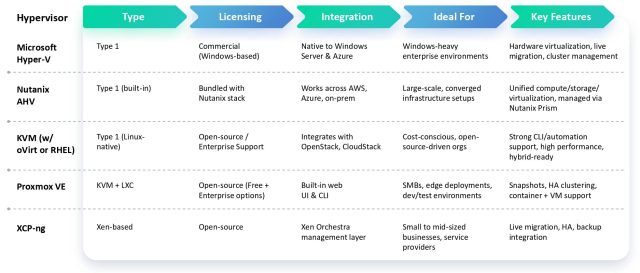
These hypervisors offer viable replacements for VMware based on your environment, budget, and long-term strategy. Whether you prefer commercial solutions or open-source flexibility, Calsoft helps evaluate and implement the best-fit virtualization stack.
Free Alternatives to VMware ESXi Hypervisor
With VMware ESXi now available only via paid subscription, many enterprises are turning to free, open-source hypervisors such as:
Proxmox VE
Proxmox VE (Virtual Environment) combines KVM-based virtualization and LXC containers under a single, open-source platform. It offers advanced storage, networking, and cluster management through a user-friendly web GUI or CLI, making it ideal for mixed VM and container workloads.
XCP-ng
XCP-ng (Xen Cloud Platform – Next Generation) is an open-source virtualization platform derived from XenServer. Designed for enterprises and SMBs alike, it delivers stable performance, live migration, and integration with open-source management tools such as Xen Orchestra.
oVirt
oVirt is a community-driven virtualization management platform based on KVM and a free alternative to Red Hat Virtualization. It provides enterprise-grade features, multi-host management, and snapshot capabilities—all without licensing fees.
While “free” doesn’t always mean “risk-free,” Calsoft helps enterprises wrap these platforms with automation, monitoring, and backup tools for production-grade resilience.
The Best Alternatives to VMware vSphere
When replacing VMware vSphere, you’ll need both a new hypervisor and a management layer for VM lifecycle orchestration. Consider these top options:
OpenStack
OpenStack is an open-source cloud operating system that lets you build and manage private or public clouds similar to AWS or Azure. It offers a full suite of services: Nova (compute), Cinder/Swift (storage), and Neutron (networking), all managed via a unified dashboard called Horizon.
It’s best suited for large enterprises, service providers, and research organizations seeking complete control over their infrastructure.
Red Hat OpenShift Virtualization
Red Hat OpenShift Virtualization extends Kubernetes by allowing management of both containers and VMs on the same platform. Based on the open-source KubeVirt project, it enables gradual modernization—ideal for companies moving from legacy infrastructure to cloud-native environments.
AWS (Amazon Web Services)
AWS offers a scalable, pay-as-you-go alternative to on-prem VMware infrastructure. Core services like Amazon EC2 provide virtual servers within minutes, eliminating hardware management while offering global reach, reliability, and cost flexibility.
Organizations seeking full control may prefer OpenStack or RHV, while those prioritizing scalability and operational agility can benefit from AWS.
Alternatives for Deploying Virtual Machines
Modern virtualization isn’t limited to hypervisors. Alternatives for deploying workloads include containers, bare-metal servers, and cloud-native environments. Containers offer lightweight, faster, and portable application deployment aligned with DevOps practices.
Public Cloud Options:
- AWS EC2
- Azure Virtual Machines
- Google Cloud Compute Engine
Hybrid (On-Prem + Cloud):
- Azure Stack HCI
- OpenShift Virtualization
- Harvester (by SUSE) or Rancher for Kubernetes-native VM orchestration
Calsoft helps enterprises build hybrid deployment blueprints, integrate automation pipelines, and maintain security across diverse environments.
VMware vs. Microsoft Azure: Which Is Better for the Future?
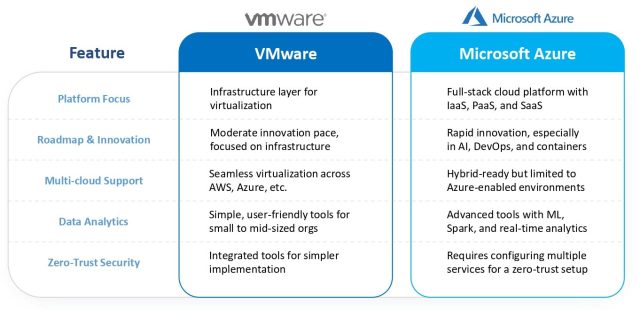
Both VMware and Microsoft Azure offer strong virtualization and cloud solutions. VMware focuses on enterprise virtualization and hybrid flexibility, while Azure leads in cloud-native scalability, analytics, and integrated AI. Choosing between them depends on your modernization goals, workload types, and long-term cloud strategy.
Takeaway
Virtualization is no longer one-size-fits-all. Whether your goal is to reduce costs, modernize your IT stack, or scale hybrid workloads, today’s VMware alternatives are mature, stable, and enterprise-ready.
Calsoft offers a structured, automation-first migration approach—helping you move faster, smarter, and more securely.
Start with a free consultation or download our VMware Migration Blueprint to get started.
Frequently Asked Questions (FAQs)
Q1: What is the current replacement for a VMware server?A: Microsoft Hyper-V, Nutanix AHV, and KVM are leading alternatives. Hyper-V integrates seamlessly with Windows environments, while KVM and Nutanix AHV provide scalability and flexibility across platforms.
Q2: What is a free alternative to VMware ESXi hypervisor?A: Proxmox VE, XCP-ng, and oVirt are open-source hypervisors offering enterprise-grade features—ideal for testing, SMBs, or production setups with budget constraints.
Q3: What is the best alternative to VMware vSphere?A: OpenStack and Red Hat OpenShift Virtualization are strong vSphere alternatives, providing complete VM orchestration and hybrid cloud readiness.