

“An efficient telecommunications network is the foundation upon which an information society is built.” Aptly put by Talal Abu-Ghazaleh, this quote gives the true essence of what telecommunications means to the world. In today’s fast-paced world, enjoying the power of seamless connectivity is not a luxury anymore but a necessity. This highlights not just everyday communication but also the global exchange of information that helps businesses thrive in the digital era.
As the world demands more connectivity, telecommunications continue to flourish rapidly. NFV, also known as Network Function Virtualization, has emerged as a crucial element, enabling more flexible and scalable services.
However, one major question businesses struggle with when designing NFV infrastructure is choosing the right virtualization technology: Virtual Machines (VMs) or Containers. Both offer unique advantages and trade-offs that significantly impact performance, cost, and operational efficiency.
Virtual machines have long been a staple of virtualization, providing strong isolation and security, making them a trusted choice for many network functions. However, they carry the overhead of running full operating systems, consuming more resources. Containers, on the other hand, offer lightweight virtualization with faster boot times and better resource utilization, making them ideal for efficiency and scalability.
But which is better for NFV infrastructure? Should you stick with tried-and-tested VMs or adopt containers for your network needs? This blog explores the strengths and weaknesses of both technologies to help you make an informed decision for your NFV strategy.
Decoding Virtual Machines
The image below shows the basic architecture of Virtual Machines.
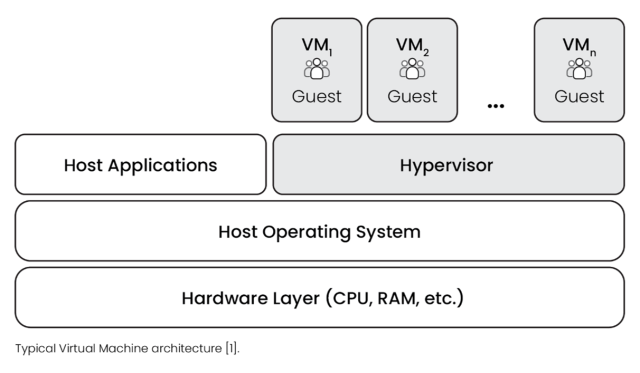
This diagram illustrates a typical Virtual Machine (VM) architecture. At the base is the hardware layer, containing physical resources like CPU and RAM. Above it lies the host operating system and a hypervisor that manages multiple VMs. Each VM runs its own guest OS and applications independently.
What are Virtual Machines?
Virtual Machines are instances of operating systems running on a physical machine via a hypervisor. Each VM has its own OS, memory, and resources isolated from others. This enables multiple operating systems to run simultaneously on the same hardware without interference. The hypervisor manages these VMs and allocates physical resources efficiently.
Decoding Containers
The image below shows the basic architecture of Containers.
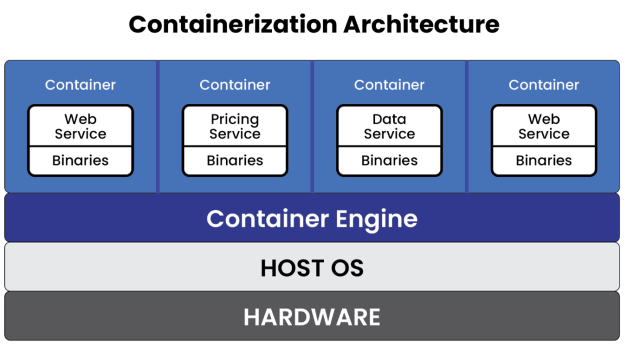
The diagram represents containerization architecture. It includes a hardware layer, a host operating system, and a container engine managing multiple containers, each with its own services and dependencies. This allows isolated applications to run simultaneously while sharing the host OS.
What are Containers?
Containers are lightweight, portable, self-contained executable units that package software applications and their dependencies. They ensure consistent deployment across environments—development, staging, and production. With orchestration tools like Kubernetes, containers can be efficiently managed and scaled.
Compared to traditional VMs, containers are more lightweight and portable, making them ideal for microservices architectures. They enable faster deployment and management, reducing time and cost during software releases.
Key Differences Between Containers and Virtual Machines
| Feature | Container | Virtual Machine |
|---|---|---|
| Operating System | Uses the host OS kernel | Includes a full OS with its own kernel |
| Portability | Highly portable across environments | Less portable due to full OS virtualization |
| Speed | Launches and shuts down quickly | Slower to boot and stop due to full OS load |
| Resource Usage | Lightweight and efficient | More resource-intensive |
| Isolation | Process-level isolation, ideal for microservices | Strong system-level isolation |
| Security | Lower isolation; depends on host OS security | Higher security due to complete isolation |
| Scalability | Excellent for dynamic scaling | Better for stable, consistent environments |
| Maintenance | Easy updates using shared OS layers | Requires managing each VM separately |
The industry shift towards cloud-native applications and Kubernetes orchestration demonstrates how focus has moved from virtualization to containerization.
The Evolution of NFV: From VMs to Containers in 5G Networks
Since Network Function Virtualization (NFV) was proposed by ETSI, the ecosystem has evolved rapidly. Initially, NFV deployments relied on VMs for hosting Virtual Network Functions (VNFs). However, as 5G networks demand agility, scalability, and low latency, the limitations of VM-based NFV have become evident, paving the way for containers.
- Resource Overheads: VMs require full OS and hypervisor layers, consuming more CPU and memory. Containers, being lightweight, need fewer resources and allow hosting more VNFs per server.
- Faster Deployment & Portability: Containers package only necessary binaries and dependencies, enabling rapid deployment and easy migration across environments.
- Security: VMs provide strong isolation, while containers depend on kernel-level security, though tools like SELinux and AppArmor now enhance container security.
- Scalability: Containers support auto-scaling through Kubernetes, offering faster provisioning and dynamic orchestration compared to VMs.
- Resiliency: Containers can be auto-restarted or replaced upon failure, thanks to Kubernetes’ self-healing features, unlike VMs which take longer to reboot.
- Agility: Containers enable quicker service deployment and upgrades due to easier orchestration within the same OS environment.
Cloud-Native Approach in NFV with Container-Based VNFs
Cloud-native development integrates continuous integration (CI) and continuous deployment (CD) methodologies to accelerate service launches. Telecom providers adopting NFV can use containerized VNFs to gain agility, scalability, and faster time to market.
By decomposing VNFs into microservices hosted in containers, telecom providers can achieve modularity and automated scaling. Kubernetes handles orchestration, ensuring efficient updates and CI/CD integration across the NFV infrastructure.
Deployment Models Using VMs and Containers
Telecom operators can deploy VNFs using:
- VMs only
- Containers only
- A hybrid mix of both
Currently, hybrid models are preferred since not all infrastructures support full containerization. Using OpenStack for VMs and Kubernetes for containers provides a robust NFV orchestration environment. VNF vendors must support both deployment types to ensure compatibility.
What to Use and When?
Choosing between VMs and containers depends on your use case. Here are some general guidelines:
- Environment Configuration: VMs provide greater control and isolation—best for testing multiple environments.
- Development Speed: Containers are ideal for rapid builds, testing, and CI/CD pipelines.
- Scalability: Containers offer lightweight scaling for microservices; VMs are suited for stable environments.
Summary
Container-based VNFs offer speed, scalability, and resource efficiency, making them a strong alternative to hypervisor-driven VMs. As 5G networks mature, containerization will drive innovation in areas like network slicing, Mobile Edge Computing (MEC), and Cloud RAN (cRAN). The telecom industry is steadily embracing containers to achieve agility and automation across NFV infrastructure.
At Calsoft, we empower global customers with NFV solutions built on cutting-edge technologies and deep industry expertise. Explore our comprehensive network transformation solutions.