
The telecom industry is undergoing a major transformation driven by the demand for faster, more reliable, and cost-effective connectivity. Network capabilities are evolving in design, architecture, operations, orchestration, and security. With the growing adoption of diverse Internet of Things (IoT) applications requiring flexible networks to meet varying Quality of Service (QoS) needs, network transformation has become essential. To stay competitive and deliver next-generation services, telecom Service Providers (SPs) must upgrade their mobile network architectures. This transformation involves migrating network infrastructure toward virtualized Data Centers (DCs) powered by Software Defined Networking (SDN), Network Function Virtualization (NFV), and Network Disaggregation principles.
Modern networks must support multiple radio-link connections—user-to-network, vehicle-to-network, drone-to-drone, and device-to-device communication. This requires a more advanced and flexible Radio Access Network (RAN). However, traditional RAN architectures rely on proprietary hardware and software, limiting flexibility and scalability. To overcome these limitations, RAN has evolved from distributed to centralized and virtualized models, giving rise to Cloud RAN (C-RAN), virtualized RAN (vRAN), and ultimately, Open RAN. Open RAN revolutionizes telecom infrastructure by introducing agility, scalability, interoperability, and cost efficiency. Read on to explore Open RAN and its architectural components.
Drivers of Open RAN Adoption
RAN and Core Network (CN) typically account for 80% and 20% of network deployment costs respectively, making RAN the most complex and expensive component. Traditional RAN systems are based on proprietary, hardware-driven, single-vendor modules. This leads to vendor lock-in and high integration costs, limiting scalability and innovation.
Telecom Service Providers (SPs) and Mobile Network Operators (MNOs) are now adopting fully virtualized, disaggregated, and cloud-native network designs. These architectures reduce Capital Expenditure (CAPEX) and Operating Expenses (OPEX) through modularity and flexibility. The transformation includes:
- Network Disaggregation: Breaking the network into independent modules that can be selected and combined based on specific use cases.
- Virtualization: Replacing dedicated hardware with software-based Network Functions (NFs) running on Commercial Off-The-Shelf (COTS) servers.
This approach disaggregates the traditional Baseband Unit (BBU) into Distributed Unit (DU) and Centralized Unit (CU). Open RAN eliminates vendor lock-in by enabling interoperability between multi-vendor components. Operators can build modular networks by combining BBUs and RUs from different vendors, reducing CAPEX and OPEX. This open, software-driven framework empowers MNOs to choose best-of-breed solutions over proprietary systems.
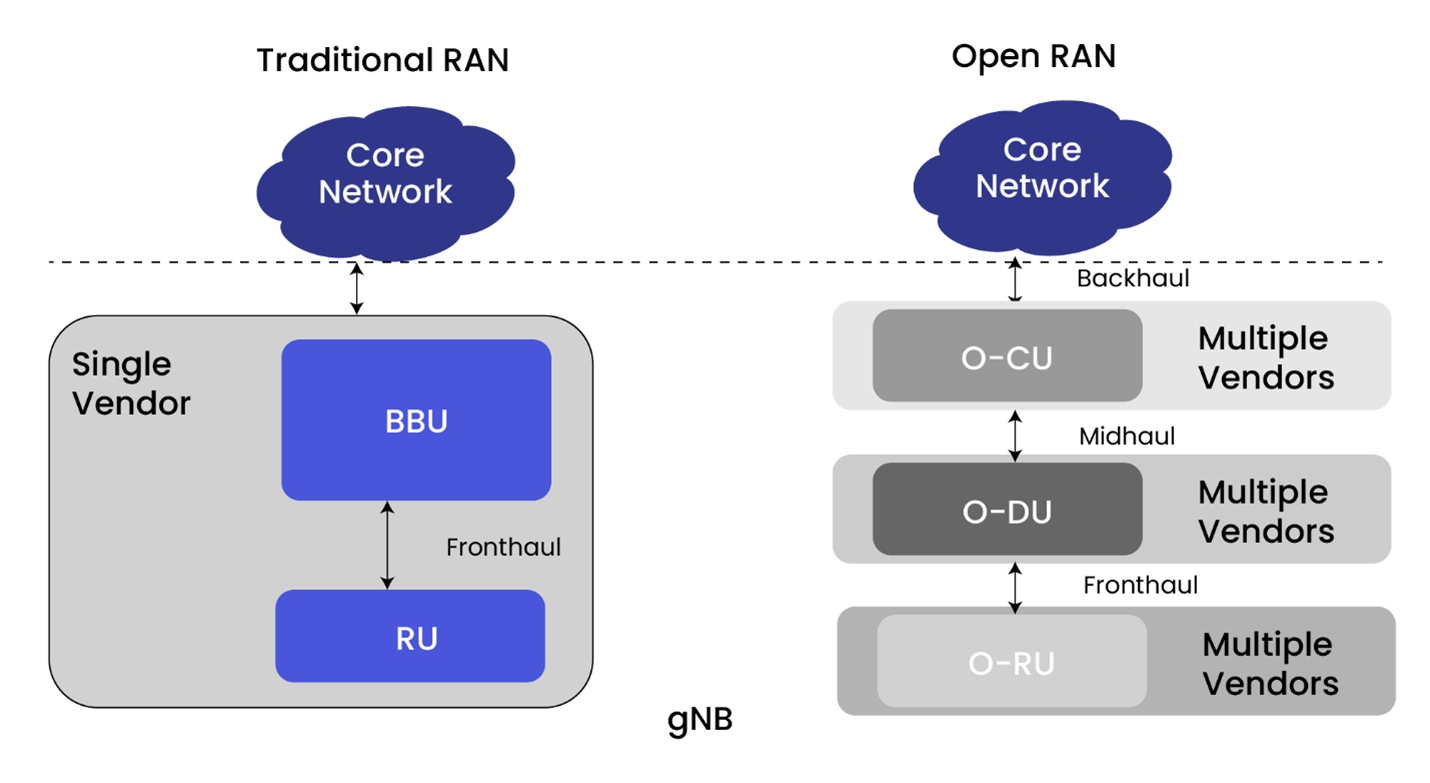
Open RAN adoption is supported by global standardization bodies and alliances such as the O-RAN Alliance, which comprises over 200 MNOs, vendors, and research institutions. O-RAN focuses on developing intelligent, open, and virtualized network infrastructures based on standardized interfaces. The goal is to foster innovation, interoperability, and cost efficiency in the RAN domain.
However, with network disaggregation comes increased operational complexity. To efficiently manage this, telecom operators are embracing intelligent RAN automation strategies powered by Artificial Intelligence (AI) and Machine Learning (ML). Within the Open RAN framework, the Service Management and Orchestration (SMO) platform plays a central role in automating network operations and orchestration.
SMO in the Open RAN Framework
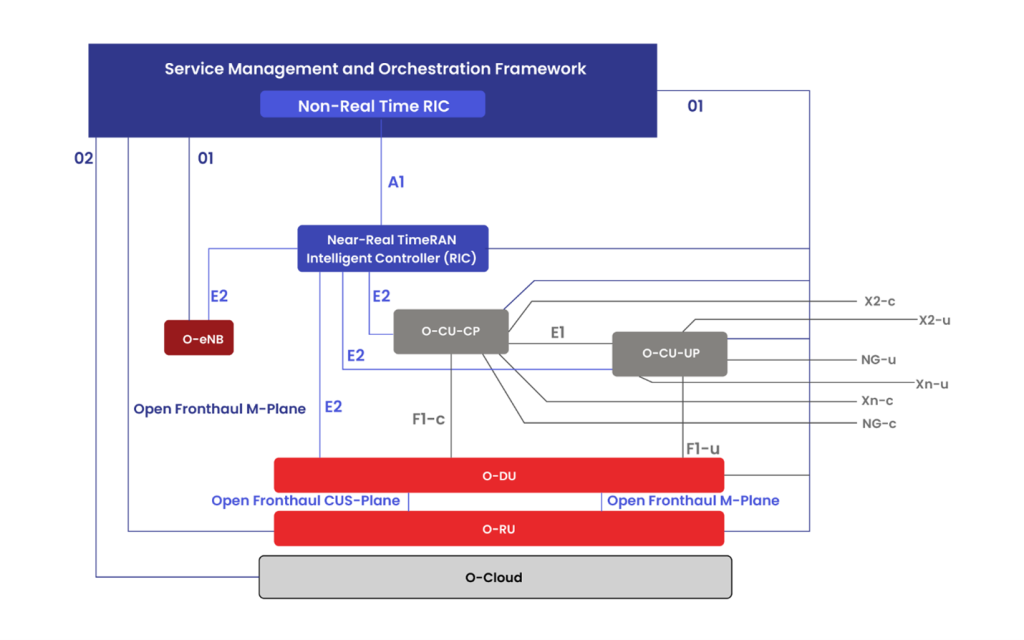
According to the O-RAN Alliance, the Open RAN architecture (Figure 2) comprises several key components and standardized interfaces.
| Key Elements | Technical Description |
|---|---|
| O-Cloud | Cloud infrastructure hosting cloud-native virtualized functions. |
| O-CU (CP/UP) | Open Centralized Unit with Control Plane and User Plane functions. |
| O-RU | Open Radio Unit. |
| O-DU | Open Distributed Unit. |
| O-eNB | Open evolved eNodeB hardware supporting 4G RAN. |
| Near Real-Time RIC (Near-RT RIC) | Software platform supporting third-party applications. It uses RAN metrics and feeds data to AI/ML models for real-time optimization. |
| Non-Real-Time RIC (Non-RT RIC) | Trains AI/ML models and communicates with Near-RT RIC via A1 interface for resource management. |
| SMO | Automation and orchestration platform managing Open RAN radio resources as part of the Operational Support System (OSS). |
SMO provides end-to-end network slicing and orchestration across RAN, transport, and core networks. It supports multi-cloud, multi-domain, and multi-tenant deployments. The main functions of SMO include:
- Network Slicing: Creates logical network segments for specific use cases, managing their orchestration and resource allocation.
- Dynamic Service Management: Automates provisioning, scaling, and lifecycle management of network services, ensuring optimal resource utilization.
- FCAPS Support: Provides Fault, Configuration, Accounting, Performance, and Security monitoring to ensure service reliability.
- Automation: Leverages AI/ML for real-time decision-making and predictive orchestration.
- Openness and Flexibility: Allows quick onboarding of new services and adapts to dynamic demands.
- Multi-Vendor Interoperability: Ensures standardized communication and integration across multiple vendor ecosystems.
The following table outlines the key interfaces in the Open RAN architecture:
| Key Interfaces | Technical Description |
|---|---|
| A1 | Enables workflows between Non-RT RIC and Near-RT RIC. |
| O1 | Connects SMO to Near-RT RIC, O-CUs, and O-DUs. |
| O2 | Connects SMO with O-Cloud for orchestrating cloud infrastructure. |
| E2 | Links Near-RT RIC with O-CUs, O-DUs, and O-eNBs; supports live data collection via X-apps. |
| R1 | Supports manageability of multi-vendor rApps. |
| Open Fronthaul CUS | Connects O-RU and O-DU. |
| Open Fronthaul M-Plane | Connects O-RU with O-DU and SMO; manages FCAPS functionalities. |
X-apps and rApps are third-party applications hosted within the RIC to enable network automation and intelligence.
With these capabilities, SMO enhances agility, flexibility, and scalability in orchestrating modern wireless networks while supporting openness, interoperability, and multi-vendor collaboration.
In a Nutshell
SMO plays a pivotal role in automating and simplifying the orchestration and management of complex Open RAN ecosystems. When extended beyond RAN domain orchestration, SMO can become a powerful enabler of next-generation, multi-vendor, and multi-domain mobile networks.
Calsoft, as a technology-first partner, is leading the transformation toward open mobile networks with enhanced efficiency, performance, and security. Calsoft’s Open RAN services include solution design, integration and testing, software development, and comprehensive security implementations.