
The world is witnessing rapid technological evolution, transforming the IT industry and its operations. One of the significant trends reshaping industrial operations is the emergence of edge computing. The journey of digital transformation in enterprises is fueled by edge computing, which modernizes data analysis and processing.
The rise of the Internet of Things (IoT) has led to the generation of massive amounts of data, demanding highly reliable processing and analysis for informed decision-making. Conventional cloud computing technologies have become inefficient and insufficient to meet the demand for quicker insights. This is where edge computing steps in.
Imagine a scenario where data processing happens close to or right at the source — at the network edge — instead of depending entirely on distant cloud servers or remote data centers (DCs). By processing data nearer to the source, edge computing is revolutionizing industrial operations, enabling real-time and data-driven decision-making, reducing end-to-end latency, and unlocking innovative opportunities in the market.
According to Gartner, by 2025, more than 75% of enterprise-generated data will be created and processed outside traditional data centers or the cloud. Edge computing acts as a catalyst for enterprises to embrace digital transformation and reshape the business landscape. Multi-access Edge Computing (MEC), a standard architecture for telecom networks, further enhances operational efficiency. Explore this blog to learn how edge computing and MEC revolutionize businesses.
What is Edge Computing and Multi-access Edge Computing (MEC)?
Edge computing is a transformative technology that brings compute capacity closer to where data is generated. This proximity reduces response time and back-end load. By processing data near its source, edge computing enhances performance and efficiency, especially in real-time and low-latency scenarios. It’s a distributed computing model where computing happens at multiple edges.
MEC (Multi-access Edge Computing) is an advanced evolution of edge computing, defined by the European Telecommunications Standards Institute (ETSI). Tailored for telecom clouds, MEC leverages 4G LTE, 5G, Private 5G, and other access networks to deliver compute, storage, and network services closer to users. The objective of MEC is to lower latency, ensure highly reliable network operations, and enhance customer experience by embedding compute power directly into network infrastructure.
Why the Need and Adoption of MEC is Significant
The rise of next-generation cellular networks like 5G and IoT brings major network transformations that deliver seamless user experiences through futuristic services. 5G and beyond networks are designed to support enhanced Mobile Broadband (eMBB), ultra-Reliable Low Latency Communication (uRLLC), and massive Machine-Type Communication (mMTC). Each of these requires stringent technical benchmarks in terms of latency, security, mobility, and reliability.
Is MEC a key enabler for 5G to achieve these requirements? Which vertical markets can MEC open for telecom operators? Let’s explore these questions.
The key factor driving the growth and significance of MEC is its tight integration with 5G deployment.
5G leverages technologies like Network Function Virtualization (NFV), Software-Defined Networking (SDN), and Edge Intelligence to enhance flexibility, automation, and service delivery. MEC complements this by meeting ultra-low latency and high-reliability requirements. Together, they enable new applications and business models that unlock additional revenue streams.
Gartner predicts the market for MEC data centers will grow to $13.5 billion by 2024, driven by the rollout of 5G.
The following table highlights key capabilities realized by Mobile Network Operators (MNOs) and Service Providers (SPs) using MEC in 5G networks:
| Capabilities | Description |
|---|---|
| Intelligent Positioning | Applications can be deployed at specific edge or 5G tracking locations based on performance requirements. |
| Traffic Optimization | Prioritizes network traffic to meet low-latency and high-QoS requirements. |
| Enhanced Customer Experience | Ensures seamless experiences by effectively utilizing bandwidth and network capacity. |
| Cost-Effective Content Delivery | Reduces transmission costs by caching content closer to end users. |
| Understanding Network Context | Provides user and network context to applications for improved service continuity. |
| Network Capability Exposure | Enables third-party applications to utilize edge network capabilities and drive new business models. |
Integrated MEC Deployment in 5G Networks
5G implements the Control and User Plane Separation (CUPS) architecture as per 3GPP standards, decoupling signaling and data paths. MEC enhances this by moving User Plane Functions (UPF) closer to the edge, allowing localized and faster data handling. These distributed UPFs play a central role in integrated MEC deployment.
The MEC framework consists of three layers: System Level, Host Level, and Network Level.
- System Level: Includes the MEC Orchestrator, which interacts with 5G Core (CN) and Radio Access Network (RAN) to manage resources dynamically.
- Host Level: Includes the MEC Platform, Platform Manager, and MEC Applications that deliver compute and connectivity services.
- Network Level: Manages communication between User Equipment (UE) and the MEC environment, ensuring smooth integration with 3GPP networks.
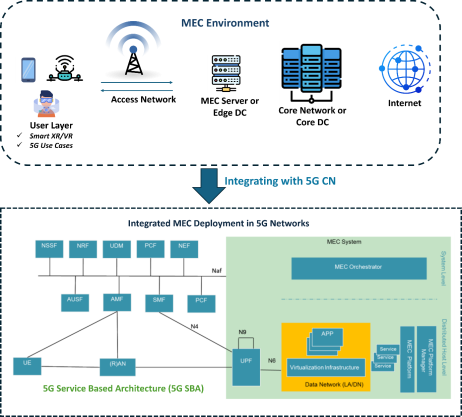
Industries like smart cities, automotive, and healthcare will benefit significantly from 5G MEC. This integrated framework enables enterprises to leverage telecom capabilities such as high-speed mobility, SLA assurance, and network reliability.
Benefits of MEC and Practical Applications
Together, 5G and MEC unlock innovative opportunities across industries such as retail, manufacturing, and IoT domains, including smart factories and smart hospitals.
Benefits of Multi-Access Edge Computing (MEC)
- Reduced Latency and Continuous Operations: MEC minimizes latency by running directly on the network infrastructure and ensures continuous operations even during temporary cloud outages.
- Efficient Resource Utilization: Frees up backend resources for other tasks such as AI/ML model training.
- Proactive Resource Allocation: Uses radio access network data to predict demand and allocate resources dynamically.
MEC can be deployed on IoT devices, gateways, RAN sites, micro data centers, or regional hubs — with optimal results achieved closer to the edge.
Practical Applications of MEC
Image and Video Analysis
In traditional setups, video analysis is performed on remote servers, causing latency and bandwidth issues. MEC enables localized video analytics near data sources, reducing response time and improving efficiency — ideal for real-time surveillance and threat detection.
Solving Latency and Data Volume Challenges
Edge servers host processing workloads closer to the source, minimizing data transfers and enabling faster decisions. This localized processing ensures scalability and reliability.
The Role of Mobility in MEC
MEC extends edge computing by introducing mobility. Compute capacity moves within the network — for example, at RAN base stations — reducing latency to as low as 10 milliseconds while easing backend loads.
Conclusion
Multi-access Edge Computing (MEC) enables communication service providers to deliver computing power directly to users, ensuring real-time responsiveness and low latency. By integrating compute resources within network infrastructure, MEC enhances performance, reliability, and efficiency. Enterprises adopting MEC can achieve better operations, reduced costs, and improved customer experiences.
With over 25 years of expertise, Calsoft specializes in high-performance networking and telecom product engineering services. Partnering with industry leaders, we deliver cutting-edge solutions to process and analyze data at the edge.