

In today’s technology-driven world, data storage plays a vital role in both business and personal life. The shift from physical to digital records has increased the need for upgraded data storage solutions. Understanding various data storage technologies is essential to ensure that your data remains accessible, secure, and efficient. Let’s explore the different types and trends shaping data storage today!
What is Data Storage?
Data storage refers to the methods and technologies used to keep data secure, accessible, and ready for use when needed. It’s the foundation of everything from personal devices to massive data centers that power the internet.
At its core, data storage is about safeguarding digital information over time. Every time you save a document, upload photos, or back up files, you’re engaging in data storage. Without reliable storage solutions, valuable data — from family memories to critical business records — could be lost. The ability to store and retrieve data effectively makes our digital world function seamlessly.
Before exploring modern storage technologies, let’s first understand the types of digital information and the limitations of traditional memory.
Types of Digital Information
- Input Data: Information provided to devices — such as typing a document, uploading photos, or entering data into a spreadsheet.
- Output Data: The processed results generated by devices, such as edited files, finalized reports, or computed outputs.
Limitations of Traditional Computer Memory
- RAM (Random Access Memory): Fast but volatile — data is lost when the device powers off. Ideal for temporary storage.
- ROM (Read-Only Memory): Non-volatile and stores essential firmware but cannot be easily modified.
Due to these limitations, more powerful and flexible solutions like Hard Drives, SSDs, and Cloud Storage emerged — allowing vast, secure, and always-accessible data storage.
Forms of Data Storage
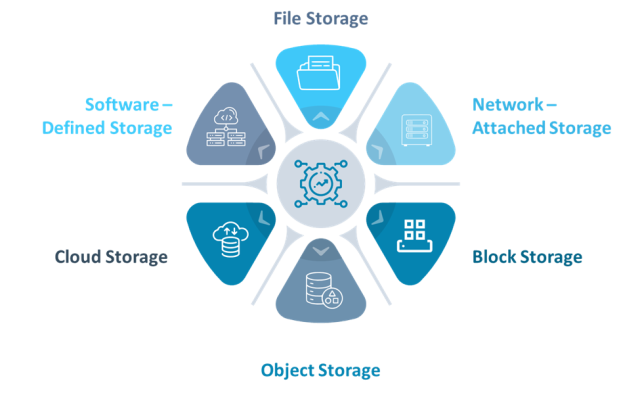
File Storage
File storage is like a digital filing cabinet. Data is organized hierarchically in directories and subdirectories, making it ideal for structured data such as documents or spreadsheets.
Block Storage
Block storage divides data into fixed-size blocks for fast access and performance. It’s widely used in databases and high-transaction environments requiring quick read/write speeds.
Object Storage
Object storage is designed for massive unstructured data. It stores data as objects with unique identifiers, making it perfect for multimedia files, backups, and cloud-native applications.
Network-Attached Storage (NAS)
NAS acts as a shared storage hub accessible by multiple users over a network. It’s ideal for teams collaborating on shared documents or media files.
- Storage Area Network (SAN): Provides high-speed access to consolidated storage, ideal for enterprises managing heavy transactional workloads.
- Direct-Attached Storage (DAS): Connects directly to a computer or server for high-speed local access, but limited in scalability and sharing capabilities.
Cloud Storage
Cloud storage enables scalable, off-site storage managed by providers like AWS, Google Cloud, and Microsoft Azure. It offers flexibility, cost efficiency, and global accessibility with robust security.
Software-Defined Storage (SDS)
SDS separates storage management from hardware. Using software, virtualization, and APIs, it allows dynamic resource allocation and centralized control, improving scalability and efficiency.
- Storage Virtualization: Pools multiple physical devices into a unified system, simplifying management and enhancing flexibility.
- Hyperconverged Infrastructure (HCI): Combines compute, storage, and networking into one software-managed platform for simplified scalability.
SSD and Flash Storage
Solid-State Drives (SSDs) and flash storage offer low latency and high speed, making them ideal for high-performance applications and modern data centers.
Hybrid Cloud Storage
Hybrid cloud storage combines private and public cloud environments. Sensitive data stays secure in private storage, while non-critical data leverages the scalability of public cloud infrastructure.
Backup Storage
Backup solutions like Backup-as-a-Service (BaaS) automate data protection and recovery, ensuring data safety against loss, hardware failure, or cyberattacks.
Data Storage Security
Data security is critical in protecting information from cyber threats. Implementing robust storage security measures ensures confidentiality, integrity, and availability.
- Permissions: Assign access levels to control who can view, edit, or delete data.
- Encryption: Secure data at rest and in transit using cryptographic techniques.
- Data Masking: Replace sensitive data with dummy values for testing environments.
- Redaction: Conceal sensitive information from unauthorized users.
- Business Continuity: Regularly back up data and test recovery processes to maintain operations during disruptions.
- Data System Security: Keep systems updated, deploy firewalls, and use intrusion detection systems to prevent breaches.
By adopting these practices, organizations can enhance data security and resilience.
Emerging Data Storage Solutions

Advancements in Cloud Storage
Cloud storage continues to evolve with improved scalability, security, and reliability. Major providers like AWS, Azure, and Google Cloud now offer multi-cloud and edge storage solutions for faster processing and reduced latency.
Multi-cloud storage enhances flexibility and redundancy, while quantum storage — using qubits and superposition — promises breakthroughs in speed and security.
AI Integration in Data Storage
Artificial intelligence optimizes storage by predicting needs, managing backups, and improving data placement. AI-driven storage ensures optimal use of resources while reducing operational costs.
Improvements in Flash Storage
Flash storage innovations, including NVMe drives, have drastically increased performance and durability. These provide ultra-fast data access and enhanced reliability — ideal for gaming, enterprise, and cloud workloads.
Wrapping Up
Understanding the landscape of data storage technologies is essential in today’s digital world. From file, block, and object storage to cutting-edge solutions like SDS and hyperconverged infrastructure, choosing the right technology depends on specific needs and growth goals.
Organizations are now embracing advanced approaches such as software-defined storage, Storage-as-a-Service, hybrid multicloud storage, and cyber-resilient storage. Calsoft’s comprehensive storage engineering services, accelerator IPs, and consulting expertise help enterprises design products that lead data center transformation and virtualization initiatives.