
As businesses increasingly adopt multi-cloud strategies, understanding the complexities of multi-cloud network architecture patterns and their security implications becomes vital. Multi-cloud environments involve using multiple cloud service providers, each with unique tools and systems, which can create challenges in managing security, data transfer, and infrastructure.
Each cloud provider comes with its own tools, security measures, and management systems, which can quickly become overwhelming. Ignoring these complexities may expose an organization to serious risks, including security breaches, data loss, and operational inefficiencies. With increasing reliance on cloud services, safeguarding the multi-cloud infrastructure becomes essential to maintain security and operational efficiency.
In fact, as per Google Cloud’s survey, business and IT leaders are leaning heavily on cloud strategies. The results are clear:
- 41.4% of companies plan to increase investment in cloud-based services and products.
- 33.4% of companies intend to migrate from legacy software to cloud-based tools.
- 32.8% of companies focus on moving on-premises workloads to the cloud.
These numbers highlight a strong trend: companies are doubling down on cloud adoption to build resilience and maintain a competitive edge. This makes understanding and managing your multi-cloud network architecture more crucial than ever.
This blog provides a clear understanding of what multi-cloud network architecture entails. It explores common architectural patterns, examines the core layers, and delves into the security challenges that arise in managing multi-cloud environments.
What is Multi-Cloud Network Architecture?
Multi-cloud network architecture refers to the strategic deployment and integration of multiple cloud services from different providers. Its goal is to create a cohesive network that ensures interoperability and reliability. This approach enhances performance and security while minimizing risks like outages or vendor lock-in.
Components of a Multi-Cloud Architecture
- Cloud Providers: Platforms such as AWS, Google Cloud, and Microsoft Azure provide computing resources. Each has unique strengths, and integrating them effectively ensures efficiency.
- Network Infrastructure: Includes Virtual Private Clouds (VPCs) and Virtual Private Networks (VPNs) that enable secure data transfer between clouds.
- Data Management: Ensures data consistency, security, and compliance across multiple platforms while avoiding data silos.
Why You Should Choose Multi-Cloud
- Distribute workloads across multiple providers to prevent dependency.
- Ensure business continuity through disaster recovery across clouds.
- Leverage the strengths of different providers for specific workloads.
- Reduce the risk of breaches through diversified infrastructure.
- Adopt cost-efficient solutions tailored to specific business needs.
Having explored the components, let’s look at common multi-cloud network architecture patterns.
The Common Multi-Cloud Network Architecture Patterns
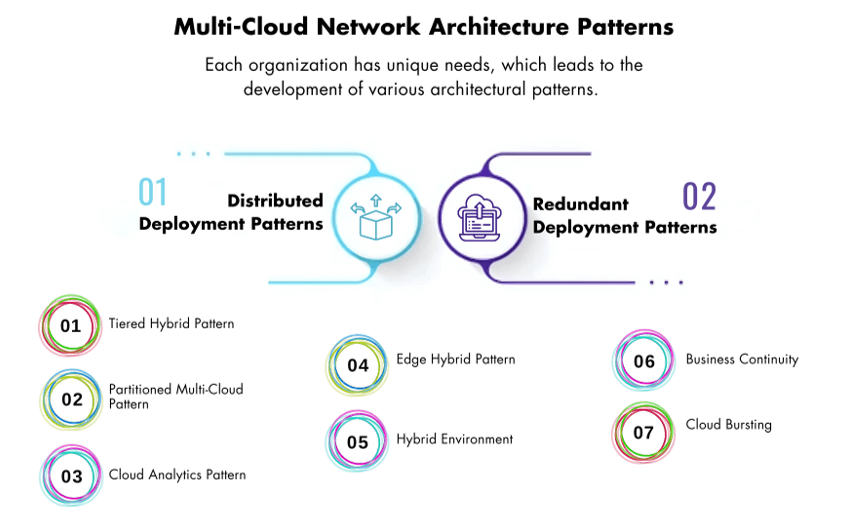
When working with multi-cloud environments, no single solution fits all. Each organization has unique needs, leading to different architectural patterns that balance flexibility, performance, and resilience.
- Distributed Deployment Patterns: Spread workloads across multiple clouds for better flexibility and performance.
- Redundant Deployment Patterns: Focus on reliability and high availability through duplication across clouds.
1. Tiered Hybrid Pattern
Spreads application layers across multiple clouds — UI, business logic, and database — each aligned with the best-fit resources for performance and scalability.
2. Partitioned Multi-Cloud Pattern
Hosts different applications or services on separate clouds rather than splitting a single app. This approach reduces risk and enhances flexibility.
3. Cloud Analytics Pattern
Distributes analytics workloads across providers based on their strengths. For instance, real-time analytics on low-latency clouds and deep learning on GPU-optimized platforms.
4. Edge Hybrid Pattern
Combines edge computing with cloud resources for real-time data processing near the source, reducing latency and improving efficiency.
5. Hybrid Environment Pattern
Integrates on-premises infrastructure with the cloud. Ideal for industries requiring regulatory compliance or control over sensitive workloads.
6. Business Continuity Pattern
Ensures high availability and disaster recovery by duplicating critical systems across multiple clouds with automated failover mechanisms.
7. Cloud Bursting Pattern
Temporarily extends workloads to another cloud during traffic spikes, maintaining performance and avoiding downtime during peak demand.
Core Layers of Multi-Cloud Network Architecture
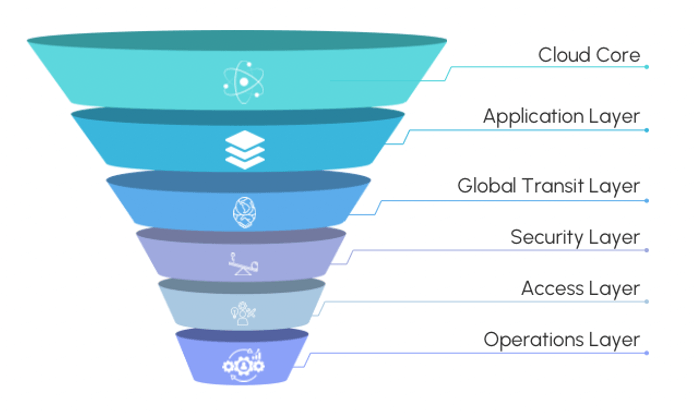
- Cloud Core: Provides essential compute, storage, and networking services that support integration between providers.
- Application Layer: Manages deployment, scaling, and orchestration of apps across clouds.
- Global Transit Layer: Ensures smooth, low-latency data transfer with traffic management and load balancing.
- Security Layer: Protects against threats through firewalls, encryption, and identity management.
- Access Layer: Controls user authentication and authorization via SSO and MFA.
- Operations Layer: Handles continuous monitoring, automation, and disaster recovery.
Benefits of Multi-Cloud Architecture
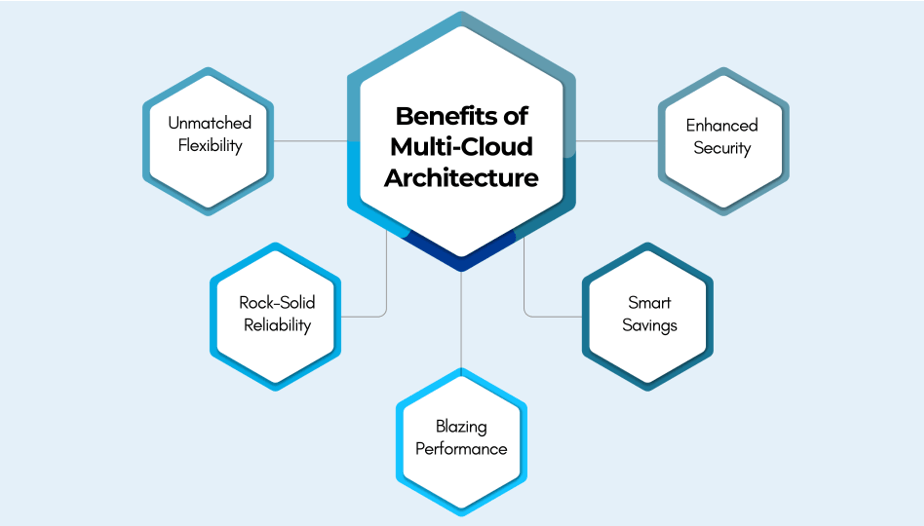
- Flexibility: Choose the best cloud for each workload.
- Reliability: Avoid single-provider outages by distributing risk.
- Performance: Optimize workloads across high-performing clouds.
- Cost Efficiency: Use dynamic scaling and pricing models.
- Security: Distribute data to reduce the impact of potential breaches.
Various Security Challenges in Multi-Cloud Environments
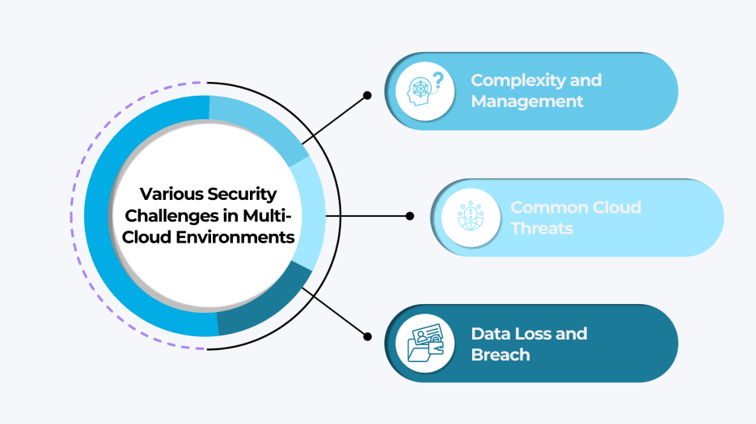
Complexity and Management
Each provider’s different tools and interfaces increase the difficulty of aligning security measures across clouds, potentially creating exploitable gaps.
Common Cloud Threats
- Botnets: Compromise resources for DDoS attacks.
- Zero-Day Exploits: Target unpatched vulnerabilities.
- Cryptomining: Hijack resources for unauthorized computation.
Data Loss and Breach
Managing and securing distributed data is challenging. Breaches can cause severe financial and reputational damage if proper safeguards are not in place.
Insecure APIs
APIs are critical for multi-cloud integration but can be exploited if not properly secured. Consistent API security across providers is essential.
Conclusion
Securing a multi-cloud network architecture requires a comprehensive strategy. This blog explored key patterns, layers, and security challenges. By implementing a zero-trust model, enforcing end-to-end encryption, and continuously monitoring vulnerabilities, businesses can ensure resilience, scalability, and security in their multi-cloud ecosystems.
Calsoft leverages over 25 years of product engineering expertise and domain knowledge to deliver innovative cloud solutions. We ensure seamless connectivity, real-time analytics, and optimized operations to enhance business agility and security.