

The Internet of Things (IoT) is a transformative force reshaping industries, people, and everyday life. The core enabler of this transformation is IoT cloud architecture, a framework that combines IoT devices, sensors, connectivity networks, and cloud-computing resources to enable seamless connectivity, intelligent data processing, and smart decision-making. But as billions of new devices come online, the attack surface grows just as fast, making IoT cloud security one of the defining engineering priorities in the coming years.
According to Mordor Intelligence, the global IoT security market is valued at USD 11.66 billion in 2026 and is projected to reach USD 47.33 billion by 2031, growing at a 32.35% CAGR.
But why do you need it? Because IoT devices often pose security risks due to incompatibility with existing tools and a lack of basic protection features. Traditional cybersecurity measures aren’t enough. IoT cloud security involves securing information and devices connected to IoT systems through cloud-based security measures.
The security conversation has therefore moved from “How do we protect an IoT device?” to “How do we maintain trust from device to edge to cloud?” For decision-makers, the question is no longer whether to invest in IoT cloud security, but how fast the organization can close the gap between IoT adoption and IoT protection. For CXOs, CIOs, and VPs of Engineering, IoT cloud security is no longer a back-office IT concern; it has become a board-level risk decision. IoT connectivity has turned into one of the fastest-growing attack surfaces in enterprise technology.
What is IoT Cloud Security?
IoT cloud security refers to the methods, architectures, and tools used to protect the data, devices, and workloads of Internet of Things systems that are hosted, managed, or processed in the cloud. It secures the full pipeline, from device onboarding and data transmission to cloud-based storage, analytics, and application access, through encryption, identity management, and continuous monitoring.
Rather than treating security as an afterthought, mature IoT cloud architecture builds protection into every layer: the device, the network, and the cloud platform itself. Think of it as a digital vault, equipped with encryption, access control, and continuous monitoring, keeping distributed devices and the data they generate secure against attack.
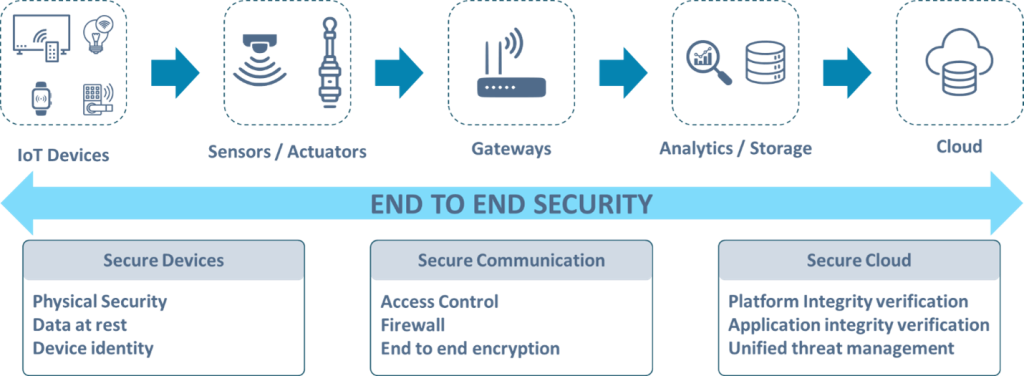
Image: IoT Cloud Architecture and Security Features
Think of IoT cloud security as a digital vault, equipped with encryption, access control, and continuous monitoring, ensuring your data and devices remain secure against attacks.
Why IoT Cloud Security Matters
IoT devices are always-on and always-connected, which makes them a constant target. For a CXO, the cost of getting enterprise IoT security wrong is measured in regulatory penalties, customer churn, and board-level scrutiny.
- Financial exposure: The EU Cyber Resilience Act can impose penalties of up to €15 million for non-compliant connected devices entering the EU market, while the UK's PSTI Act bans default passwords outright.
- Operational continuity: Downtime from an IoT-originated breach remains a top-cited concern among U.S. CISOs, directly affecting revenue and SLAs.
- Regulatory compliance: Strong IoT compliance frameworks support GDPR, CCPA, and HIPAA obligations through audit trails and demonstrable data protection.
- Customer trust and brand equity: Enterprises seen as security-conscious win and retain trust in markets where a single breach can undo years of brand investment.
- Investor and partner due diligence: IoT risk management posture increasingly features in due diligence for funding rounds, partnerships, and acquisitions. The takeaway for enterprises: IoT security is no longer a compliance checkbox. It is now a board-level risk category with direct financial, legal, and reputational consequences.
Types of IoT Cloud Security
Ensuring IoT device security requires a multilayered approach that integrates encryption, authentication, and real-time monitoring across the stack.
| Aspect | Focus | IoT Cloud Security Solutions |
|---|---|---|
| Network Security | Protects the network IoT devices connect to. |
|
| Embedded Security | Protects IoT devices at the hardware and firmware level. |
|
| Firmware Assessment | Secures low-level software that controls IoT hardware. |
|
IoT Cloud Security Challenges and Threats
- Weak Authentication and Authorization: Many IoT devices ship with default or weak passwords and lack multi-factor authentication, giving attackers an easy entry point.
- Memory and Processing Power Limitations: Limited device resources restrict what security controls can run on-device. Lightweight encryption and efficient coding practices help close this gap.
- Insecure Communication Channels: Unencrypted data transmission remains a leading cause of breaches. Enterprises should encrypt data in transit using protocols like TLS or IPSec as standard practice, not an afterthought.
- Patching and Update Challenges: Device diversity complicates regular patching. Where devices can't be updated, isolate them or apply compensating layers of protection.
- AI-Driven and Automated Attacks: Attackers are increasingly using machine learning to scan for vulnerable devices faster, automate reconnaissance across networks, and adapt tactics in real time to evade detection. This is shifting enterprise defense from static, rule-based systems toward adaptive, AI-powered threat detection.
- Common Attack Patterns: IoT environments face multiple security risks, including botnets that hijack devices for DDoS attacks or malware spread, ransomware that locks devices and disrupts operations, IT/OT convergence gaps that create blind spots without shared ownership, asset invisibility caused by rapid device growth, and legacy or rogue devices that introduce hidden access points into networks
Effective Strategies for Managing IoT Cloud Security
To strengthen IoT security, organizations should keep a complete inventory of devices, configurations, and firmware, apply updates quickly, and protect data with strong encryption and regular key rotation. Regular penetration testing also helps identify weaknesses before attackers can exploit them. They should also isolate IoT devices from core systems, monitor behavior in real time, and use runtime security to stop threats as they happen. A zero-trust approach combined with AI-driven detection adds continuous verification and better spotting of unusual activity.
IoT Security Trends CXOs Should Watch
AI-powered threat detection, Zero Trust by default, edge security, and hardware-level trust are quickly becoming the new standard for IoT security. At the same time, global regulations such as the EU Cyber Resilience Act and UK PSTI Act are pushing organizations toward compliance-by-design, making security an expected part of the architecture rather than an afterthought.
Calsoft supports enterprises across manufacturing, telecom, and connected-device industries with end-to-end IoT security, from secure firmware and embedded systems to cloud-native integration . With capabilities spanning penetration testing, network segmentation, AI-driven detection, and continuous monitoring, Calsoft helps organizations build secure, compliant, and observable IoT ecosystems from day one.
By combining the right security frameworks with AI-powered protection, technology leaders can turn IoT security from a recurring risk into a lasting source of trust and competitive advantage.