

The Internet of Things (IoT) has revolutionized how devices communicate, enabling seamless connectivity across various industries. IoT platforms are the backbone of this ecosystem, providing the necessary infrastructure and tools to manage, connect, and secure IoT devices.
Have you reached the critical point of choosing your IoT device platform? You’ve likely encountered similar opportunities from various providers, each with its challenges, making this decision more significant. After all, your choice of platform will determine how effectively you can scale and depend on operations—a crucial factor in the IoT world.
Markets and Markets research projected the global IoT market will grow to $650.5 billion by 2026. As more companies turn to IoT to enhance their operations, selecting the right platform can feel overwhelming.
This blog will detail the different types of IoT platforms, highlighting their strengths and how they meet different business needs.
What is an IoT Device Platform and Its Key Components
An IoT device platform represents the central system for connecting, operating, and managing your IoT devices. Simply put, it is the command center that controls your entire IoT ecosystem, enabling devices to interact and process the data they generate.
Here’s how it works:
- Device Management: Connect thousands of devices and control them with ease. The platform ensures proper configuration and uptime.
- Data Processing: Collects and processes data from devices, turning raw information into valuable insights for decision-making.
- Security: Protects connections, prevents unauthorized access, and ensures data integrity.
- Integration: Connects to your existing systems, ensuring smooth interoperability across business operations.
As technology evolves, managing more connected devices becomes critical. Let’s understand the core components of IoT device platforms that make them indispensable today.
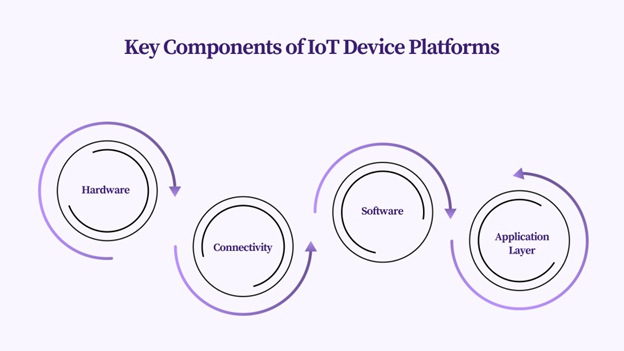
Hardware
Hardware includes sensors, actuators, and connected devices. These form the foundation of the IoT system and gather data from the physical environment. Actuators use this data to trigger actions—turning on machines, dimming lights, or adjusting temperature.
Connectivity
Connectivity ensures secure and efficient data transmission between devices using protocols like MQTT, HTTP, or CoAP—enabling device-to-device or client-server communication over networks.
Software
The software layer provides intelligence to the IoT platform. It manages devices, processes data, and delivers analytics, enabling seamless device coordination and insightful reporting.
Application Layer / User Interface
This is the user-facing layer—dashboards, mobile apps, or APIs—that enables users to interact with the platform, visualize data in real time, and manage devices effectively.
Together, these components define a reliable, scalable, and secure IoT ecosystem. Now, let’s explore the different types of IoT platforms.
Types of IoT Device Platforms
There are several types of IoT device platforms, each serving a specific purpose—End-to-End Platforms, Connectivity Platforms, and Cloud Platforms.
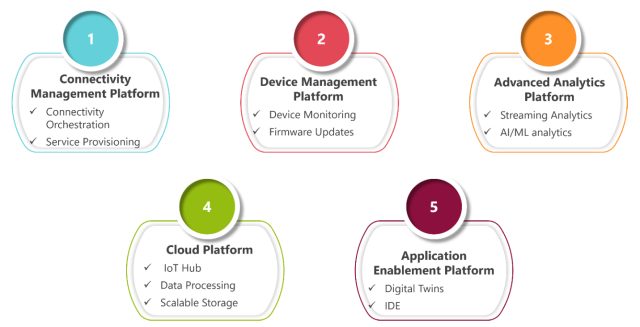
- IoT Device Management Platform: Manages firmware updates, alerts, key metrics, and security patches for all connected devices—ideal for large IoT ecosystems.
- IoT Connectivity Management Platform: Ensures reliable communication between devices via Wi-Fi, Bluetooth, or cellular networks.
- IoT Cloud Platforms: Focuses on data storage, processing, and analysis, enabling real-time insights and faster decision-making.
- IoT Application Enablement Platform: Provides tools to create and deploy IoT applications quickly using APIs and templates.
- IoT Advanced Analytics Platform: Uses AI, ML, and big data analytics to uncover insights and support predictive decision-making.
- IoT End-to-End Platform: Offers a complete, integrated solution—covering device management, connectivity, and analytics in one package.
Key Considerations in Choosing an IoT Platform
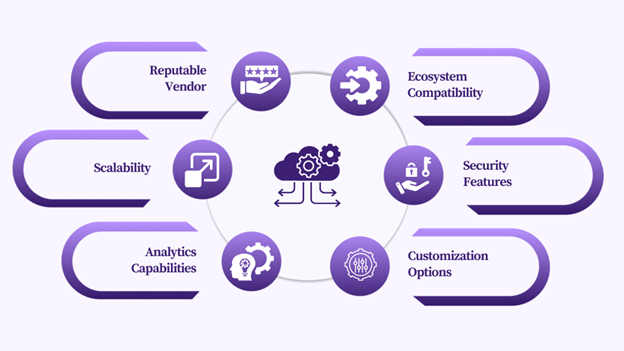
To choose the best IoT platform for your business, evaluate key factors such as functionality, scalability, and integration. Here’s what to consider:
- Reputable Vendor: Choose trusted providers with proven reliability and support.
- Ecosystem Compatibility: Look for platforms that integrate seamlessly with your existing systems.
- Scalability: Ensure the platform can handle future growth without performance drops.
- Security: Opt for platforms with robust encryption and access control.
- Analytics Capabilities: Prioritize platforms that provide real-time insights and data visualization.
- Customization: Look for flexible, configurable dashboards and API options.
IoT Platforms: Bridging Cloud and Edge
Many IoT platforms operate in the cloud, offering scalability and cost-efficiency. However, edge computing is becoming equally critical, especially for remote or latency-sensitive environments.
Edge computing processes data closer to devices, minimizing cloud dependency and improving responsiveness—vital for industries like autonomous vehicles and manufacturing.
To fully leverage edge computing, an IoT platform should support flexible deployment across cloud, edge, and on-premises environments.
Top IoT Device Platforms
Below are some of the most popular IoT device platforms that power today’s connected world:
| IoT Platform | Features | Pros | Cons | Pricing Model |
|---|---|---|---|---|
| AWS IoT Core | Deep AWS integration, advanced analytics, secure communication. | Highly scalable, robust security, seamless cloud integration. | Complex setup, costly at scale. | Pay-as-you-go with a limited free tier. |
| Microsoft Azure IoT Hub | Real-time data processing, enterprise scalability, Azure integration. | Seamless Microsoft ecosystem support, strong analytics. | Complex setup for small teams, higher cost. | Flexible pay-as-you-go model. |
| IBM Watson IoT | AI-driven analytics, predictive maintenance, real-time insights. | Comprehensive data management and analytics. | High cost, limited customization. | Custom pricing for enterprise deployments. |
| Bosch IoT Suite | Industrial-grade security, device management, scalability. | Excellent for Industrial IoT, reliable and secure. | Complex implementation, high cost for SMBs. | Custom pricing for large-scale enterprises. |
Parting Thoughts
Choosing the right IoT device platform depends on your business objectives, system complexity, and long-term strategy. The future of IoT will integrate AI, ML, and edge computing to enhance speed, security, and intelligence.
Calsoft, as a technology-first company, builds enterprise-class, secure, and intelligent systems to help businesses in Manufacturing, Hi-Tech, and Data Center domains accelerate IoT adoption. Our IoT-powered solutions and frameworks empower enterprises to deploy, manage, and scale connected ecosystems efficiently.