

How do you minimize the risk of a cyber-attack when connecting public and private clouds?
When you deploy hybrid clouds, the attack surface increases, as integrating your private cloud with a public one creates additional entry points that attackers can target.
As businesses increasingly adopt hybrid cloud models, ensuring security across both public and private infrastructures becomes a significant challenge. According to Gartner, by 2025, 85% of organizations will have a cloud-first principle, which makes securing hybrid environments more critical than ever. Hybrid cloud security introduces complex issues such as managing data protection, ensuring consistent security policies, and addressing compliance across multiple environments.
Moreover, cybercriminals are becoming increasingly sophisticated, and even the smallest security gap may leave the whole infrastructure vulnerable.
This blog closely examines the challenges surrounding hybrid cloud computing, the entailing risks, and some practical strategies to help safeguard it, including the best ways to secure your network.
This will help you clearly understand the unique hybrid cloud challenges, and you will walk away with actionable steps to safeguard your data and systems.
What is Hybrid Cloud Security?
Imagine you’re running two different workspaces, one shared and the other private. Each has its advantages, but when you connect them, you can choose where to do each task. That’s what a hybrid cloud does—it merges public and private clouds.
- In a public cloud, you’ll find economies of scale. It’s cost-effective because you share infrastructure with others.
- With a private cloud, your organization has more control, often for sensitive operations. Here, you can keep your data in a more isolated, secure environment.
But it gets tricky here: you need to manage security across these two environments.
Why is Security Important in a Hybrid Cloud?
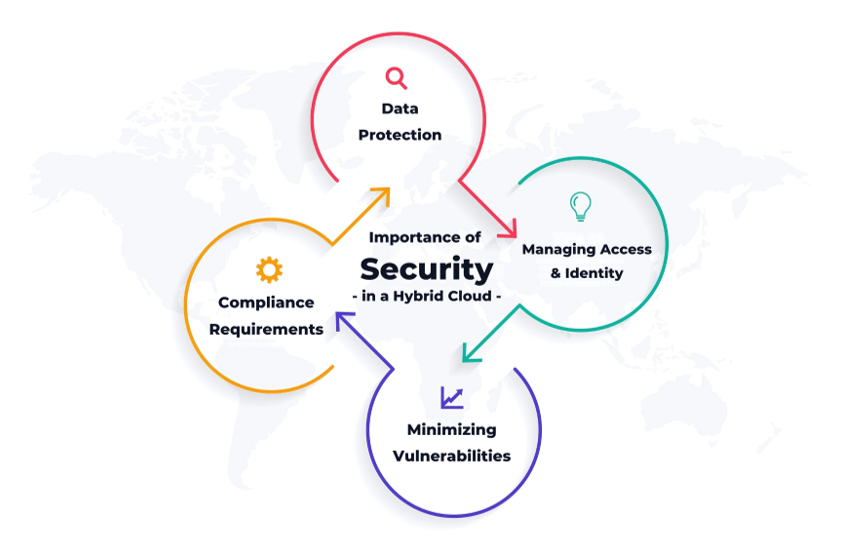
Now, let’s talk about why securing the cloud—especially a hybrid one—is essential. When you move to the cloud, your data and services spread across various environments. That means security risks can multiply if you do not manage them correctly.
- Your data often moves between private and public clouds. Without encryption or proper access controls, it could be intercepted or exposed.
- When you can’t see all your data flows, security blind spots appear, making it harder to track threats.
- Each environment might have its rules, and aligning security practices across both can be a significant challenge.
Now that you understand the basics of hybrid cloud challenges and security, let’s examine the various challenges in detail.
Top 6 Hybrid Cloud Challenges
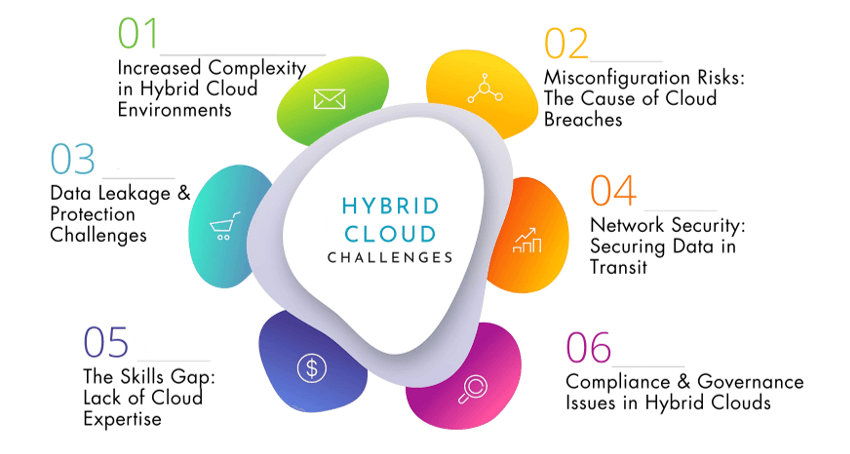
1. Increased Complexity in Hybrid Cloud Environments
Hybrid cloud environments have different systems working together but with distinct security protocols. This creates complexity, and with complexity comes risk.
It also increases operational intricacy because what works in one environment may not transfer easily to another—it’s like trying to merge two completely different roadmaps into one.
- Visibility Issues: Security teams often lack real-time visibility into how data is accessed and stored across environments.
- Inconsistent Security Policies: Different cloud providers may have varying security standards, making it difficult to enforce consistent policies.
- Threat Detection: Identifying threats across multiple environments is more complex since each cloud has its own logging and alerting mechanisms.
Security teams need to monitor both environments, manage protocols, and ensure compliance, but this heavy workload often leads to missed alerts and slow responses.
2. Misconfiguration Risks: The Cause of Cloud Breaches
Misconfiguration of systems is a common cause of hybrid cloud challenges. A single mistake—like leaving an open port or failing to set the correct permissions—can expose critical data to the world.
- Open S3 Buckets: Sensitive data exposed due to misconfigured storage permissions.
- Unpatched Vulnerabilities: Failing to patch software leaves backdoors for attackers.
- Improper Access Controls: Not limiting access rights can open sensitive resources to unauthorized users.
Misconfigurations are common due to complexity and human error, but they’re avoidable with automation and proper tools.
3. Data Leakage and Protection Challenges
Data leakage occurs when sensitive information is exposed or transferred to unauthorized parties. In hybrid clouds, this often happens as data moves between environments without proper protection.
- Insecure APIs: Poorly configured APIs can expose data.
- Poorly Secured Endpoints: Endpoints without proper authentication increase risk.
- Weak Access Controls: Insufficient data access restrictions lead to leaks.
Prevention Tips: Encrypt data at rest and in transit, use secure API gateways, and implement DLP (Data Loss Prevention) tools to monitor unauthorized transfers.
4. Network Security: Securing Data in Transit
Data doesn’t stay in one place—it moves between clouds. Each transfer introduces risk if not properly encrypted.
- Use VPNs: Create secure tunnels between clouds.
- Encrypt Data in Transit: Always protect moving data.
- Adopt Zero Trust Network Access (ZTNA): Verify every user and device continuously.
5. Bridging the Cloud Expertise Gap
Hybrid clouds require new skills that traditional on-premises teams may not have. This gap leads to misconfigurations and failure to detect threats.
- Invest in hybrid cloud security training and certifications (AWS, Azure, Google Cloud).
- Work with Managed Security Service Providers (MSSPs) like Calsoft to fill gaps while building in-house expertise.
6. Compliance and Governance Issues in Hybrid Clouds
Compliance becomes complex in hybrid environments since data may reside across different jurisdictions with varying regulations (GDPR, HIPAA, etc.).
- Each provider handles compliance differently.
- Security policies must be consistent across all environments.
- Use the shared responsibility model: providers secure infrastructure; you secure your data and configurations.
Compliance Tips: Conduct regular audits and use multi-cloud policy management tools.
Solutions to Challenges and Risks in Hybrid Cloud Security
- Develop a unified security policy for both cloud types.
- Conduct quarterly security audits to identify vulnerabilities.
- Use cloud platforms with automated threat detection and compliance monitoring.
- Implement Zero-Trust frameworks with strict identity verification.
- Provide ongoing training for your team on hybrid cloud security.
Using Cloud Security Platforms and Managed Services
Managing hybrid cloud challenges can be overwhelming. Cloud security platforms and Managed Security Services (MSS) help by providing:
- Centralized management of all security protocols.
- Automated threat detection for faster response.
- 24/7 monitoring and continuous protection.
Conclusion
Addressing hybrid cloud security challenges is essential to maximizing cloud benefits. Organizations must proactively manage risks through encryption, Zero-Trust models, compliance monitoring, and skilled security teams. As the cloud landscape evolves, staying updated with emerging threats ensures resilience and scalability in hybrid environments.
Calsoft, as a technology-first partner, offers seamless integration between public and private clouds, ensuring flexibility, compliance, and strong data protection. Our hybrid cloud capabilities optimize business performance through secure, scalable architectures.