
Since the Industrial Revolution, technology has evolved at a blistering pace! What seems modern today soon becomes a legacy, and organizations must stay agile and adapt to stay competitive in the market. To drive digital transformation, every enterprise should be adaptable and compatible with the latest technologies and trends. This helps enterprises stay agile, flexible, competitive, and intuitive.
Modernization involves updating and enhancing an existing product to address growing customer needs, incorporating technological advancements, and staying in tune with market trends. To gain a competitive edge, constant growth is essential for any organization that creates and markets its products. A robust modernization roadmap can help reshape an enterprise’s legacy applications by leveraging innovative technologies, frameworks, and architectures.
According to MarketsandMarkets, the application modernization market is expected to reach $32.8 billion by 2027 — up from $15.2 billion in 2022, nearly doubling in size.
DevOps acts as a catalyst and plays a significant role in the application modernization process, especially in digital product engineering. DevOps helps realize innovative applications that meet customer demands by enabling teams to collaborate efficiently and respond quickly to dynamic requirements. DevOps principles ensure a strong, reliable, and user-friendly modernization initiative aligned with technological breakthroughs and market trends.
We have already summarized how DevOps is modernizing industries today. Taking this further, let’s explore how DevOps plays a major role in product and application modernization!
The First Step: Reassessing the Legacy – Why Modernize?
Even if a product or application is stable and performing well, one may still ask: Why modernize? And is it worth the risk and investment?
The answer: when an organization invests in modernization, it can improve operational efficiency, reduce costs, and enhance the user experience — ultimately driving growth and competitive advantage. Today’s users constantly demand new features, compare offerings, and continuously reassess product value.
Of course, modernization comes with challenges. Striking a balance between preserving existing functionality and introducing new features that meet business needs requires thoughtful planning, testing, and implementation to ensure minimal disruption to end users.
Traditional application architectures face challenges in communication, automation, visibility, and bug detection. These issues impact flexibility and agility in business operations. For enterprises, decoupling a monolithic framework to transition to microservices architecture without DevOps practices can be costly and complex. Key challenges include:
- Inflexible architecture
- Inability to scale
- Lack of integration with modern programming languages or technologies
- Static, non-responsive user interfaces (UI)
- Difficulty deploying to the cloud
Modernization enhances customer experience by transforming user interfaces, integrating new features, automating manual tasks, and offering new services. Understanding the challenges and significance of modernizing legacy applications, let’s explore the strategies involved.
The Second Step: Choosing a Modernization Strategy
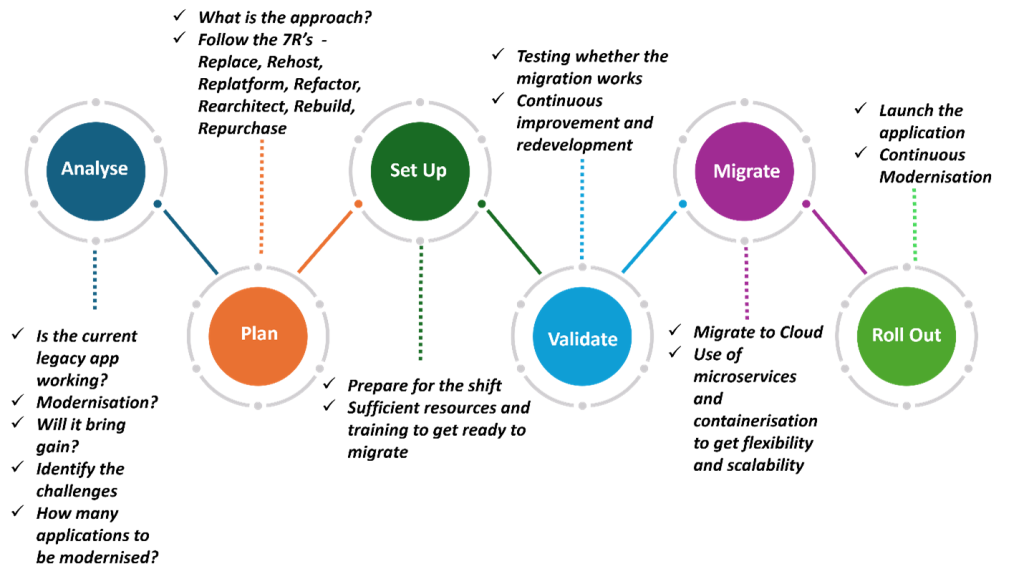
Multiple strategies exist for product and application modernization. However, the focus on business goals over technology choices is crucial to achieving success. The following image highlights the key steps in a modernization strategy:
The Third Step: Adopting the DevOps Approach
DevOps plays a crucial role in modernizing products and applications for organizations striving to keep pace with rapid technological advancements.
DevOps is not just a technological shift — it’s a cultural paradigm shift!
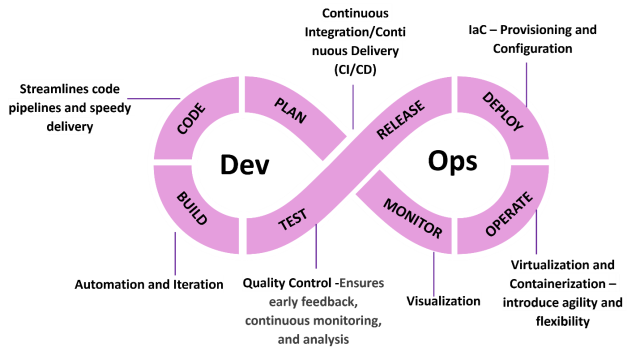
The DevOps approach fosters collaboration between development (Dev) and operations (Ops) teams. It streamlines the software development lifecycle, promotes automation, and enhances product and application quality through continuous integration, delivery, and deployment — ensuring faster and more reliable software releases.
Built on agile principles, DevOps emphasizes close collaboration among developers, operations professionals, and quality assurance teams.
The Benefits: How DevOps Facilitates Product Modernization
The COVID-19 pandemic pushed companies to prioritize technological infrastructure and security to manage their digital customer experience (CX). Organizations began advancing app development methodologies to support remote work, accelerating the need for DevOps to streamline processes. DevOps aligns people, processes, and technologies, helping enterprises adapt to evolving market demands.
Before diving deeper, let’s compare legacy versus modernized applications using the DevOps approach:
| Legacy Products | Modernized Products |
|---|---|
| Manual processes | Automated processes |
| Lack of coordination between teams | Collaboration between all stakeholders |
| Manual deployment & testing | Automated CI/CD pipelines |
| Decentralized environments with dependencies | Centralized yet independent toolchains enabling frequent releases |
| Minimal scope for change | Agile and flexible for continuous improvement |
DevOps doesn’t follow the traditional software development cycle. Instead, it ensures high-quality delivery through:
- Agility and flexibility
- Continuous integration and delivery (CI/CD)
- Automation and iteration
- Streamlined pipelines for faster delivery
- Continuous feedback, monitoring, and analysis
- Incremental changes for reduced risk
- Scalability, productivity, reliability, and mobility
The table below illustrates how DevOps facilitates product modernization:
| Process | Tools & Techniques |
|---|---|
| Automation | CI/CD: Automates integration and deployment, ensuring code changes are tested and released faster. Infrastructure as Code (IaC): Tools like Terraform and Ansible automate infrastructure management and scaling. |
| Collaboration | Cross-functional teams: Shared responsibility, continuous feedback, and faster issue resolution. Communication tools: Platforms like Jira, Slack, and Confluence improve transparency and collaboration. |
| Monitoring & Feedback | Monitoring tools: Grafana, Prometheus, and others support continuous monitoring and performance optimization. |
| Scalability & Flexibility | Microservices architecture: Enables modular scalability. Containerization: Docker and Kubernetes provide portability across environments. |
| Quality Assurance | Automated testing: Integrated testing within CI/CD pipelines ensures consistent quality and efficiency. |
| Cost Efficiency | Resource optimization: Automation reduces waste and improves utilization. Cloud integration: Dynamic resource allocation leads to cost savings. |
| Security | Continuous security assessments and automated compliance checks ensure security is integral to every stage. |
Adopting DevOps helps businesses become more responsive and competitive. The goal is to support rapid innovation while minimizing risk by modernizing applications, infrastructure, and processes.
The Way Forward
The DevOps approach enables organizations to deliver software products more efficiently, respond quickly to business requirements, and enhance security and customer satisfaction. DevOps offers a powerful solution for modernizing legacy applications without hindering growth or adoption of modern technologies.
With the rise of Generative AI, DevOps is evolving to include intelligent automation, predictive analysis, and AI-assisted decision-making. However, ensuring data privacy and security remains crucial.
To mitigate vulnerabilities and ensure compliance, especially when adopting AI-enabled DevOps, partnering with a trusted technology provider is key. Calsoft, with over 25 years of experience and early adoption of GenAI, helps organizations adapt to market dynamics by bridging the gap between tradition and innovation. Our dedicated DevOps Center of Excellence accelerates implementation and enhances speed, quality, and security for our customers.