
Security is becoming a critical element of modern business operations as organizations face increasing threats and vulnerabilities in the digital realm. With growing awareness around cybersecurity, DevSecOps is emerging as a key enabler for secure, efficient, and agile product development. From startups to global enterprises, businesses are embracing DevSecOps to integrate security into every phase of the development process. Its unique value lies in bridging the gap between development, operations, and security teams — making security a core part of modern product engineering.
In today’s fast-paced technology landscape, innovation constantly reshapes how development and operations work together. DevOps introduced speed, reliability, and collaboration into software delivery. Building upon this, DevSecOps brings security into the mix — creating a culture where protection and compliance are built into every stage of development. By integrating development, security, and operations, DevSecOps transforms traditional workflows into secure, proactive, and collaborative environments that address potential risks early in the software lifecycle.
DevSecOps revolutionizes how we approach security by embedding it from the start — ensuring products are designed to withstand emerging threats. Let’s explore how DevSecOps strengthens product security and reshapes the software development process.
Implementing DevSecOps Best Practices in the Software Development Lifecycle (SDLC)
DevSecOps enhances the software development lifecycle by integrating early security measures, automated testing, continuous monitoring, and policy enforcement. This holistic approach ensures that products are secure, resilient, and compliant from design to deployment.
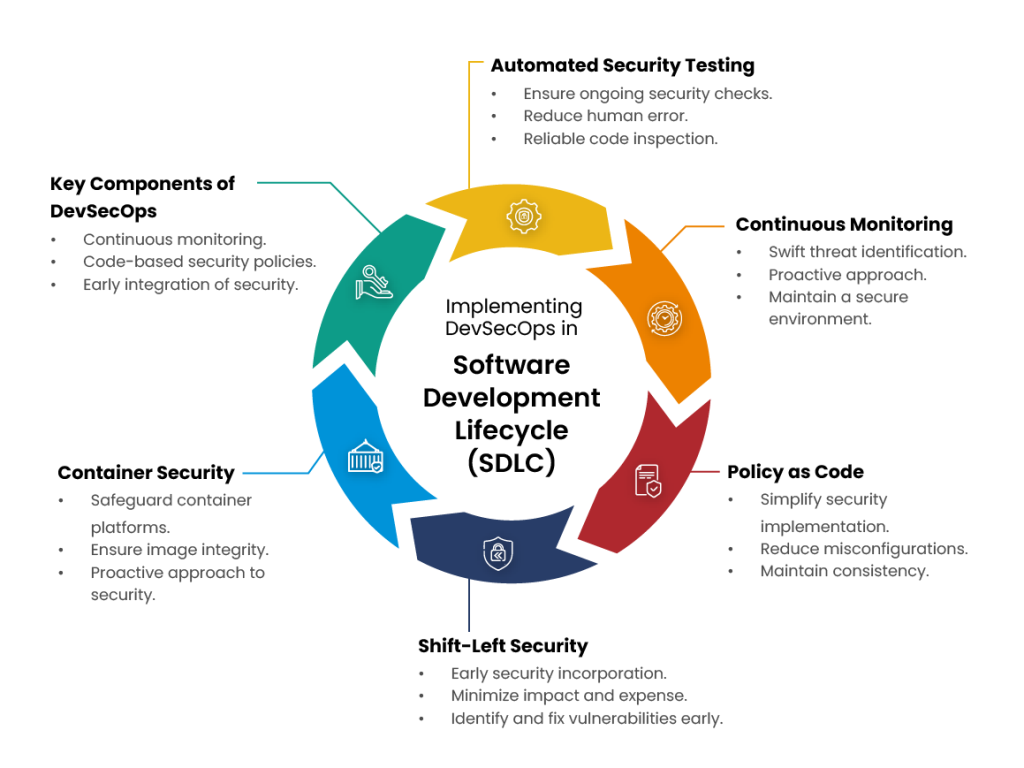
Automated Security Testing: Automated testing is at the heart of DevSecOps. Integrating security tools into the CI/CD pipeline ensures consistent and continuous checks throughout the development process. It reduces manual errors, identifies vulnerabilities faster, and strengthens overall code reliability.
Continuous Monitoring: DevSecOps emphasizes real-time monitoring of applications and infrastructure to detect and respond to threats immediately. Continuous monitoring helps organizations identify anomalies, prevent breaches, and maintain compliance through ongoing visibility.
Policy as Code: By expressing security policies as code, organizations can automate and standardize security enforcement across environments. This approach minimizes configuration errors, ensures consistency, and aligns perfectly with DevSecOps principles of automation and transparency.
Shift-Left Security: The “shift-left” concept focuses on addressing security earlier in the development cycle — identifying and resolving vulnerabilities before they escalate. Early security integration reduces costs and risks while enhancing software reliability and trustworthiness.
Container Security: As containerization becomes a key part of software development, securing containers and orchestration platforms is vital. DevSecOps ensures container image integrity, compliance, and runtime protection — helping businesses leverage containerization without compromising security.
Together, these practices create a secure, automated, and adaptive development pipeline that safeguards both software and infrastructure from evolving threats.
The Roles of DevSecOps Teams in Supporting Product Security
DevSecOps fosters collaboration among developers, security experts, and operations teams to embed security across every phase of the software lifecycle. Each team plays a distinct yet interconnected role in ensuring robust product security.
Developers: Developers are responsible for writing secure code and implementing security practices during development. They identify vulnerabilities early and address them at the code level, making secure coding a core part of their workflow.
Security Teams: Security specialists define policies, conduct risk assessments, and guide developers in secure practices. They ensure compliance, enforce security standards, and collaborate with other teams to maintain a strong security posture.
Operations Teams: Operations teams secure the infrastructure and manage deployment pipelines. They monitor system integrity, detect incidents in real-time, and ensure configurations align with security requirements.
Collaboration Specialists: These professionals facilitate communication across departments, ensuring security isn’t siloed. They promote shared accountability and help align goals between development, security, and operations teams.
Automation Specialists: Automation experts implement and maintain automated testing, scanning, and deployment systems. They ensure that security tools are seamlessly integrated into development pipelines to prevent, detect, and remediate vulnerabilities continuously.
Together, these teams uphold security at every stage — ensuring that it’s not an afterthought but a built-in feature of every product.
Challenges and Considerations in DevSecOps Implementation
While DevSecOps offers immense benefits, organizations often face challenges related to culture, complexity, and skill gaps. Overcoming these hurdles requires strategic planning and collaboration.
Resistance to Cultural Change: Shifting to a DevSecOps mindset often faces internal resistance. Teams accustomed to traditional workflows may hesitate to adopt new processes. Addressing this requires awareness programs, leadership support, and cross-functional collaboration that emphasizes shared responsibility for security.
Complex Integration: Integrating security into existing DevOps workflows can be challenging. The solution lies in adopting an incremental approach — starting with pilot projects, using automation tools compatible with existing systems, and gradually scaling across teams.
Skill Gaps: Security expertise is often limited among developers and IT professionals. Organizations should invest in training, certifications, and cross-functional workshops to bridge this gap and build a team well-versed in both development and security practices.
A structured, incremental approach — focused on training, automation, and collaboration — enables smooth DevSecOps adoption while mitigating these challenges effectively.
Future Trends and Opportunities in DevSecOps
DevSecOps continues to evolve rapidly, offering new opportunities for organizations to enhance security, efficiency, and agility. Staying ahead of emerging trends is key to leveraging its full potential.
AI and Machine Learning Integration: The use of AI and ML will strengthen DevSecOps through predictive analytics, real-time anomaly detection, and automated response systems. These technologies will make threat detection faster and more precise.
DevSecOps as a Service (DaaS): Managed service providers are increasingly offering DevSecOps as a Service, enabling smaller businesses to access enterprise-grade tools, automation, and expertise without heavy upfront investments.
Advances in Container Security: As container adoption grows, future DevSecOps models will focus on enhancing container image scanning, securing orchestration layers, and implementing zero-trust principles across microservices.
Evolution of Cloud-Native Security: Cloud-native architectures are driving DevSecOps innovation. Future implementations will focus on embedding security within serverless and distributed systems to safeguard workloads across hybrid and multi-cloud environments.
Conclusion
In today’s landscape of evolving cyber threats, DevSecOps stands as a powerful framework that unites development, operations, and security into a single, proactive workflow. Its collaborative and continuous approach ensures that security is not an afterthought but a fundamental part of modern product engineering.
Calsoft seamlessly integrates security principles early in the application development cycle — strengthening DevOps pipelines and ensuring compliance without compromising performance. With deep expertise in DevSecOps implementation, Calsoft empowers enterprises to build resilient, secure, and scalable software solutions.