

5G, the next-generation cellular network, is revolutionizing the way we communicate and conduct business. With higher data rates, ultra-low latency, and enhanced capacity, 5G has the potential to transform industries, disrupt traditional business models, and redefine how we live, work, and interact with technology.
The 5G rollout enables enterprises to connect and transfer massive volumes of data seamlessly, fostering real-time collaboration and communication. This advancement will have a significant impact on various industries, driving innovation and enabling more economical business models.
5G also plays a pivotal role in reshaping the telecom industry by increasing competitiveness, enabling new entrants, and facilitating the launch of next-generation services. It supports the growth of emerging technologies such as digital healthcare, autonomous vehicles, industrial automation, and smart cities. With 5G, telecom operators can create new revenue streams through enterprise-grade Internet of Things (IoT) and cloud-based services, thereby boosting profitability.
By 2025, nearly half of the telecom industry in developed regions such as Asia and North America is projected to be 5G-enabled. Moreover, by 2024, there will be approximately 1.9 billion 5G subscriptions worldwide.
Source: Statista – 5G Mobile Subscriptions Worldwide
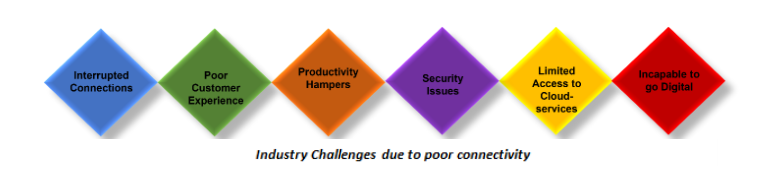
5G is designed to support next-generation use cases that demand stringent technical requirements in terms of data rate, connectivity, latency, and reliability. Therefore, robust connectivity, extensive coverage, and high capacity are essential. Poor connectivity can pose major challenges for businesses, impacting operational efficiency and customer experience.
How 5G Will Impact Business and the Telco Industry
5G introduces a modern approach to telecom infrastructure—bringing modularity, scalability, and flexibility to an industry traditionally dominated by rigid, purpose-built hardware. This transformation enhances agility, efficiency, and innovation.
One of the key advantages of 5G for businesses is the ability to leverage new-age technologies such as the Internet of Things (IoT) and Artificial Intelligence (AI). IoT connects billions of devices—smartphones, sensors, and machinery—allowing them to communicate and share data in real-time. Meanwhile, AI uses machine learning algorithms to automate processes, detect patterns, and make intelligent predictions from large data sets.
Let’s explore how 5G will transform businesses and empower the telecom industry.
1. Enhanced Coverage and Connectivity
5G networks combine low-band and high-band spectrums to deliver wide-area coverage and ultra-high-speed connectivity. The use of small-cell deployments in dense areas enhances capacity, while technologies such as beamforming and Massive MIMO (Multiple-Input, Multiple-Output) improve network performance and user experience.
2. Network-as-a-Service (NaaS)
5G enables Network-as-a-Service (NaaS), providing businesses with a scalable, secure, and on-demand network infrastructure. This model allows enterprises to consume network resources on a subscription or pay-per-use basis. Service Providers (SPs) manage, optimize, and maintain the network while ensuring its availability and security. With 5G network slicing, telcos can offer customized, on-demand services to different customers and industries.
3. Ultra-Low Latency
5G’s ultra-low latency makes it ideal for real-time applications like Augmented Reality (AR), Virtual Reality (VR), and IoT-driven automation. This real-time responsiveness unlocks new opportunities for immersive experiences, remote surgeries, autonomous driving, and other mission-critical use cases.
4. Secure and Flexible Networks
5G’s enhanced security architecture strengthens protection against cyber threats and unauthorized access—crucial for mission-critical communications. Furthermore, its flexible architecture allows telecom operators to adapt rapidly to changing business needs, improving responsiveness and market competitiveness.
5. Immersive Experiences
5G enables immersive experiences through high-speed, low-latency connectivity for AR, VR, and metaverse applications. These innovations open new revenue streams for telcos, allowing them to offer premium digital experiences and differentiate themselves in the market.
6. Energy Efficiency
5G networks are designed to be energy-efficient, reducing operational costs and environmental impact. With technologies such as software-defined networking (SDN) and network function virtualization (NFV), operators can optimize resource utilization, improve reliability, and lower maintenance costs.
Conclusion
5G marks a major milestone in telecommunications and technology evolution. Its influence on businesses and the telco industry will be profound—driving innovation, improving operations, and enhancing user experiences. Organizations that proactively invest in 5G will be better positioned to leverage emerging technologies and gain a competitive advantage. As the 5G revolution unfolds, it will continue to reshape the future of business and connectivity across the globe.