

Consider a scenario for an application: every functional test in the suite has been green. Every code review has been approved. However, after it shipped to production and absorbed real traffic for the first time, the response times increased from 150ms to 2 seconds within 30 minutes. The on-call Site Reliability Engineer (SRE) confused, the incident channel filled up, and stakeholders started asking questions. The critical reason is nobody had benchmarked the system against a defined performance standard before release.
Shipping reliably is the differentiator. Yet most engineering teams still treat Quality Assurance (QA) as a final checkpoint rather than a continuous, data-backed discipline. The result? Costly rollbacks, degraded user experiences, and executive conversations nobody wants to have after go-live.
Want to ensure your software delivers the performance and reliability your users expect? Looking to measure how well your application performs against defined standards or industry benchmarks? Or trying to identify performance bottlenecks before they impact user experience?
If so, the shift toward Testing as a Service (TaaS) and structured pre-launch benchmarking becomes an essential part of the process. It helps you evaluate system performance, uncover inefficiencies, and understand how your software performs under different conditions. This blog breaks down how QA engineers and CTOs are using these disciplines together to establish secure, quantifiable launch readiness.
Why Benchmarking Is the Missing Layer in Most TaaS Strategies
The Market Has Already Chosen TaaS
The global software testing market reached $54.44 billion in 2026 and is projected to approach $100 billion by 2031 at a 12.92% CAGR.
Organizations are migrating QA out of siloed test labs and into flexible, cloud-native, on-demand testing models. Agile cadences and CI/CD pipelines demand it. However, volume of testing alone doesn't guarantee launch confidence. That requires benchmarking with intent.
Read the blog to gain more insights: Managed Testing Services: A Step-by-Step Guide
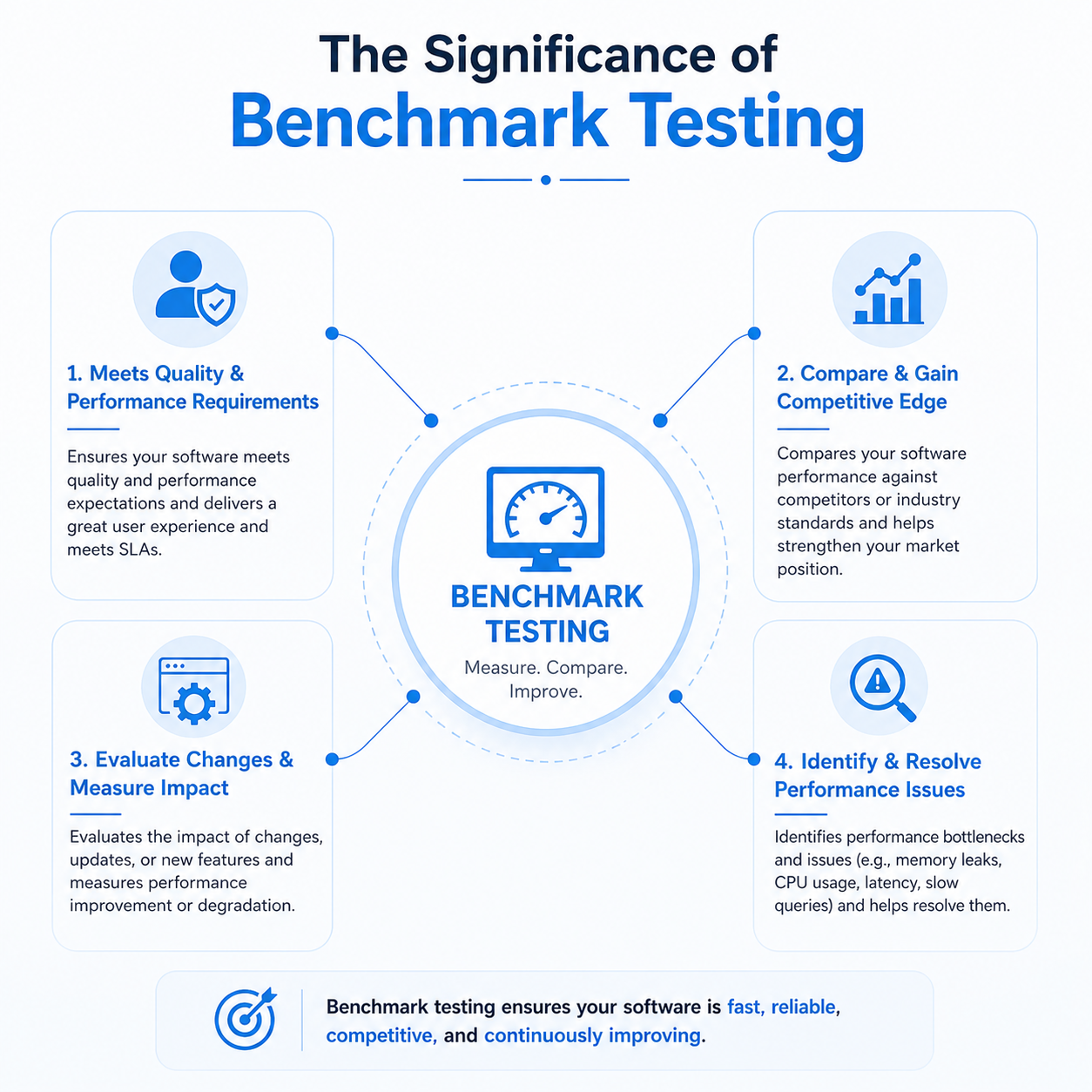
Most teams run performance tests. Performance testing tells you how the system behaved under a specific load at a specific moment. However, structured benchmarks establish repeatable baselines across application layers, infrastructure tiers, and business KPIs, so every future release has a verifiable reference point. The difference matters significantly at the decision layer.
The reactive testing trap:
- Measuring performance only post-deployment or after user complaints
- Entering cloud migrations or monolith-to-microservices refactors without reference metrics
- Making vendor or infra decisions without comparative, data-backed benchmarks
- Committing to SLAs without validated cost-performance tradeoffs
Each of these gaps is an information architecture failure. The fix is building benchmarking into the release lifecycle from day one.
How Calsoft Operationalizes Benchmarking for Launch Readiness
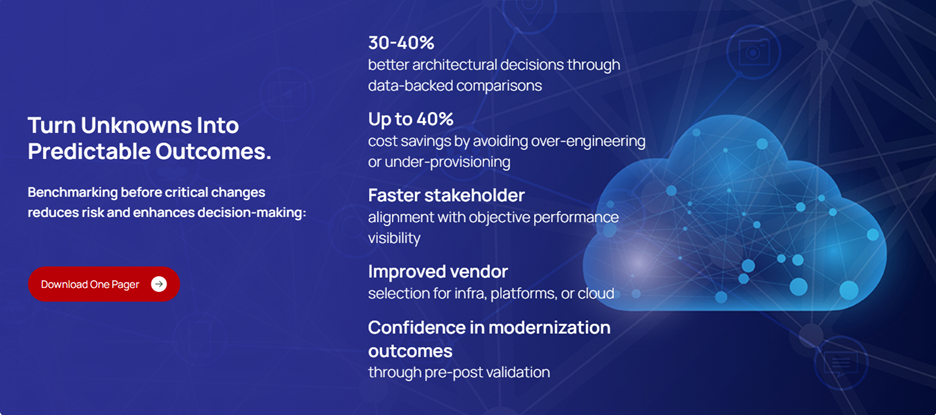
Calsoft’s Benchmarking for Readiness service helps enterprises validate performance, scalability, and infrastructure decisions before launch. As part of its broader Testing as a Service offering, Calsoft takes a business-aligned approach that connects benchmark design with real KPIs, user flows, infrastructure readiness, and stakeholder decisions. The engagement covers KPI mapping, simulation design, benchmark execution, observability, and executive-ready recommendations. This helps teams reduce launch risk, right-size infrastructure, align SLAs, and make data-backed decisions across cloud migration, modernization, DevOps, and OEM/hardware evaluation.
What '100% Launch Readiness' Means in Practice
Launch readiness is a multi-dimensional confidence signal. It is a set of answered questions, each one backed by measured data.
Do you have performance baselines per endpoint? An average response time of 300ms can hide the fact that 5% of your users are waiting 2 seconds. Benchmark testing defines acceptance gates using percentile metrics, p95 and p99 per critical endpoint, validated under peak synthetic load.
Do you know where the system breaks? Scalability benchmarking identifies where throughput drops or where errors spike, and whether the system degrades gracefully or collapses suddenly under pressure.
Are app, database, network, and edge benchmarked together? A fast API sitting on a slow database is still a slow system. Benchmarks run in isolation miss the compound failures that only emerge when all layers are under load simultaneously.
Are your SLAs grounded in measured data? Contractual commitments mapped against measured reality. SLA validation means mapping what you promised against what the system delivered under test conditions.
Did the latest release introduce a regression? Pre/post benchmarking compares the current build against the last known baseline, proving no performance regression introduced by the release.
When these five dimensions are green, you have a secure launch position. When even one is unclear, you have unquantified risk into production.
TaaS + Benchmarking: The Engineering Architecture
A well-structured TaaS model handles the execution layer: elastic test infrastructure, automated regression suites, continuous integration hooks, and reporting pipelines. Benchmarking provides the decision layer: the reference data against which every execution result is evaluated.
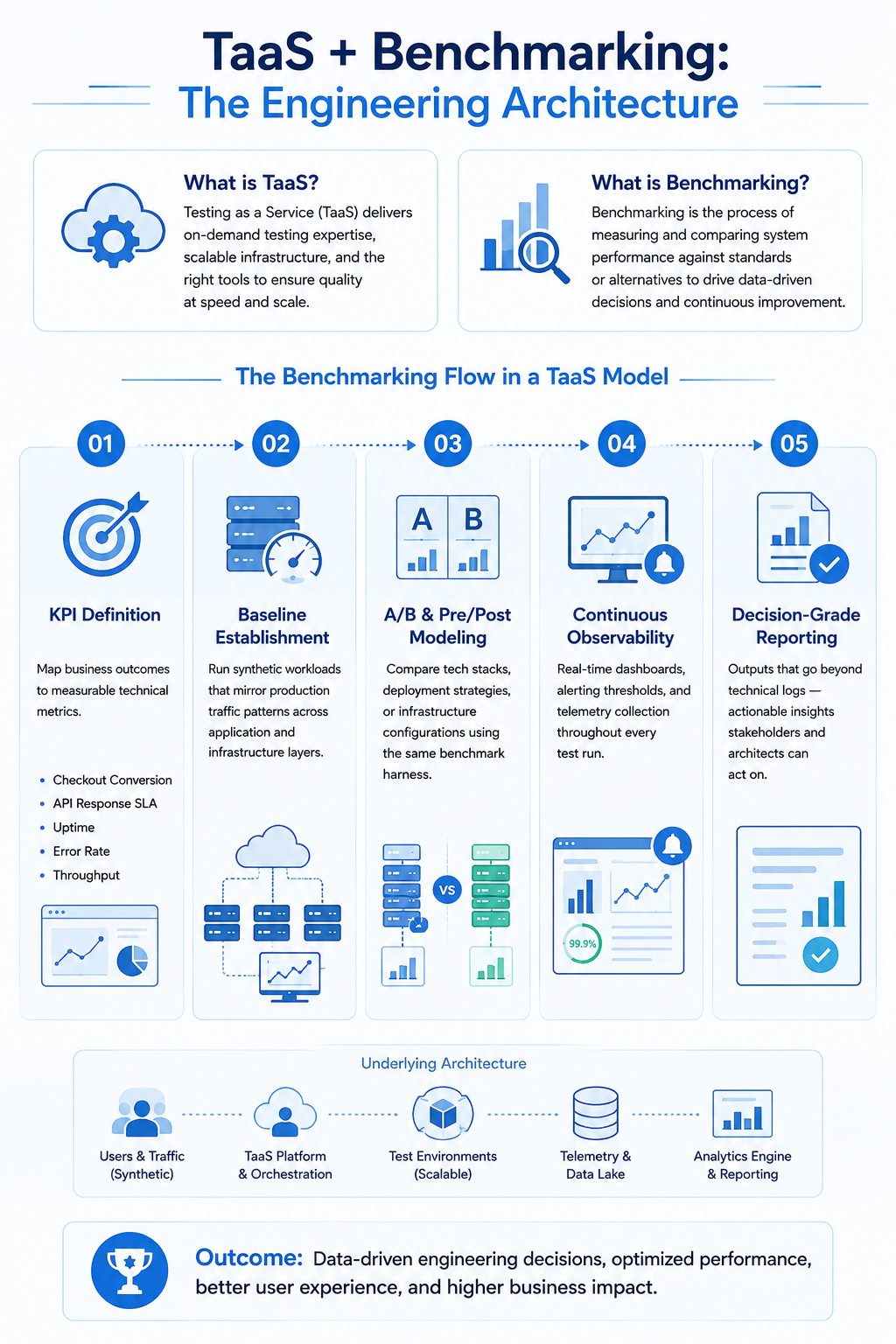
The combined architecture looks like :
- KPI Definition: Map business outcomes (checkout conversion, API response SLA, uptime) to measurable technical metrics
- Baseline Establishment: Run synthetic workloads that mirror production traffic patterns across app and infra layers
- A/B & Pre/Post Modeling: Compare tech stacks, deployment strategies, or infra configurations using the same benchmark harness
- Continuous Observability: Real-time dashboards, alerting thresholds, and telemetry collection throughout every test run
- Decision-Grade Reporting: Outputs that go beyond technical logs, actionable insights stakeholders and architects can act on.
This architecture becomes the foundation of data-driven architecture governance.
The new QA mindset: Prove readiness before release
For QA leads, launch reviews become stronger when they are backed by benchmark evidence. For CTOs, benchmark evidence makes release approval more objective by showing what risks remain and whether the system is truly ready to launch. Organizations should treat benchmarking as a continuous launch readiness practice, and not a last-stage checkpoint. That is how teams reduce uncertainty before release and avoid high-pressure fixes after launch.
Launch readiness is a measurement practice. Start building it before your next release cycle begins.

FAQs
Q1: What is the difference between performance testing and benchmark testing? Performance testing measures how a system behaves under load. Benchmark testing goes a step further; it validates that behaviour against a predefined standard or baseline.
Q2: What metrics should a benchmark test cover for launch readiness? At minimum: p95 and p99 latency per critical endpoint, throughput under peak concurrent load, error rate thresholds, and resource utilisation across app, database, and network layers.
Q3: How does Testing as a Service (TaaS) support continuous benchmarking? TaaS provides the on-demand infrastructure to run benchmark tests at every stage of the release cycle, and not just before go-live. This means every build is validated against the same baseline, making performance regressions visible before they reach production.
Q4: Is 100% benchmark test coverage worth the investment? Rarely. Benchmarking every endpoint in a complex system produces diminishing returns fast. Focus on the 10–15% of paths that carry 80%+ of production traffic or revenue impact.