
Data is essential for success. Businesses cannot afford to lose or compromise data in any situation. As one of the most crucial assets for success, data has been the focus of several research studies aimed at understanding its many facets. According to Statista, by 2025 global data creation is projected to exceed 180 zettabytes. Considering these numbers, it’s clear that data is growing exponentially. Today, enterprises rely on data for numerous reasons — from making informed decisions to ensuring customer satisfaction — data plays a vital role in driving business success.
But what are the most suitable storage solutions for enterprises to store all this data?
This question can have several answers, as there are many storage options such as SSDs, HDDs, and cloud storage. However, the right choice depends on business needs. Each storage type offers distinct advantages and trade-offs in security, scalability, accessibility, and cost. Choosing the right solution is critical to effectively manage and leverage the growing volume of data for business innovation and insights. This blog provides detailed information on the evolution of storage solutions, their characteristics, and the factors to consider before selecting one.
A Brief Introduction to Data Storage Options
Understanding data storage requires careful consideration, especially when comparing Solid-State Drives (SSDs) and Cloud Storage. Both offer exceptional speed, scalability, and flexibility. SSDs have transformed data center performance by replacing traditional HDDs. Unlike HDDs, which use magnetic storage and moving parts, SSDs rely on flash memory — offering enhanced speed, reliability, and durability. Cloud storage has revolutionized data management by providing secure, remote access and scalability, eliminating the need for costly hardware upgrades.
Storage Solutions: HDD and SSD
NAND flash memory, found in SSDs, revolutionized storage in the early 2000s. Initially used for specialized purposes like military and industrial applications, it’s now the go-to option for high-performance storage across laptops, desktops, and data centers. Advances in NAND technology have drastically improved SSD performance, reliability, and cost-effectiveness — making them indispensable in modern computing.
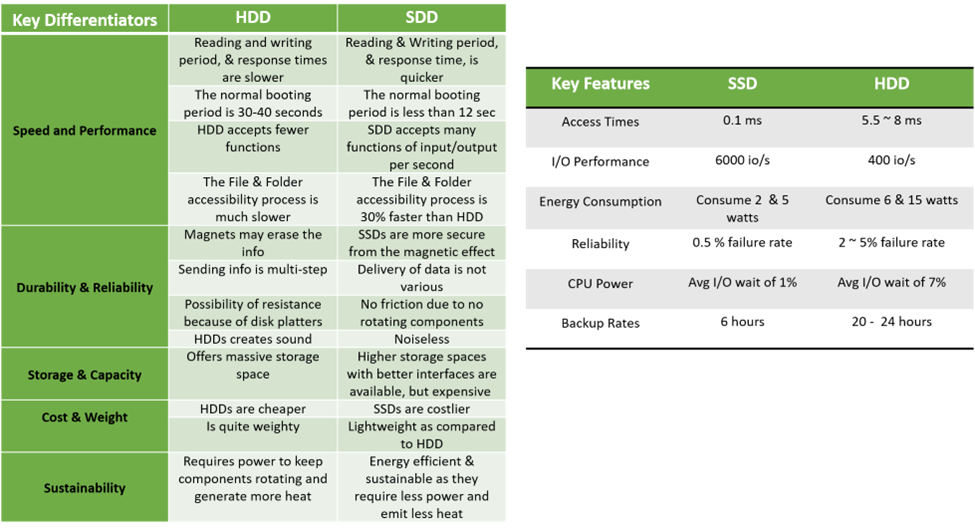
The continuous evolution of SSD technology has driven better capacity, speed, and energy efficiency, solidifying its position as a cornerstone of data storage infrastructure. Below is a visual comparison of key differences between SSDs and HDDs.
Factors to Consider When Opting for SSD
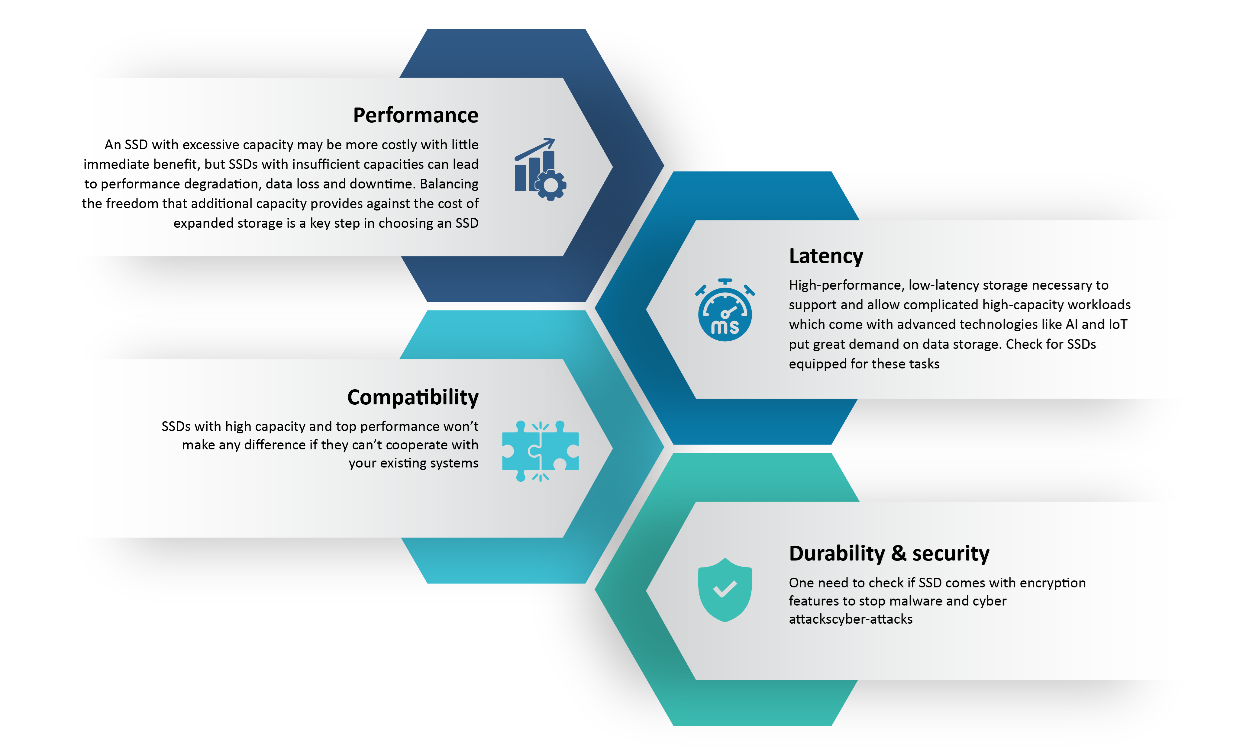
Data centers increasingly utilize SSDs to boost performance and reliability. However, selecting the right SSD involves understanding several critical factors — as shown below.
The shift from HDDs to SSDs has been transformative, offering faster, more reliable, and energy-efficient storage. However, other solutions like Tape Storage, Hybrid Arrays, Storage Area Networks (SAN), Network-Attached Storage (NAS), and Data Lakes still hold relevance based on business needs. Modern data centers often combine these technologies for optimal performance.
Cloud storage and AI-based SSD systems are shaping the future of enterprise storage. Enterprises must now explore how AI can optimize data center operations.
To unify these diverse storage solutions, a software layer independent of hardware has emerged — offering greater flexibility in how data is stored and retrieved. This brings us to Software-Defined Storage (SDS).
Software-Defined Storage (SDS)
Software-defined storage (SDS) is a type of storage virtualization that separates storage software from hardware, improving simplicity and flexibility in managing data. According to Transparency Market Research, the global SDS market is projected to reach US$53.6 billion by 2027, growing at a CAGR of 25%.
SDS works by:
- Abstracting storage software from hardware.
- Enabling flexible and efficient data storage through a software layer.
- Reducing costs by using commodity servers and separating software purchases from hardware investments.
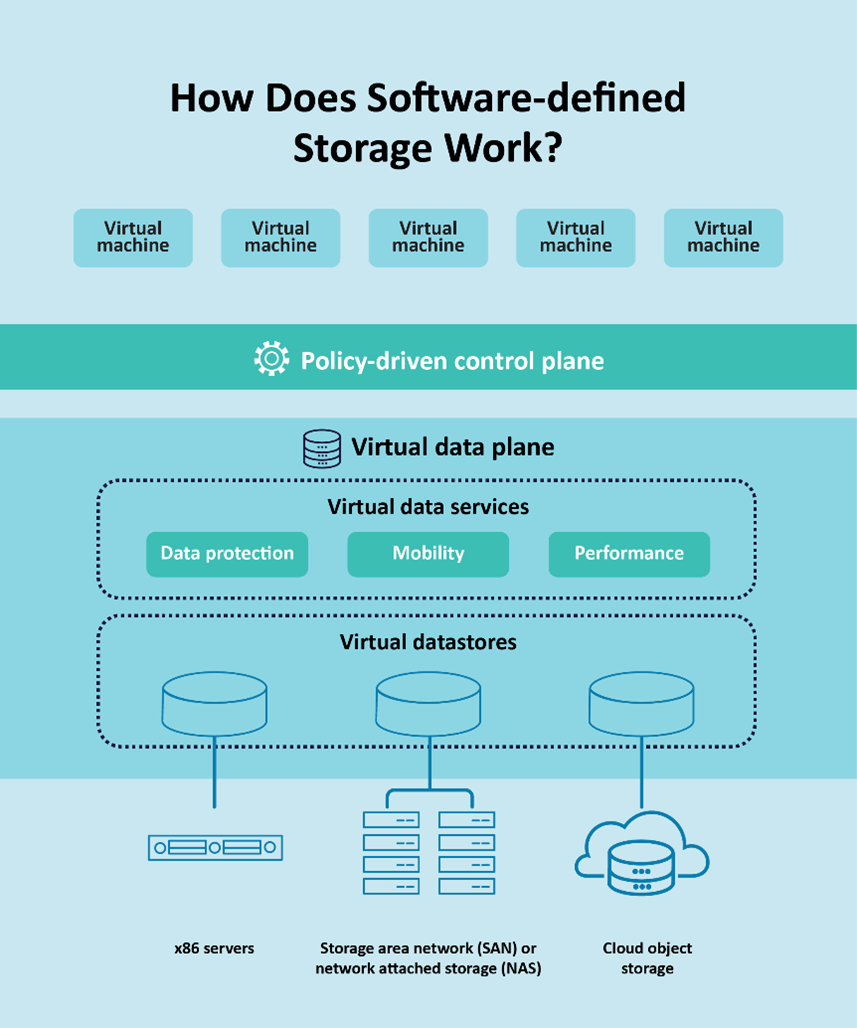
SDS creates a virtual storage pool by decoupling storage management (control plane) from the physical infrastructure (data plane). It balances resources through a hypervisor layer and supports features such as replication, deduplication, provisioning, and snapshots — ensuring better flexibility and cost savings.
Benefits of SDS
- Capacity & Performance: Easily scalable without downtime.
- Geo Flexibility: Distribute and manage storage across multiple locations seamlessly.
- Scalability: Add capacity dynamically by leveraging off-the-shelf hardware or cloud resources.
- Vendor Flexibility: Avoid vendor lock-in.
- Interoperability: Enable integration across heterogeneous storage environments.
- Compatibility: Open-source foundations and APIs ensure cross-platform integration.
- Optimized Resource Utilization: Maximize efficiency while minimizing costs.
- Reduced Operational Costs: Replace legacy infrastructure with streamlined management.
- Simplified Operations: Unified control for all storage systems under one platform.
- Disaster Recovery: Streamlined backup, replication, and recovery processes.
- Enhanced Security: Features such as encryption, access control, and real-time monitoring protect against breaches.
Organizations can now manage data across multiple storage environments using SDS, adapting quickly to changing needs while ensuring seamless integration across their IT ecosystem. While challenges such as hardware compatibility and migration exist, the advantages far outweigh them, especially in hybrid and private cloud setups.
The Power of the Trio: AI, Cloud Storage, and SDS
The convergence of Artificial Intelligence (AI), Cloud Storage, and Software-Defined Storage is redefining enterprise storage. Many organizations now invest in AI-powered hardware, where SSDs are the preferred choice.
With flash storage, SSDs offer lower latency and up to 35x faster read/write speeds compared to HDDs — a critical factor when AI models must process massive datasets in real time. Gartner projects that over 80% of enterprises will adopt or deploy generative AI by 2026. With global data volumes expected to reach 175 zettabytes by 2025, optimizing storage has never been more urgent.
While cloud storage remains a top choice for scalability, portable SSDs still offer advantages in speed and localized access. The combination of SSDs and SDS allows real-time scalability, monitoring, and protection against cyber threats in modern cloud environments.
| Portable SSDs | Cloud Storage |
|---|---|
| Local storage using non-volatile solid-state chips. | Storage managed remotely by cloud providers. |
| Faster read/write speeds with flash memory. | Users do not own or maintain storage; access speed depends on connectivity. |
How Calsoft Can Help
Flexibility, resilience, and high-performance storage are essential for enterprise success. As data becomes a business differentiator, technologies such as storage virtualization, cloud, and SSDs are becoming indispensable. Calsoft specializes in helping enterprises choose and implement the right storage solutions tailored to their needs.
Our expertise spans software-defined storage, Storage-as-a-Service, hybrid multi-cloud, hyper-converged infrastructure, SSD & flash arrays, and cyber-resilient storage. With 25+ years of experience, Calsoft delivers engineering services, accelerators, and consulting to help customers stay ahead of evolving storage challenges.
Parting Thoughts
The storage solutions landscape has evolved rapidly, driven by innovations like SSDs, cloud storage, and software-defined storage (SDS). These technologies bring unparalleled flexibility, scalability, and cost efficiency. As data volumes surge and AI-driven workloads expand, the synergy between AI, cloud, and SDS opens new possibilities for intelligent data management.
Partnering with an experienced provider like Calsoft ensures seamless integration, modernization, and future-ready storage architectures tailored to your business.