
The last decade has witnessed remarkable technological advancements, and one of the most transformative among them is Big Data. Big Data enables organizations to improve operations, personalize marketing campaigns, and deliver enhanced customer service. It drives efficiency and contributes to significant revenue growth. With more than 44 zettabytes of data currently existing in the digital universe, as reported by PwC, the volume continues to increase exponentially each year. This growing expanse requires a flexible and scalable infrastructure to manage and utilize data effectively.
Big Data offers tremendous opportunities for businesses, providing real-time analytics, reporting, and efficient data storage and processing. However, it also presents several challenges — primarily concerning security, data transfer rates, data volume, and processing. Understanding these challenges is key to harnessing Big Data successfully. Let’s take a closer look at these storage challenges.
Understanding the Challenges in Big Data
Big Data presents a unique set of challenges — from data management to storage and analysis. Overcoming these requires innovative solutions, best practices, and awareness of current trends and technologies. The characteristics of Big Data, often referred to as the five Vs of Big Data, highlight its complexity and the opportunities it provides.
Enterprises must ensure proper data storage before processing. The ideal solution often lies in scalable, unstructured repositories like data lakes. Modern Big Data storage solutions — including distributed file systems, NoSQL databases, and cloud platforms — are designed to handle the scale, speed, and variety of enterprise data. However, ensuring data security and scalability remains crucial to maintain performance and prevent breaches. The following figure illustrates the key challenges of Big Data storage and management.
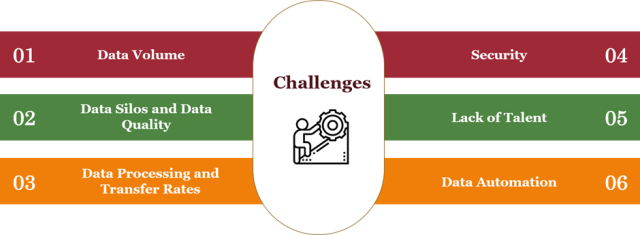
Data Volume
The volume of data generated globally has exploded over the past few years and continues to grow rapidly. Traditional storage systems often struggle to manage this data deluge, leading to inefficiencies like storage sprawl and redundant infrastructure. Managing and sorting massive datasets can significantly impact productivity and operational costs.
Furthermore, most enterprise data is unstructured, making it more difficult to organize and analyze. To handle such vast and dynamic datasets, businesses are increasingly adopting object-based storage systems, which support massive scalability and simplify content management through metadata tagging. These systems also leverage dense, cost-effective disk drives to optimize space and reduce expenses.
Data Silos and Data Quality
Data silos arise when data is scattered across multiple, disconnected sources — making consolidation and analysis difficult. This fragmentation creates redundancy, increases hardware costs, and reduces efficiency. Moreover, inconsistent or duplicate data across silos can degrade data quality, compromising decision-making accuracy. Establishing centralized data management and governance practices is essential to ensure the integrity and reliability of insights derived from Big Data.
Data Processing and Transfer Rates
With the explosion of data, cloud providers are constantly seeking solutions to manage storage and processing at scale. Traditional storage technologies like Hard Disk Drives (HDDs) are proving inadequate for modern business needs that require real-time data access and analytics. Many enterprises are turning to flash storage, which offers superior speed and performance. Although flash storage was once more expensive, its cost is rapidly declining and is expected to reach parity with HDDs soon.
In the digital economy, the speed of data transfer directly impacts business outcomes. Slower transfer rates hinder real-time analytics and delay decision-making. To address this, many organizations are deploying private High-Performance Computing (HPC) environments instead of relying solely on public clouds. These solutions deliver the performance, availability, and reliability needed for high-speed data movement and analytics.
Security
With the rise of digital transformation, data security has become a top concern for organizations. Cyberattacks, data breaches, and ransomware incidents are increasing globally. Protecting sensitive and high-value data requires stringent security practices and technologies.
While Big Data environments offer built-in layers of security, risks remain. Enterprises should implement attribute-based encryption, data masking, and access control mechanisms to mitigate exposure. Many businesses are also shifting from public cloud environments to private or hybrid cloud architectures for greater control over data privacy and compliance.
Harnessing Talent for Big Data Success
Maximizing the potential of Big Data requires specialized skills and expertise. Professionals with experience in Machine Learning (ML), Artificial Intelligence (AI), and advanced data engineering are essential to manage and extract insights from large datasets. Enterprises are increasingly investing in upskilling programs and hiring data specialists to ensure they can fully capitalize on Big Data opportunities in a competitive market.
Data Automation
Data automation streamlines data-related operations, enhancing accuracy and accelerating decision-making. However, implementing automation at scale remains a challenge due to the immense volume of Big Data and limitations in scalable infrastructure. Organizations are addressing this by adopting compression, deduplication, and data segregation techniques to improve storage efficiency while maintaining security through encryption and access controls.
In Conclusion
Data storage is at the heart of every modern business operation, powering analytics, automation, and customer experience. Big Data continues to evolve as an essential component of enterprise strategy, offering scalability and adaptability for both structured and unstructured data. Despite challenges in volume, security, and processing, the benefits of Big Data far outweigh the hurdles when managed effectively.
As technology advances, organizations must adopt storage solutions that provide greater capacity, scalability, and flexibility — all while ensuring data integrity. The ideal approach involves custom-tailored storage architectures supported by skilled professionals who can adapt solutions to the unique needs of each enterprise.
Calsoft, a technology-first leader in digital and product engineering, provides comprehensive software-defined storage solutions to help enterprises meet their growing data demands securely and efficiently.