

The rate at which data is growing is mind-boggling. By 2025, it is estimated that the global datasphere will increase to 175 zettabytes (Sigma). Another report by Sigma states that around 2 quintillion bytes of data are generated every day across industries.
But what happens when there is no space to store and manage this data? Systems may slow down or crash, affecting overall business operations.
So, what can businesses do? The most effective method to ensure peak performance and reliability of storage systems is to leverage storage testing services. Whether operating on-premises or in the cloud, robust storage testing ensures your systems can store, retrieve, and manage data efficiently without risk of overflow or data loss.
In this data-driven world, storage testing has become a key strategy for identifying bottlenecks, ensuring data integrity, and maintaining high availability. This blog provides a detailed, step-by-step guide to storage testing — covering fundamentals, types, processes, trends, and more.
Decoding the Concept of Storage Testing
Modern applications and digital services depend heavily on data. Ensuring high-quality data storage is critical for performance. Storage testing acts as an extended version of Quality Assurance (QA) to guarantee that Storage Area Networks (SAN), Software-Defined Storage (SDS), Cloud Storage, and other storage technologies are functioning optimally.
Technically, storage testing manages storage components like disk allocation, data distribution, and memory utilization. It verifies that data is stored and retrieved from the correct directories, prevents overflow, and ensures there’s sufficient memory for smooth operations.
Storage testing evaluates systems such as SSDs, SANs, NAS, hard drives, and cloud platforms to ensure they meet business performance, reliability, and scalability needs. It assesses throughput, latency, data integrity, and system resilience under various workloads while ensuring compatibility and security.
Comprehensive storage testing bridges the gap between infrastructure and operational needs — minimizing risks of data loss, system failure, and performance degradation.
The Objective of Storage Testing
The primary goal of storage testing is to ensure that storage systems remain stable, efficient, and secure under diverse conditions and workloads.
Key objectives include:
- Understanding storage limits before deployment
- Observing how systems respond to hardware or software updates
- Reducing response time and improving processing speed
- Ensuring reliable performance under varying loads
Types of Storage Testing
Storage systems form the backbone of enterprise data management. Performing regular testing ensures that data is stored securely, retrieved quickly, and protected from corruption or loss. Below are the major types of storage testing:
Performance Testing: Evaluates read/write speeds, IOPS (Input/Output Operations per Second), and latency to ensure systems handle heavy workloads efficiently.
Reliability Testing: Measures stability and fault tolerance by assessing data integrity and system recovery from hardware or software failures.
Scalability Testing: Determines how well storage systems accommodate growing data volumes without compromising performance.
Data Integrity Testing: Verifies that stored data remains accurate and unchanged, even after read/write operations. It detects corruption and validates error correction mechanisms.
Compatibility Testing: Ensures seamless integration of storage systems across diverse hardware, operating systems, and applications.
Understanding the Storage Testing Process
A storage testing setup typically involves three key components:
- Storage: The actual hardware or virtual system being tested — such as disks, arrays, or cloud storage.
- Application: The software that interacts with storage to simulate real-world workloads.
- Load Generator: The tool that creates traffic and workloads to evaluate storage performance under varying demand levels.
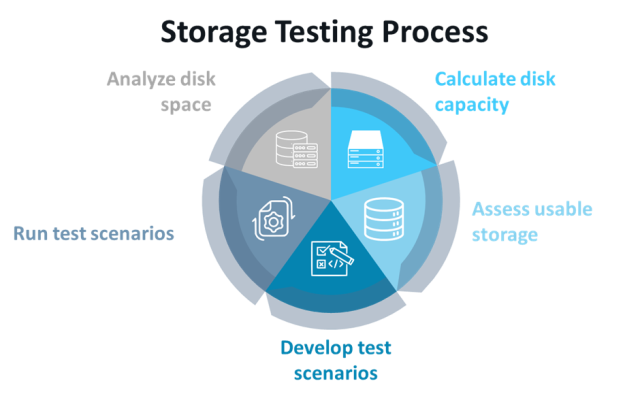
Storage Testing Process
1. Calculate Disk Capacity: Determine total and partitioned storage space to understand how much capacity is available for testing and allocation planning.
2. Assess Usable Storage: Evaluate occupied and free space to identify usable capacity, ensuring there’s sufficient room for test data and performance trials.
3. Develop Test Scenarios: Design test cases that simulate real-world storage interactions — such as concurrent reads/writes, high I/O loads, or data migration tasks.
4. Run Test Scenarios: Execute tests to validate performance, reliability, and functionality. Measure metrics like response time, throughput, and error handling under different workloads.
5. Analyze Disk Space: Compare expected vs. actual disk usage post-testing to detect inefficiencies and optimize future resource management.
Top Challenges in Storage Testing and How to Mitigate Them
Storage testing, while essential, comes with several challenges. Below are some common pitfalls and ways to address them.
Common Challenges and Solutions
| Challenge | Description | Solution |
|---|---|---|
| Data Corruption | Unintended changes to data during read/write operations. | Use checksums, parity checks, and error-correcting codes (ECC) to ensure integrity. |
| Performance Bottlenecks | Slowdowns under heavy loads or specific conditions. | Utilize performance monitoring tools and optimize configurations. |
| Scalability Issues | Decreased performance as data volume increases. | Adopt scalable architectures and perform load testing. |
| Environmental Variability | Inconsistent testing environments leading to unreliable results. | Standardize environments and use virtualization for consistency. |
| Test Coverage Gaps | Incomplete testing across all storage aspects. | Design comprehensive test plans covering failover and load balancing scenarios. |
| Security Vulnerabilities | Exposure to unauthorized access or data breaches. | Conduct security audits and use encryption and access controls. |
| Inadequate Backup & Recovery Testing | Unverified disaster recovery procedures can cause data loss. | Regularly test backup and recovery operations under simulated failures. |
| Interoperability Issues | Incompatibility with other systems or software. | Use standardized protocols and perform interoperability tests. |
The Outlook
The future of storage testing will be driven by advancements in cloud computing, artificial intelligence, and machine learning. As data volumes explode, testing methods must evolve to handle hybrid and multi-cloud environments. Automated testing tools will be essential for performance optimization, and AI-powered analytics will predict failures before they occur. Security testing will play a crucial role in safeguarding sensitive information as privacy concerns grow.
The End Note
Choosing the right storage testing approach is vital for maintaining reliable and scalable systems. With proper methodologies, organizations can ensure efficiency, mitigate risks, and improve long-term performance. Investing in robust storage testing not only strengthens current operations but also prepares businesses for future challenges in the data-driven era.
At Calsoft, we believe in delivering high-quality products and services that meet market demands. Our managed testing services accelerate digital transformation with just-in-time quality checks, ensuring excellence across every phase of product development.