

Modern enterprise applications run across cloud platforms, containers, microservices, and always-on release cycles. While these technologies enable innovation, they also introduce operational complexity. These include issues such as dependencies that are harder to trace and decreased reliability when teams focus only on delivery. To manage this complexity, organizations are increasingly adopting Site Reliability Engineering (SRE) practices. This is why SRE consulting services are becoming a priority for enterprise cloud teams.
A strong Site Reliability Engineering model helps teams define reliability targets, improve observability and monitoring, automate routine operations, and reduce the cost of production incidents. For enterprises scaling digital products, SRE is an operating model that keeps innovation stable.
Site Reliability Engineering (SRE) is a discipline that applies software engineering practices to IT operations to improve the availability, scalability, and performance of software systems.
Why enterprise cloud teams need an SRE implementation framework
Many organizations already use DevOps practices, cloud infrastructure, and CI/CD pipelines. The gap appears when services become distributed, and production ownership becomes fragmented. Teams may release frequently but still struggle with inconsistent alerts, noisy dashboards, manual incident handling, and unclear reliability thresholds.
An SRE implementation framework brings structure to that complexity. It gives engineering leaders a way to align uptime goals, user experience, deployment velocity, and operational cost. That is the practical value of DevOps and SRE working together.
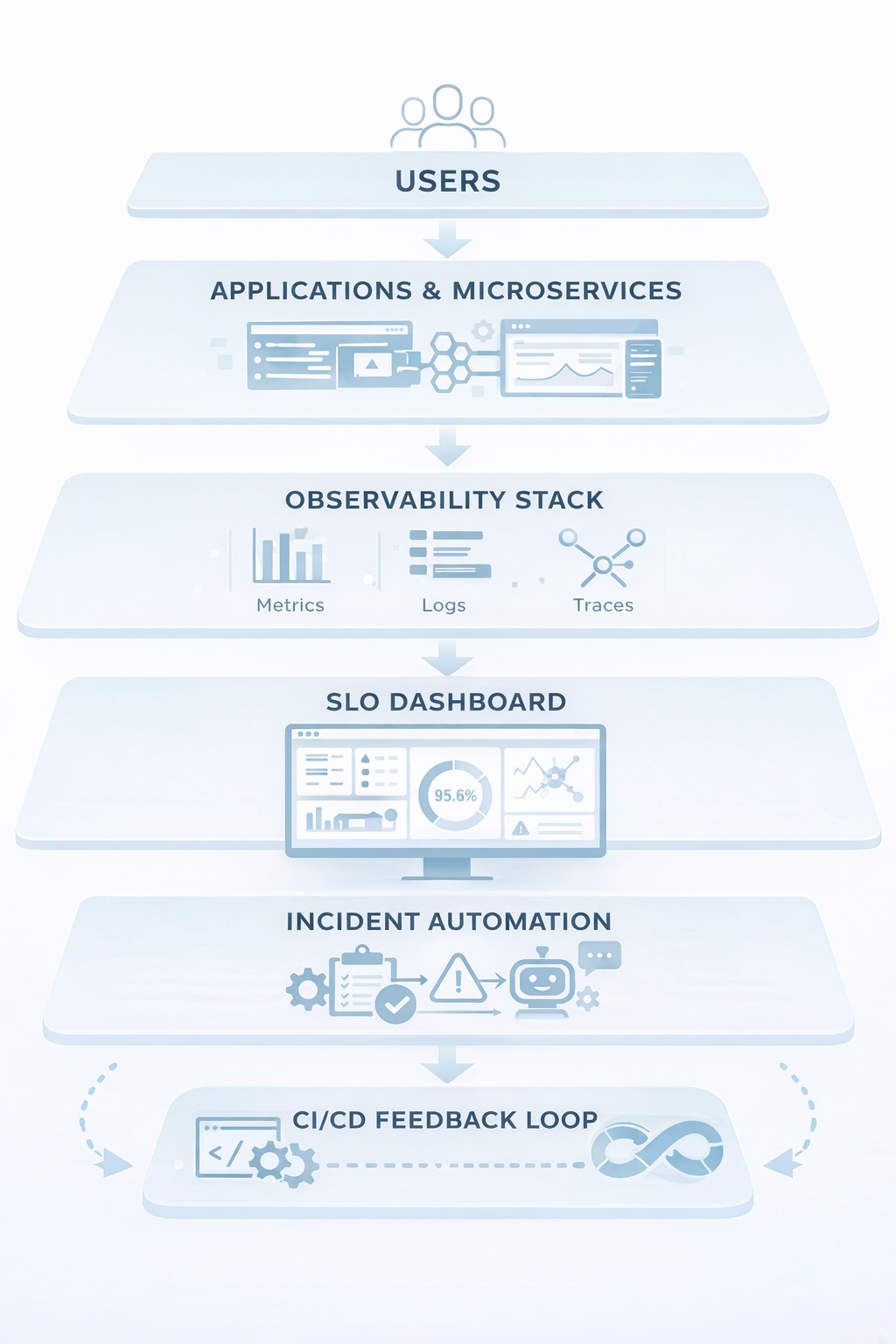
Image: An enterprise SRE model connects service health, observability, automation, and release decisions in a single continuous loop
Core elements of the framework
-
Define service-level baselines — Start with SLIs and SLOs for latency, availability, throughput, and error rates. These metrics should reflect what users actually experience, not just what infrastructure reports.
-
Use error budgets to balance change and stability — Error budgets create a practical decision model that guides when teams can move faster and when they need to refocus on hardening and remediation.
-
Build observability from the application outward — Modern observability and monitoring should connect logs, metrics, traces, dependency mapping, and user-impact signals.
-
Automate operational work — SRE reduces operational overhead through runbooks, self-healing workflows, IaC, rollback logic, and incident response automation.
-
Strengthening incident management — Enterprise teams need clear escalation paths, severity models, post-incident reviews, and remediation tracking.
-
Feed reliability into delivery pipelines — Reliability should influence release gates inside CI/CD pipelines through performance validation, service health checks, and rollback readiness.
Latest trends shaping SRE in 2026
Currently, three shifts are shaping SRE:
-
AIOps help teams reduce alert noise and detect anomalies earlier.
-
Platform engineering is making reliability standards reusable across teams.
-
Cost efficiency is becoming part of the reliability strategy, especially in multi-cloud and Kubernetes-heavy environments.
In practice, leading teams now measure reliability, performance, and cloud efficiency together. This means SRE consulting services are increasingly expected to support not just uptime, but also release quality, developer productivity, and infrastructure efficiency. That broader view matters for enterprise leaders who need operational maturity to translate into measurable business value.
How Calsoft supports SRE services
Calsoft supports enterprise teams with a practical approach to DevOps and SRE. Calsoft’s DevOps & Site Reliability Engineering services automate delivery, accelerate releases, and ensure 99.99 % uptime— across cloud, hybrid, and edge deployments. For enterprises modernizing digital platforms, Calsoft brings the engineering depth required to make SRE executable. We deliver production-grade DevOps & SRE services that fit your team, stack, and scale ambition.
Explore Calsoft’s whitepaper, “Site Reliability Engineering (SRE): Top CXO Considerations,” to learn strategies and frameworks that help enterprise leaders implement SRE for scalable, resilient cloud environments.
Conclusion
For enterprise cloud teams, reliability cannot be a side activity. A clear SRE implementation framework helps turn reliability into an operating discipline built around measurable targets, observability, automation, and better release decisions. When applied well, SRE consulting services help organizations scale cloud platforms with fewer surprises and stronger production confidence.
FAQs
-
What are SRE consulting services?
SRE consulting services help organizations improve production reliability through SLO design, observability, automation, incident management, and release governance.
-
Why do enterprise cloud teams need Site Reliability Engineering?
Enterprise cloud teams need Site Reliability Engineering to manage distributed systems, reduce downtime, improve incident response, and keep release speed aligned with reliability goals.
-
How is SRE different from DevOps?
DevOps focuses on delivery speed and collaboration, while SRE applies engineering discipline to production reliability. Together, DevOps and SRE help teams ship faster with better operational stability.
-
What should an SRE implementation framework include?
An SRE implementation framework should include SLIs, SLOs, error budgets, observability and monitoring, automation, incident response practices, and reliability checks inside delivery pipelines.
-
How does Calsoft support SRE adoption?
Calsoft supports SRE adoption through reliability assessments, SLO frameworks, observability improvements, CI/CD optimization, automation, and operating model guidance for enterprise engineering teams.