

We live in the digital age where innovations and transformations in technology have fundamentally influenced the way we operate at both local and global levels.
Our previous blog, Sustainability as a Strategic Imperative in Product Engineering, discussed why organizations need to embrace sustainability in their product engineering cycle and the benefits it brings.
This blog explores how green coding within the IT sector can help minimize carbon footprints to create a more sustainable future.
Did you know?

Want to learn how to reduce digital footprints? Read on to explore the emerging field of green software engineering and sustainable software development, and how they can positively impact society and the environment.
History of Green Software Engineering
Software plays a central role in our daily lives, but its environmental impact often goes unnoticed. While hardware energy efficiency has been studied extensively, the greenness of software is still underexplored. The data over the past decade clearly shows the need for more sustainable practices.
The 2019 pandemic accelerated digital interactions, leading to the establishment of the Green Software Foundation in 2021 — a non-profit organization aiming to create a network of people, standards, tools, and best practices for green software.
The foundation developed six core principles for sustainable software development, as shown below.
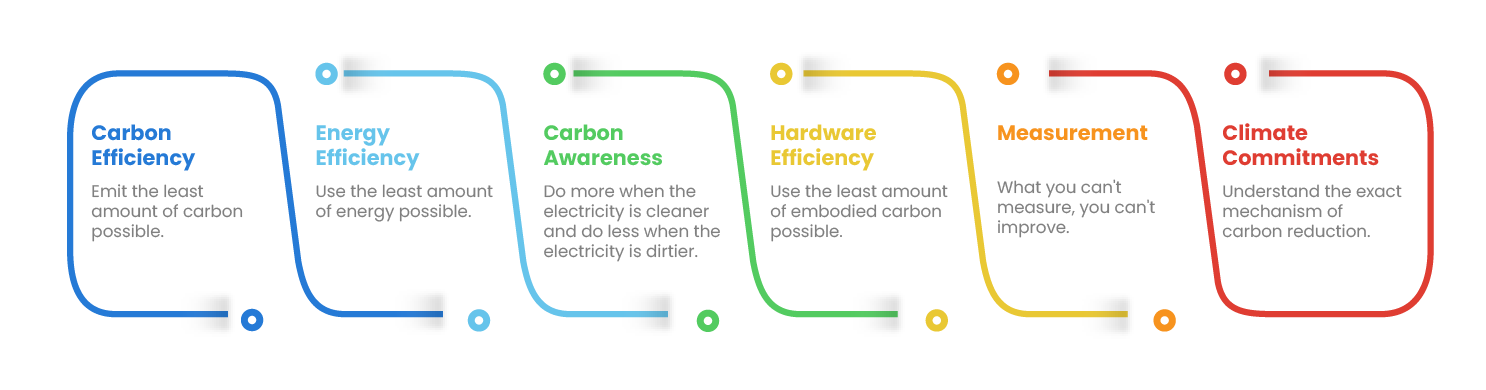
Green computing focuses on the efficient use of resources to promote sustainability. Software, being integral to nearly all operations, directly impacts environmental sustainability depending on how it is developed and used.
Green IT is defined as “the study and practice of designing, developing, using, and disposing of computing systems efficiently and responsibly without harming the environment.”
In their paper Green Measurements for Software Product Based on Sustainability Dimensions, Komeil Raisian et al. identified three sustainability dimensions — economic, social, and environmental — each measured through key factors like productivity, cost reduction, usability, energy efficiency, and resource efficiency. Their study concluded that defining a measurement framework is essential for assessing the greenness of software products.
Understanding where energy is consumed during the software development cycle helps promote green coding practices. The three main energy-consuming areas are:
- Infrastructure: Hardware and networks that consume energy during operation.
- Processing: Larger or more complex software requires more energy to run.
- DevOps: The development and build process consumes energy, especially if non-renewable sources are used.
Green Coding
Green coding refers to writing software in a way that minimizes energy consumption. It involves optimizing algorithms, reducing complexity, and using fewer resources. Efficient code not only consumes less power but also runs faster and is easier to maintain.
Beginners often write long or inefficient code, which is part of the learning process. As developers mature, refactoring becomes critical for improving readability, performance, and energy efficiency. Tools that measure energy usage can help developers build more sustainable applications, though external factors like network congestion or user device settings can also impact energy use.
Sustainability through Green Coding
Green coding is inspired by green computing, which emphasizes responsible design, manufacturing, and disposal of computing systems. It also includes practices like virtualization, containerization, and cloud adoption to minimize hardware usage and energy consumption.
Ways to achieve sustainability through green coding:
- Automatically shut down under-utilized servers.
- Redistribute workloads to conserve energy.
- Optimize code performance.
- Avoid redundant processes such as recompilation.
- Reduce file sizes.
- Lower network bandwidth usage.
- Use efficient algorithms.
- Adopt compilers optimized for virtualization.
- Write platform-efficient code blocks.
- Design applications with optimized microservices.
- Automate repetitive tasks.
Behavioral best practices:
- Encourage collaboration and flexibility among teams.
- Leverage automation for efficiency.
- Choose energy-efficient programming languages (e.g., Java, C++, Rust).
- Reduce unnecessary logging.
- Introduce “energy-saving” modes in applications.
- Follow the GREENSOFT Model (see below).
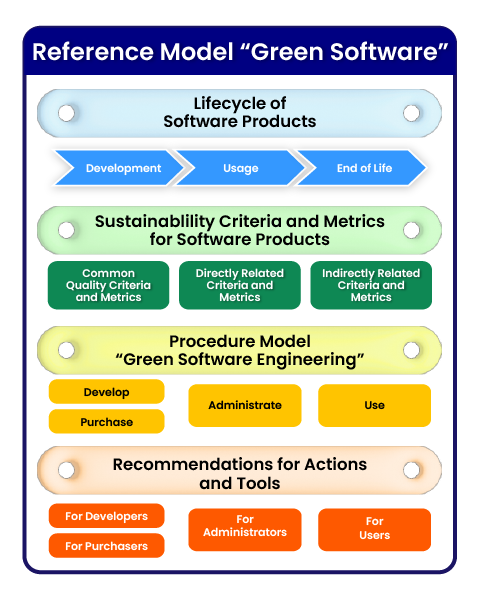
Benefits of Green Coding
Green coding offers benefits across multiple dimensions in the IT industry:
| Action Taken | What It Impacts | Results |
|---|---|---|
| Reduce energy consumption | Reduces energy costs | Ensures financial sustainability and cost efficiency amid volatile energy prices. |
| Work towards sustainable goals | Achieves net-zero emissions | Enhances CSR initiatives and supports Sustainable Development Goals (SDGs). |
| Enable sustainable digital transformation | Improves operating margins | Attracts environmentally conscious clients, partners, and investors. |
| Promote culture change among developers | Streamlines complex infrastructures | Boosts productivity, efficiency, and morale among employees. |
By adopting Green Coding practices, organizations can:
- Reduce processor load and memory usage for faster performance.
- Eliminate bloated code and encourage clean, efficient programming.
- Utilize sustainable, energy-efficient data centers.
- Adopt Green AI models that optimize energy usage.
- Switch to eco-friendly hosting and cloud providers.
- Implement sustainability metrics throughout the software lifecycle.
Conclusion
The software industry plays a pivotal role in achieving sustainability goals. Green software development enables organizations to meet their ESG targets and build a more balanced, eco-friendly future.
As a technology-first company and pioneer in software product engineering, Calsoft is committed to driving positive change and building sustainable IT products and services for a better tomorrow.
References
- How Green Is Your Software – Harvard Business Review
- Tech Industry Carbon Emission Progress
- Green Software Foundation
- Definition of Green IT – TechTarget
- Sustainable Software Development: Best Practices
- ACM Research on Energy-efficient Software
- ScienceDirect – Software Sustainability Study
- Energy Efficiency Across Programming Languages
- The GREENSOFT Model – Umwelt Campus
- How Much Energy Do Data Centers Consume?
- Green AI Research Paper (arXiv)