

Most organizations are fighting tomorrow's AI-powered attacks with yesterday's firewall mentality.
As someone who's spent years building resilient infrastructure across datacenters, IoT deployments, and software products, I've watched security evolve from an afterthought to an existential requirement. But here's what frustrates me; we're still treating security as something we layer on top of our systems rather than engineering it into the foundation.
Security only scales when it is embedded into how we build and operate systems. If you're not already implementing Zero Trust with AI-native defenses, you're not just behind, you're fundamentally unprepared for what's coming. And what's coming will make the SolarWinds and MOVEit attacks look like practice runs.
The $7.42 Million wake-up call nobody’s answering
Breaches remain costly and persistent. IBM’s 2025 report puts the global average breach at USD 4.44M, with the U.S. at USD 10.22M. Healthcare again tops industries at USD 7.42M. Security AI and automation shortened breach lifecycles by ~80 days and reduced average breach costs by ~34% in the study.[1] Microsoft reports detecting over 30B phishing emails in 2024 alone; Gmail blocks ~15B unwanted emails daily.[2][3] The volume and speed of attacks means manual, perimeter‑centric controls are not enough.
I still see organizations spending millions on perimeter defenses while leaving their SNVC infrastructure wide open to lateral movement. It is time to rethink the architecture practices. The game has fundamentally changed. Google's Big Sleep agent was credited with foiling in-the-wild exploitation tied to CVE-2025-6965 (SQLite) which became a first for an AI agent in defense. Meanwhile, most engineering teams are still bolting security onto existing architectures like it is 2015.
The Uncomfortable Truth is that traditional security architectures aren't just inadequate, they're architecturally incapable of defending against AI-accelerated attacks that adapt faster than human defenders can respond.
Zero Trust isn’t optional anymore
I have read a lot of vendor hype about Zero Trust. Here’s what it means from an infrastructure engineering perspective: assume breach, verify everything, trust nothing.
NIST NCCoE's SP 1800-35 documents 19 examples for end-to-end Zero Trust implementations you can model but let me save you the 300-page read! From my interactions with CIO’s and CTO’s and numerous infrastructure deployments, every successful Zero Trust implementation follows this engineering pattern.
- Week 1-2: Map your actual attack surface Inventory every SNVC component, every IoT endpoint, every API. In one datacenter project, we discovered 40% more assets than IT knew existed, including "temporary" test servers running for three years. Use automated discovery because manual audits always miss the shadow IT.
- Week 3-4: Re-engineer identity as the new perimeter In a recent virtualization environment redesign, switching from network-based to identity-based access control reduced unauthorized access attempts by 94% in our deployment. Start with privileged accounts, implement phishing-resistant MFA (FIDO2, not SMS), then expand systematically.
- Week 5-8: Implement micro segmentation at the infrastructure layer In virtualized environments, proper micro segmentation contains breaches that would otherwise compromise entire infrastructures. One client’s deployment showed lateral movement attempts dropped by 87% after implementing workload-level boundaries. Each workload gets its own security perimeter with no exceptions.
- Week 9-12: Automate policy enforcement through infrastructure-as-code Manual policy management doesn't scale. In a recent multi-datacenter deployment, we reduced policy violations by 78% by implementing policy-as-code and removing human interpretation from the enforcement chain.
Take A principles‑first approach
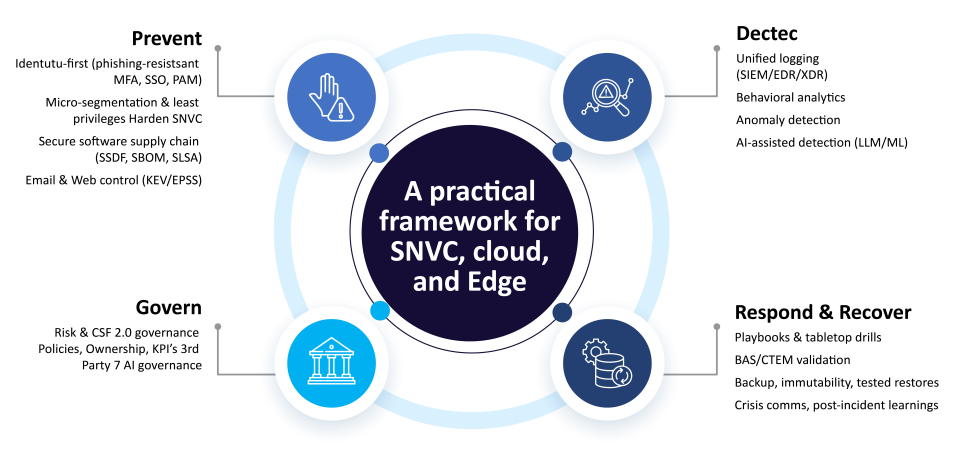
- Use CSF 2.0 as the backbone. The six functions, Govern, Identify, Protect, Detect, Respond, Recover map cleanly to practical controls and help executives track measurable outcomes.[4]
- Adopt Zero Trust as an operating model. NIST SP 800‑207 defines the tenets; CISA’s maturity model and new microsegmentation guidance give a practical path to reduce lateral movement.[5][6][7]
- Prioritize by exploitability, not just severity. Patch what’s known to be exploited (CISA KEV) and use exploit likelihood (FIRST EPSS) to triage the rest.[8][9]
- Treat software as a supply chain. Implement SSDF (SP 800‑218), require SBOMs, and aim for SLSA provenance in builds.[10][11][12]
- Plan for resilience. Use NIST SP 800‑34 and SP 800‑184 to build, test, and improve recovery playbooks—covering people, process, and technology.[13][14]
A practical framework for SNVC, cloud, and Edge
The AI Security Paradox: Your Infrastructure is the battleground
Here's what concerns me as an engineer; AI agents are becoming autonomous enough to launch infrastructure attacks but we're not building secure-by-design systems to defend against them. We're in a transition where the attack/defense asymmetry has never been greater.
I recently reviewed an IoT deployment where attackers were using AI to poison ML models in edge devices, creating persistent backdoors in the firmware. The defenders? Still using signature-based detection that couldn't identify the attack vectors. This is an engineering failure, not a security failure.
The solution isn't to fear AI—it's to engineer AI-native defenses into your infrastructure from the ground up.
The OWASP LLM Top 10 (2025) and NIST AI RMF provide the frameworks, but here's what I'm implementing in production systems:
- Behavioral baselines at the infrastructure level detecting anomalies in compute, network, and storage patterns
- Automated incident response orchestrated through infrastructure automation tools (Ansible, Terraform) for sub-second containment
- Model integrity verification built into CI/CD pipelines, treating AI models like any other deployable artifact
You must implement these controls NOW, before agentic AI becomes mainstream. That means engineering prompt injection defenses, model poisoning detection, and treating AI agents as privileged identities in your IAM architecture. [19] [20] [21] [22]
Supply Chain: Engineering’s biggest blind spot
Every software engineer acknowledges supply chain risk. Almost none have actually implemented Software Bills of Materials (SBOMs) or continuous dependency scanning in their build pipelines.
Remember the Target breach? It started through an HVAC vendor's network access, a perfect example of why NIST 800-82 exists for OT/physical crossover security. In my product engineering work, I've seen how one compromised npm package can cascade through entire deployment pipelines, yet most teams still treat dependency management as a version control problem rather than a security architecture requirement.
Three engineering controls you must implement today:
1. Integrate SBOM generation into your CI/CD pipeline—make it automatic, not optional
2. Implement continuous dependency scanning with breaking builds on critical vulnerabilities
3. Engineer supplier risk scoring into your vendor management systems
Physical-Digital Convergence: The architecture everyone’s fragmenting
Here's an engineering truth; keeping physical and digital security separate creates attack vectors at every integration point.
In datacenter environments, I've consistently seen attackers exploit the gaps between physical and cyber controls. Environmental monitoring systems have become network entry points. Badge readers become lateral movement paths. The infrastructure itself becomes the attack vector.
Proper convergence engineering looks like:
• Unified monitoring across physical access controls and logical access systems
• Environmental systems (HVAC, power, cooling) on isolated VLANs with strict egress filtering.
• Biometric authentication is integrated with Zero Trust policy engines
• Infrastructure monitoring that correlates physical and digital events
More datacenters are initiating convergence projects, unifying these systems to reduce security incidents by ~50% while cutting operational overhead by +30%. Engineering efficiency alone justifies the required investment.
The Engineering reality check: What is your Security Maturity?
Most organizations overestimate their security readiness. Here's an infrastructure engineer's assessment framework:
Can you answer these questions immediately?
• How many AI agents have API access to your production systems?
• What's your infrastructure's mean time to detect AND contain a breach?
• Can your systems survive complete encryption of a primary datacenter?
• Is your PKI infrastructure quantum-resistant?
• What percentage of your endpoints have EDR deployed?
• How much of your traffic uses mutual TLS?
• What percentage of applications have current SBOMs?
If you’re struggling with these, your infrastructure isn’t ready for 2025’s threat landscape.
90‑day plan (execute, measure, iterate)
Days 1-30: Infrastructure Foundation
• Deploy phishing-resistant MFA across all systems (FIDO2 preferred)
• Implement EDR on 100% of endpoints (no exceptions for "air-gapped" systems)
• Begin identity inventory for Zero Trust planning
• Enable comprehensive logging on all SNVC components with centralized aggregation
Days 31-60: Architecture Acceleration
• Deploy AI-powered email security (automated response to phishing)
• Implement micro-segmentation for Tier-0 assets
• Establish SBOM requirements in procurement processes
• Integrate physical access systems with identity providers
Days 61-90: Operational Transformation
• Launch continuous security validation through chaos engineering
• Implement policy-as-code across infrastructure
• Deploy behavioral analytics at infrastructure layer
• Establish AI agent governance framework
This isn't theoretical—I've run variations of this playbook across different infrastructure scales. The key is treating it as an engineering project with measurable deliverables, not a compliance exercise.
Metrics that matter
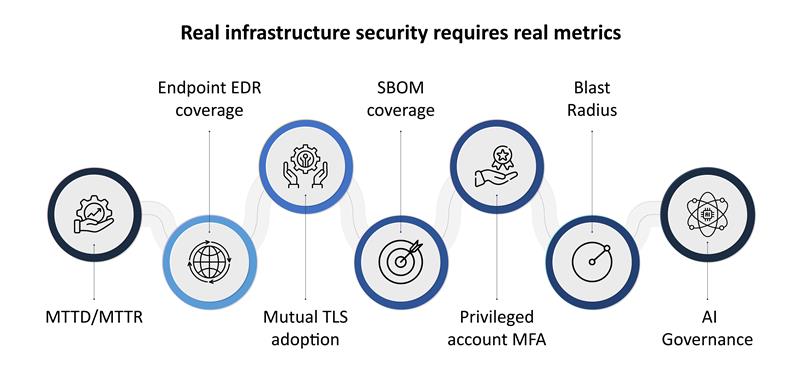
Real infrastructure security requires real metrics:
• MTTD/MTTR: Current industry average is 204 days to identify, 73 days to contain. Target: <24 hours/<1 hour
• Endpoint EDR coverage: Anything below 95% is accepting unnecessary risk
• Mutual TLS adoption: Should be 100% for service-to-service communication
• SBOM coverage: Target 100% for critical applications, 80% minimum overall
• Privileged account MFA: Must be 100% with phishing-resistant methods
• Blast Radius: Backup success and restore time; ransomware blast‑radius score (BAS)
• AI Governance: AI model change control coverage; % agent actions traced/audited
The Binary Choice: Engineer Security or Become a Breach Statistic
The security landscape has reached an inflection point where traditional bolt-on approaches guarantee failure. Infrastructure must be secure by design, not by afterthought.
Organizations that are engineering solutions today must include comprehensive, AI-native, Zero Trust architectures into their infrastructure so that they can operate through tomorrow's attacks. The rest will become case studies in our incident reports.
Security excellence isn't about perfection. It's about engineering resilience into your architecture at every layer, adapting faster than attackers evolve, and treating security as a fundamental system property rather than an operational overlay.
The question isn't whether AI-powered threats will target your infrastructure, It's whether you've engineered it to survive.
References
[1] IBM – Cost of a Data Breach 2025; IBM Think: healthcare USD 7.42M; security AI impact.
[2] Microsoft Security blog (Mar 24, 2025): >30B phishing emails detected in 2024.
[3] Google – Gmail blocks ~15B unwanted emails daily (Oct 3, 2023).
[4] NIST Cybersecurity Framework (CSF) 2.0 - https://www.nist.gov/cyberframework
[5] NIST SP 800 207 – Zero Trust Architecture - https://csrc.nist.gov/pubs/sp/800/207/final
[6] CISA Zero Trust Maturity Model v2.0
https://www.cisa.gov/sites/default/files/2023-04/zero_trust_maturity_model_v2_508.pdf
[7] CISA Micro segmentation in Zero Trust – Part One
https://www.cisa.gov/news-events/alerts/2025/07/29/cisa-releases-part-one-zero-trust-microsegmentation-guidance
[8] CISA Known Exploited Vulnerabilities (KEV) Catalog -- https://www.cisa.gov/known-exploited-vulnerabilities-catalog
[9] FIRST EPSS – Exploit Prediction Scoring System -- https://www.first.org/epss/
[10] NIST SP 800 218 – Secure Software Development Framework (SSDF) v1.1 https://csrc.nist.gov/pubs/sp/800/218/final
[11] NTIA Minimum Elements for SBOM (2021) + CISA SBOM Sharing Primer (2024).
[12] SLSA v1.0 (2024).
[13] NIST SP 800‑34r1 (Contingency Planning).
[14] NIST SP 800‑184 (Cybersecurity Event Recovery).
[15] NIST SP 800‑209 (Storage Security).
[16] NIST SP 800‑125A Rev.1 (Hypervisor Security).
[17] NIST SP 800‑190 (Container Security).
[18] NSA/CISA Kubernetes Hardening Guide.
[19] NIST AI Risk Management Framework 1.0 (2023).
[20] NIST SP 800‑218A (2024) – SSDF for GenAI and DUFMs.
[21] OWASP Top 10 for LLM Applications (2025).
[22] MITRE ATLAS – Adversarial Threat Landscape for AI Systems.
[23] NIST SP 800‑53r5 – PE controls / PIV/ePACS overlays.
[24] NIST SP 800‑82r3 (OT Security).