

Physical networks design and operation is costly and complex. Operators need to invest time and capital in designing infrastructure, only to find it unable to adapt when requirements change. Physical networks are static by design. Evolving telecom networks and new technological advancements require network solutions that are flexible, agile, and scalable.
Physical networks are expensive to build and upgrade. For telecom operators managing 5G rollouts and rising data demands, that trade-off is not feasible.
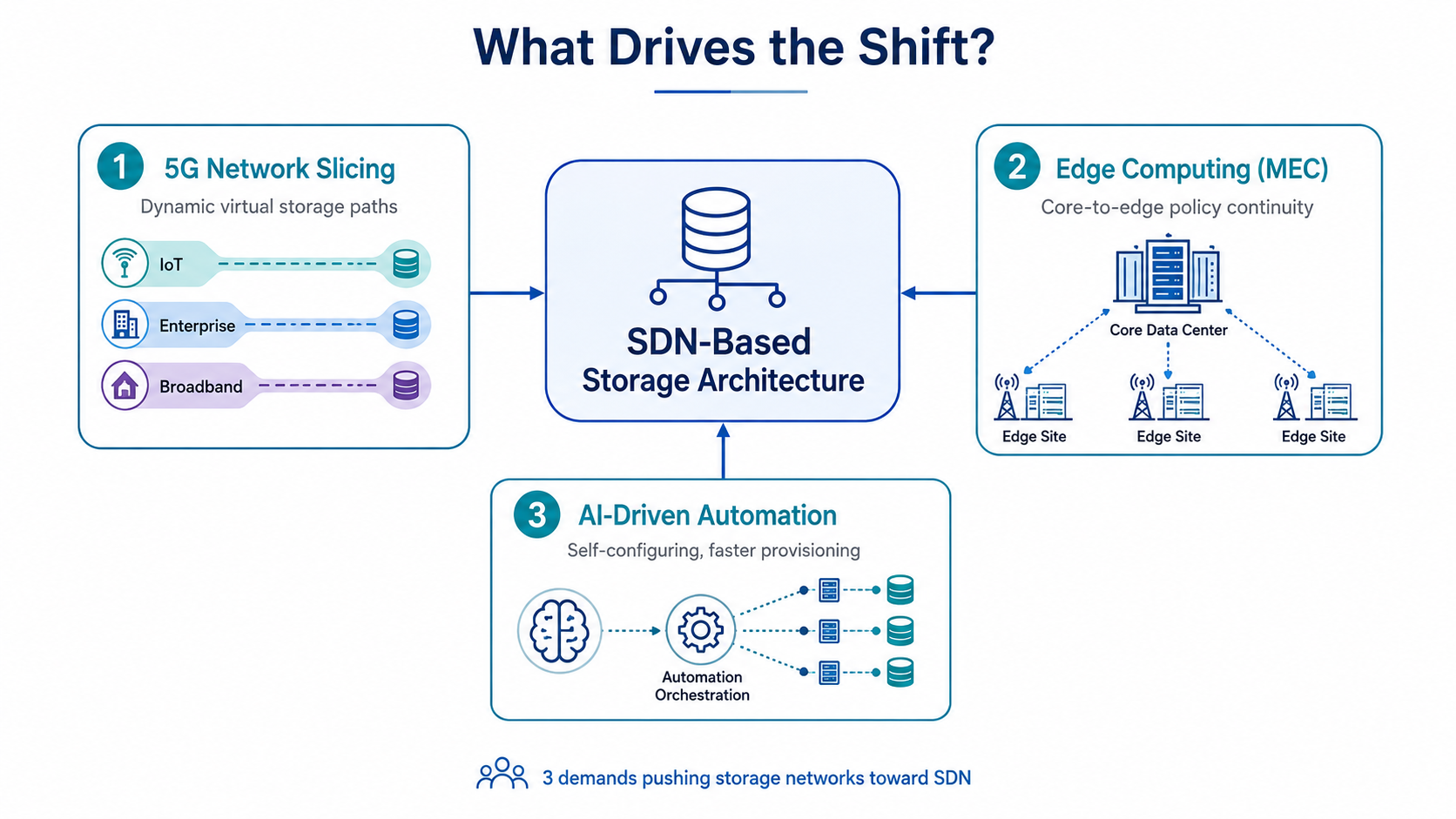
Traditional monolithic networks are no longer enough to support today’s demand for flexibility, scalability, and faster service delivery. To meet these needs, network transformation is moving toward modern architectures powered by technologies such as Network Function Virtualization (NFV), Software-Defined Networking (SDN), Multi-access Edge Computing (MEC), and Network Slicing.
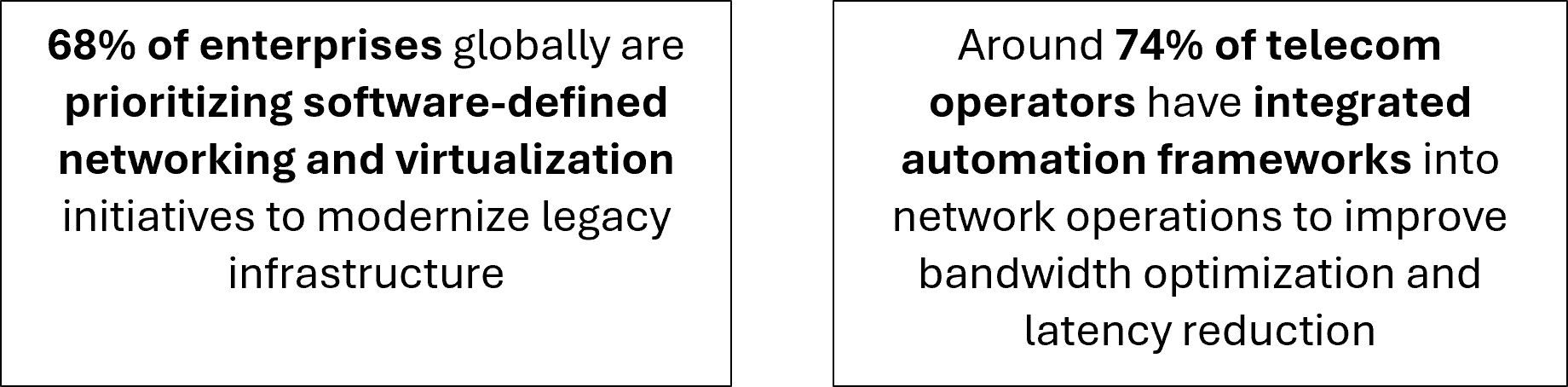
For storage networks, this shift is particularly important. Telecom storage traffic is heavy, latency-sensitive, and constantly changing. SDN brings more control by moving network configuration, policies, and traffic management from physical hardware to a programmable software layer. The global SDN market is projected to grow from USD 35.74 billion in 2025 and to reach USD 82.59 billion by 2030. The Network Transformation Market is witnessing accelerated deployment across telecom operators, cloud providers, and enterprises.
Core pillars of SDN architecture for storage network modernization
A well-designed SDN architecture for telecom storage networks rests on a few interconnected pillars.
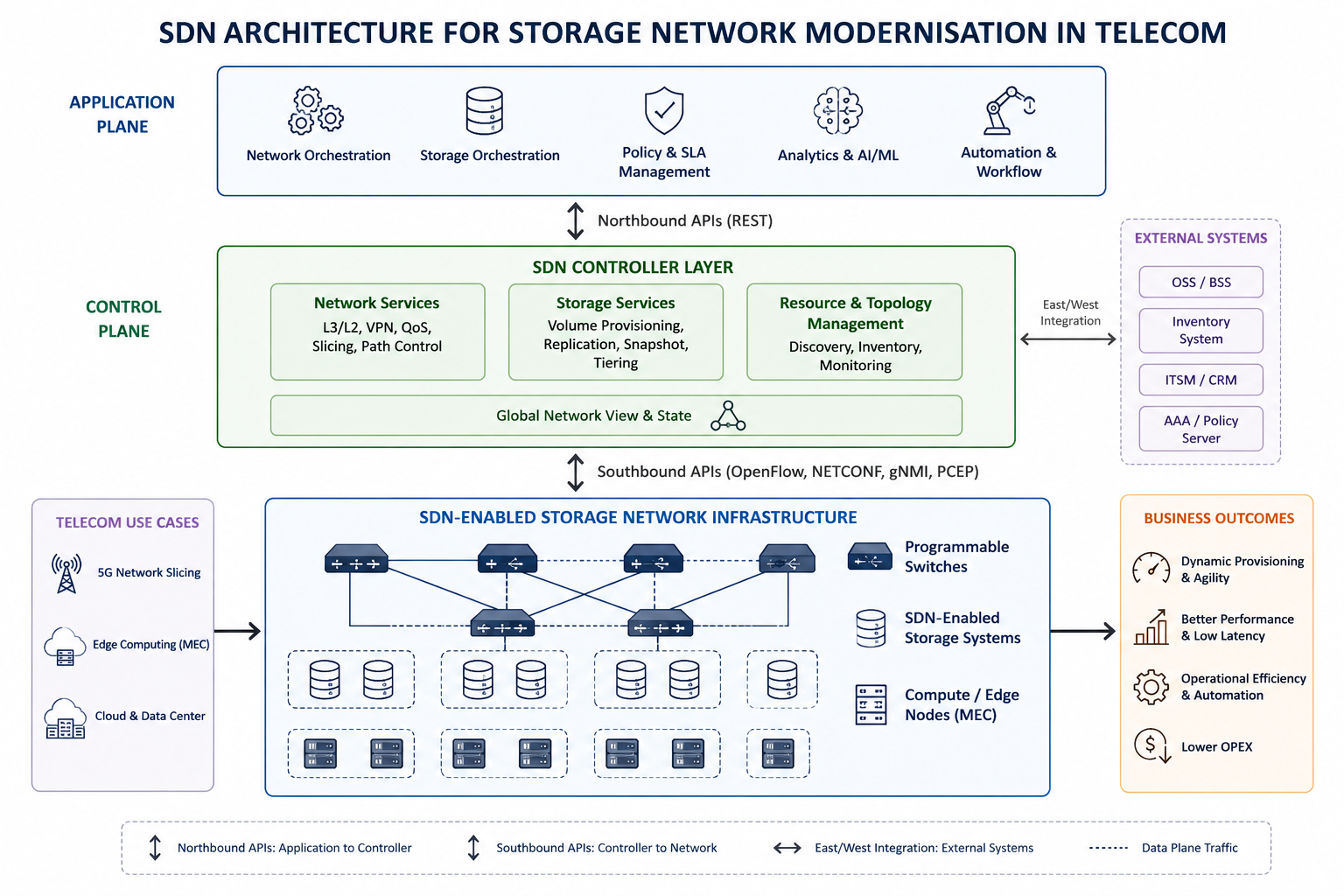
- Centralized controller-based control plane: Programmable controllers (ONOS, OpenDaylight, Cisco ACI, VMware NSX) enable centralized policy with distributed enforcement.
- Overlay networks for tenant isolation: VXLAN, GRE, and GENEVE overlays microsegment storage traffic without physical re-cabling.
- Dynamic QoS and traffic shaping: Storage I/O — backups, replication, analytics, prioritized dynamically based on real-time workload patterns.
- API-first integration: Northbound APIs (Ansible, Terraform) and southbound protocols (OpenFlow, NETCONF, REST, gRPC) fit storage networking into OpenStack, Kubernetes, and vSphere.
- Telemetry-driven operations: Real-time monitoring (Prometheus, SNMP, InfluxDB) enables proactive load balancing over reactive troubleshooting.
Together, these pillars transform storage networking from a static, manually managed layer into a programmable fabric that adapts in real time to 5G, edge, and cloud-native demand.
How Calsoft helps telecom operators modernize storage networks with SDN
Calsoft helps telecom and network-led enterprises build agile, programmable, and secure network infrastructure using SDN, NFV, SD-WAN, 5G, edge computing, and cloud-native architectures. Our capabilities span controller-based network design, OpenFlow, VXLAN/GRE/GENEVE overlays, microsegmentation, dynamic QoS, traffic shaping, service assurance, real-time telemetry, and AI-driven network orchestration. We integrate SDN with OpenStack, Kubernetes, vSphere, ONOS, OpenDaylight, Cisco ACI, VMware NSX, Ansible, Terraform, Netconf, REST, gRPC, Prometheus, SNMP, IAM/LDAP, GitOps, and Network-as-Code to enable scalable, automated, and policy-driven telecom networks.