

Note: This article was originally published on LinkedIn by Faiz Shaikh and is republished here with permission. The article content has been retained as originally written.
Manufacturing leaders are under pressure to improve output, reduce downtime, control energy use, strengthen supply chain resilience, and respond faster to customer demand. Most have already invested in digital tools that promise these outcomes. Plants now have connected machines, sensor data, dashboards, automation programs, cloud platforms, AI models, and digital twin pilots.
The larger challenge is scale.
A useful pilot can prove that a machine failure can be predicted, a defect can be detected, or an energy pattern can be analyzed. The business value becomes clear when that capability works across assets, production lines, plants, teams, and operating conditions. This requires reliable data, strong integration between OT and IT systems, governed AI models, secure edge and cloud infrastructure, and workflows that help people act on insight.
This is why the Global Lighthouse Network is a useful reference point. The network is an initiative of the World Economic Forum, co founded with McKinsey. It examines how Fourth Industrial Revolution technologies are shaping production and operations. It recognizes industrial sites and value chains that use digital and analytics tools across the value chain to improve growth, productivity, resilience, and environmental sustainability.
For manufacturers, the lesson is practical. Lighthouse maturity begins with the ability to connect industrial signals, convert them into trusted intelligence, and apply that intelligence inside daily operations. The intended benefit is a production system that can detect issues earlier, respond with better context, improve asset performance, reduce waste, support frontline teams, and create a more resilient operating network.
What the Global Lighthouse Network signals
The Global Lighthouse Network began as a way to identify manufacturers that were applying Fourth Industrial Revolution technologies at scale. Its scope has expanded with industrial priorities. Current Lighthouse sites show progress across productivity, supply chain resilience, sustainability, customer centricity, and workforce development.
In January 2026, the World Economic Forum welcomed 23 new industrial sites into the network. The Forum described these sites as examples of how advanced technologies can improve productivity, resilience, sustainability, talent, and customer centricity at scale. The network now includes 223 leading industry sites.
This matters because many smart factory programs remain limited to isolated use cases. A plant may have a predictive maintenance model, a quality inspection system, an energy dashboard, or a digital twin. These initiatives can create value within a controlled environment. The real test begins when the same capability must be integrated with live systems, governed across sites, monitored over time, and repeated across product lines.
The factory floor remains the center of manufacturing transformation, but the operating boundary has expanded. Machine data can improve asset uptime. Quality data can improve process control. Energy data can improve consumption patterns. Supply chain data can improve planning. Workforce data can improve training and role design. Value appears when these signals work together.
McKinsey frames the current stage of the network around resilience and impact at scale, with Lighthouse sites showing how digital and AI capabilities can move into enterprise operations.
Also Read: Injecting Security into CICD Pipelines
Why pilots remain difficult to scale
Many manufacturers have enough pilots. They have dashboards, sensor feeds, proof of concept models, automation projects, and cloud programs. The issue appears when these efforts need to become a shared operating capability.
A predictive maintenance model may work for one equipment class, then lose accuracy across other machines or locations. A digital twin may support simulation, yet remain disconnected from telemetry and maintenance workflows. A quality model may detect defects, while corrective action still depends on manual follow up. An energy dashboard may show consumption patterns, while operational teams lack the workflow link needed to act on those signals.
These gaps usually point to architecture and operating model issues. Data is fragmented. OT and IT systems are weakly connected. Data ownership is unclear. Model monitoring is immature. Governance is incomplete. Cybersecurity is handled late. Frontline adoption is uneven.
Lighthouse maturity requires repeatable patterns for sensing, analyzing, deciding, acting, and improving. It also requires ownership across operations, engineering, IT, data teams, and plant leadership. Without that discipline, smart factory investments remain useful in pockets, but hard to expand across the enterprise.
The maturity layers behind lighthouse operations
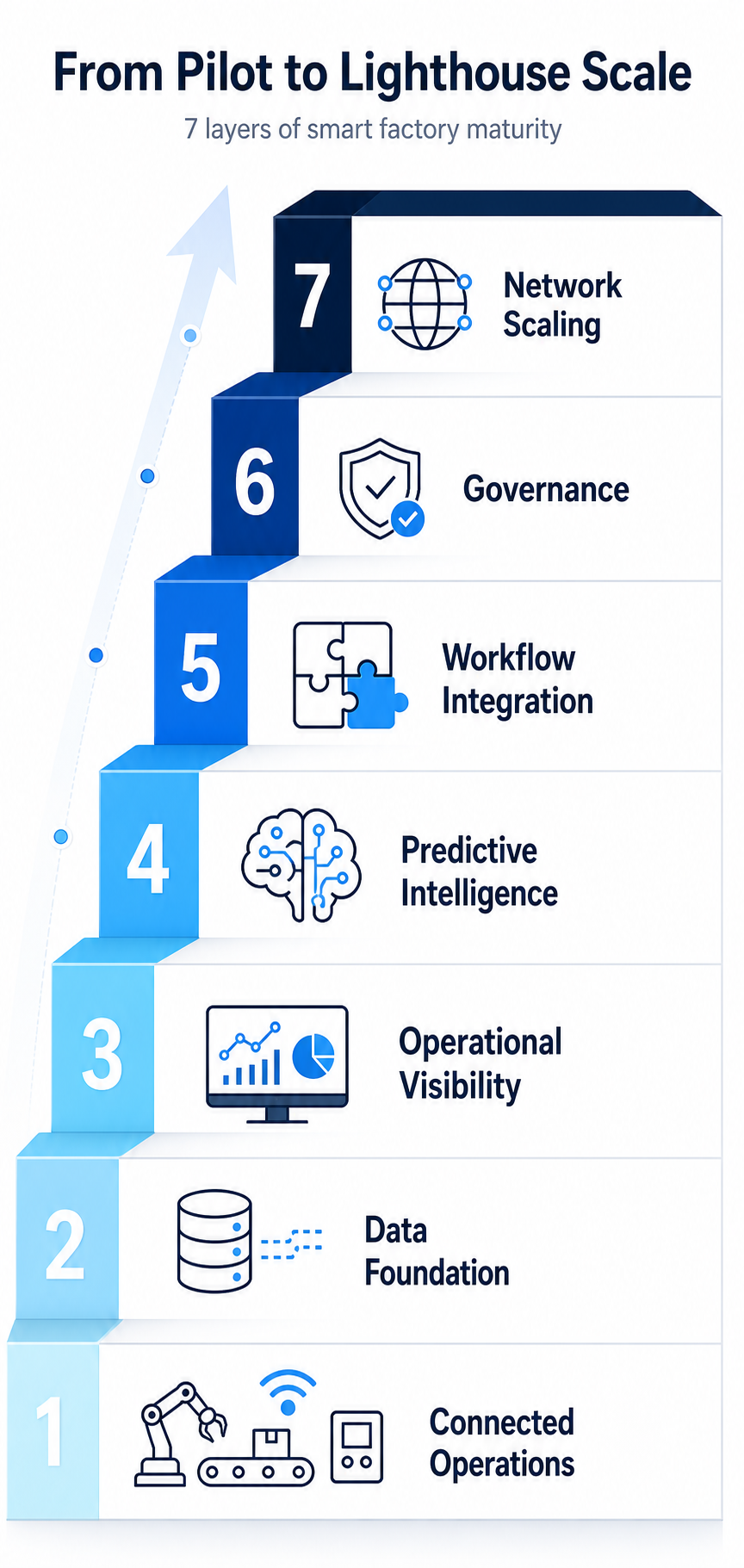
A manufacturer usually builds lighthouse maturity through clear layers.
- The first layer is connected operations. Machines, sensors, controllers, edge systems, enterprise applications, and supply chain platforms must produce usable data. Without this layer, analytics remains partial and AI remains fragile.
- The second layer is data foundation. Industrial data often sits across SCADA, MES, ERP, PLM, quality systems, maintenance platforms, supplier systems, and spreadsheets. A strong data foundation can ingest, clean, contextualize, govern, and serve this data with reliability.
- The third layer is operational visibility. Dashboards, alerts, reports, and observability systems give operators, engineers, and leaders a shared view of performance. Visibility creates the basis for faster diagnosis and coordinated action.
- The fourth layer is predictive intelligence. AI and machine learning models support condition monitoring, anomaly detection, quality prediction, demand forecasting, energy optimization, and process improvement.
- The fifth layer is workflow integration. A prediction must move into an inspection, a maintenance task, a production adjustment, a quality review, a supplier escalation, or a control decision.
- The sixth layer is governance. Data quality, cybersecurity, access control, model monitoring, compliance, change management, and operational accountability determine whether intelligence can scale with trust.
- The seventh layer is network scaling. Use cases expand across plants, product lines, suppliers, logistics partners, and customer facing processes. At this stage, smart manufacturing becomes an enterprise capability.
Also Read: Best practices for implementing automated security testing in BFSI
Why data and AI are central to the journey
AI in manufacturing depends on industrial context. A model trained on incomplete telemetry, poorly labeled defects, inconsistent asset hierarchies, or weak maintenance records will produce limited value. The model may appear advanced, but its operational reliability will remain low.
Data engineering is foundational. Predictive maintenance needs time series asset data, operating conditions, historical failures, service records, and feedback loops. Quality intelligence needs images, defect categories, inspection results, process parameters, and human validation. Energy optimization needs consumption data, load patterns, equipment behavior, weather inputs, production schedules, and cost signals. Digital twins need synchronized asset models and live operational data.
The goal is to make intelligence usable inside operational systems. That requires data readiness, model life cycle discipline, workflow integration, and production grade engineering.
Operational AI needs life cycle discipline
A common failure point in industrial AI is the gap between model development and model operation. A model can perform well during development and still fail to create production value if it cannot be deployed, monitored, retrained, audited, and improved.
MLOps addresses this gap. In industrial environments, MLOps must account for sensor drift, equipment variation, operating changes, site differences, software updates, and feedback from engineering teams.
This discipline is important because AI models do not remain stable by default. Equipment ages. Production conditions change. Materials vary. Sensor behavior shifts. Maintenance practices evolve. Models need monitoring, feedback, and retraining paths so they remain useful inside live operations.
For manufacturers, this is where AI becomes dependable. Model life cycle management gives teams better control over versioning, telemetry usage, deployment cycles, performance monitoring, and improvement loops. It also helps operations teams trust the recommendations they receive.
Edge and IoT make intelligence usable
Manufacturing intelligence cannot depend only on centralized systems. Many operational decisions need local processing, low latency, secure device communication, and edge level inference. This applies to predictive maintenance, process control, visual inspection, energy management, safety systems, and asset monitoring.
Edge systems make industrial data usable closer to the source. Cloud platforms support scale, governance, storage, analytics, and enterprise integration. The operating model needs both layers to work with discipline.
This matters because manufacturers need intelligence that works inside operating constraints. Latency, connectivity, security, device diversity, and data quality all shape the value of industrial AI. Strong edge and IoT engineering helps address these constraints early.
What manufacturers should take awayThe Global Lighthouse Network is useful even for manufacturers that do not plan to pursue formal recognition. Its value lies in the operating lessons behind the sites that qualify.
These organizations build common digital foundations. They connect use cases to measurable outcomes. They put AI into workflows. They invest in governance, cybersecurity, talent, and ownership. They scale capabilities across value chains. They treat technology as part of the business system.
For manufacturers, the message is clear. Smart factory maturity needs a connected operating base. Data, AI, IoT, edge, cloud, DevOps, MLOps, and product engineering need to work as one execution system.
Calsoft’s work across data engineering, AI and ML, IoT, edge engineering, cloud native development, DevOps, MLOps, digital twins, analytics, and product engineering aligns with the practical foundations manufacturers need for lighthouse maturity.
The role is to help build the engineering layers that make intelligent operations scalable, reliable, and useful in production. Calsoft material supports this fit across AI and ML services, data pipelines, deployment frameworks, edge analytics, digital twins, predictive maintenance, OEE, time series infrastructure, AIOps, workflow integration, Docker, and Kubernetes.
Read the original article on LinkedIn: Scaling smart factory intelligence with lighthouse discipline | LinkedIn
.jpg)