

Enterprise AI is moving from experimentation to operational discipline. In manufacturing, sustainable value depends on production-ready RAG (Retrieval-Augmented Generation), structured knowledge, secure model control, and governed deployment.
A Custom LLM for manufacturing, supported by Retrieval-Augmented Generation in manufacturing, can connect engineering data, maintenance records, and operational systems to deliver reliable, traceable insights. By strengthening manufacturing data integration, manufacturing knowledge management, and lifecycle monitoring, enterprises can build secure manufacturing AI systems that improve decision-making, support automation, and scale AI for manufacturing operations with greater accuracy and cost control.
Custom LLM and RAG for manufacturing: Building AI systems for smarter operations
Manufacturing leaders have moved past the question of whether to adopt generative AI. They need an operating system for trusted decisions - one that can understand the language of the plant, retrieve the right evidence, respect industrial permissions, and work across the systems that already run production.
That is the real promise of RAG for manufacturing. It is not simply a chatbot placed on top of factory documents. When designed correctly, Retrieval-Augmented Generation in manufacturing serves as a secure context layer that connects people, processes, enterprise knowledge, and live operational systems. Combined with a Custom LLM for manufacturing, it can support maintenance, quality, engineering, production, supply chain, and frontline decision-making without forcing every user to search across disconnected applications.
The strategic question for CEOs, CTOs, CIOs, COOs, and manufacturing VPs is therefore not, "Which model should we buy?" It is, "How do we build Manufacturing AI systems that produce reliable, governed, measurable outcomes in the environment where mistakes are expensive?"
Deloitte's survey of 600 manufacturing executives found that 92% viewed smart manufacturing as a primary driver of competitiveness over the following three years. Respondents reported average improvements of 10%-20% in production output, 7%-20% in employee productivity, and 10%-15% in unlocked capacity after smart-manufacturing implementations.
Does a manufacturing company need LLM fine-tuning?
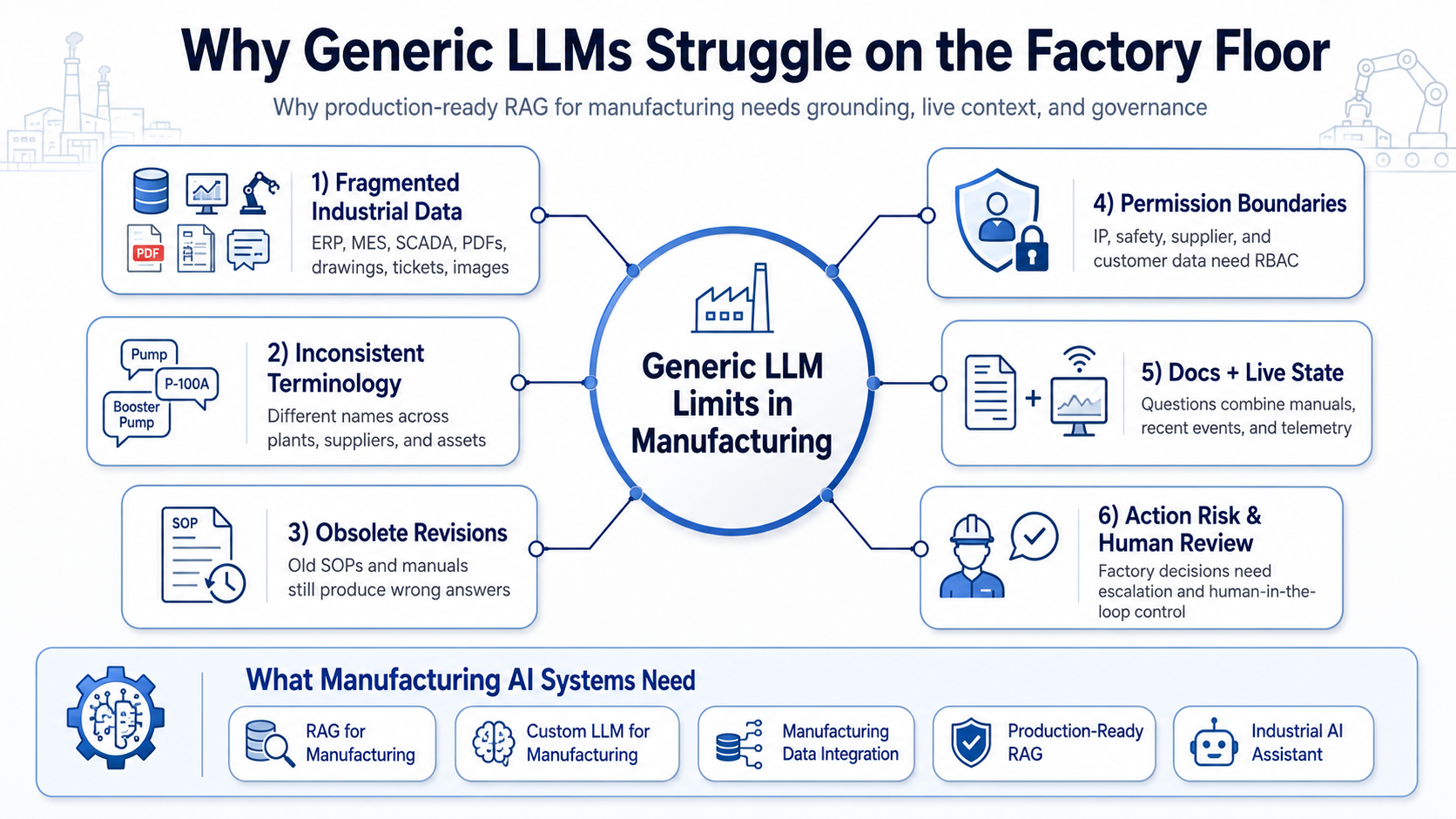
General-purpose language models are trained almost entirely on public data. They understand manufacturing in the abstract, like lean principles and common failure modes, but know nothing about a specific plant's equipment history, supplier codes, calibration logs, or the exact wording of its standard operating procedures. Ask a foundation model to interpret a fault code tied to a proprietary PLC configuration, and it will guess with confidence. In a regulated or safety-critical environment, a guess dressed up as a definitive answer is a liability.
This is the risk CTOs raise most often: hallucination. A generative AI in manufacturing deployment that fabricates a torque specification or misreads a maintenance interval does not just produce a wrong answer; it can trigger unplanned downtime, safety incidents, or warranty disputes. That is why the strongest manufacturing AI systems being built today are architected around retrieval and grounding.
RAG retrieves relevant, permissioned evidence from approved sources and feeds it to the model before it answers, so the model doesn't need to memorize every document. In manufacturing, that evidence spans standard operating procedures, PLM documents, CMMS work orders, ERP records, engineering drawings, maintenance records, and equipment telemetry from MES, SCADA, IIoT, and OPC UA (Open Platform Communications Unified Architecture) systems, static content indexed for retrieval, live data pulled fresh via governed APIs. A well-built Industrial AI assistant also surfaces source citations, document revision, asset context, confidence, and escalation guidance.
RAG isn’t the intelligence itself—it is the evidence layer that makes manufacturing LLMs auditable, grounded, and operationally safe.
Custom LLM vs RAG for manufacturing: A decision framework for technology leaders
One question comes up in nearly every executive briefing: Custom LLM vs RAG for manufacturing, do we need to fine-tune a model, or is retrieval enough? The honest answer is that most manufacturers need both, applied to different problems.
RAG is the right tool when the goal is factual accuracy grounded in documents that change often, like SOPs, drawings, supplier specs, and inspection reports. Fine-tuning earns its cost when the goal is behaviour, not facts: teaching a model your plant's specific terminology, report formats, or the tone and structure of a maintenance write-up.
Deployment choices compound this decision.
- Latency-sensitive shop-floor use cases increasingly favour small language models and edge AI, where a compact model runs close to the equipment it supports rather than making a round trip to a centralized service.
- Data sensitivity pushes many manufacturers toward an on-premises LLM or hybrid architecture, keeping proprietary process data inside the four walls of the plant network while still benefiting from cloud-scale model development elsewhere.
The result is a portfolio: a private LLM for manufacturing handling sensitive internal knowledge, paired with lighter, faster models at the edge, all grounded through a shared retrieval layer.
The right level of customization depends on the business problem
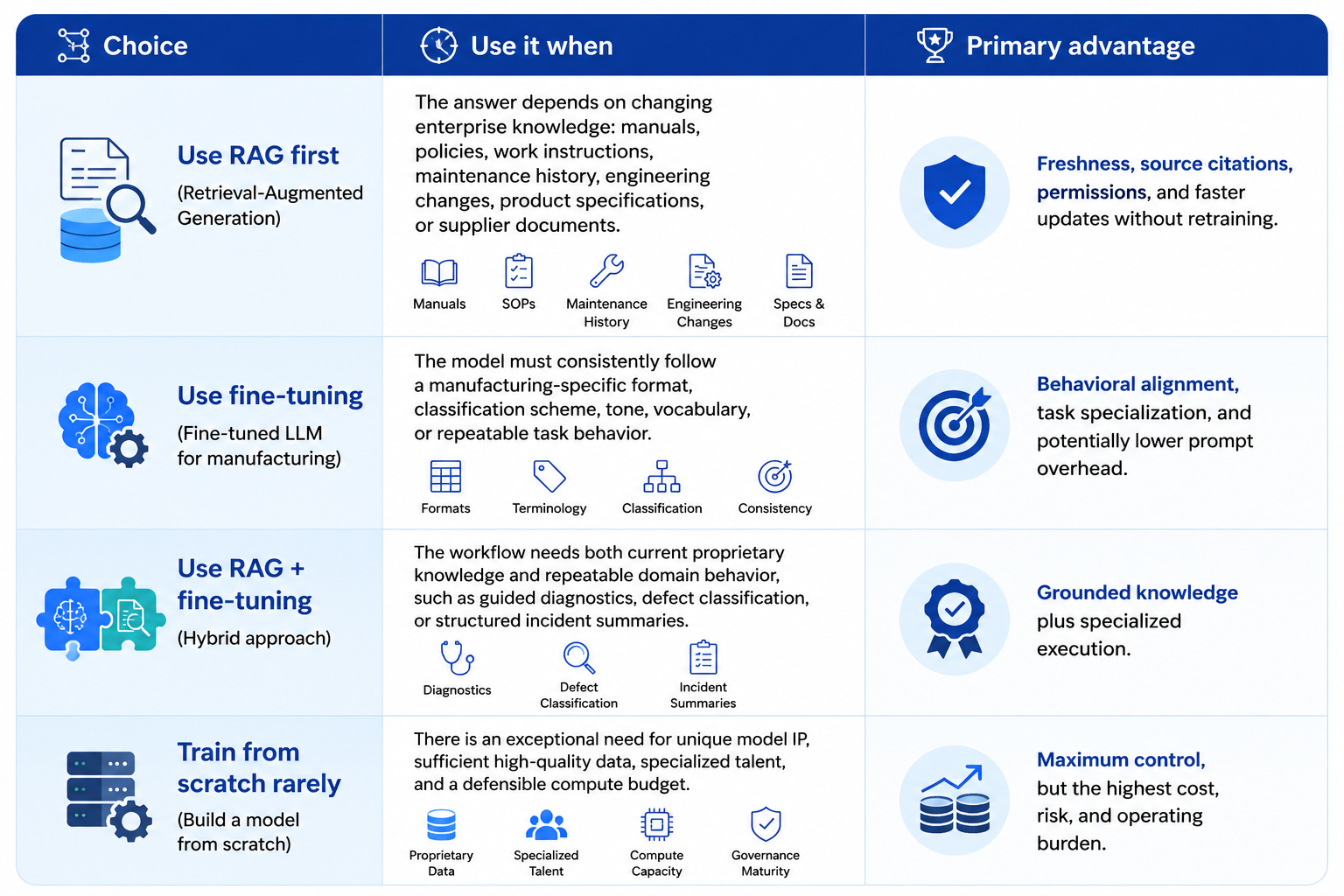
A Custom LLM for manufacturing rarely means building a model from scratch. It typically combines secure deployment, RAG, domain prompts, tool integration, fine-tuning, guardrails, and evaluation based on the specific business need.
Leadership principle: Do not make the model the center of the architecture. Make the manufacturing workflow, evidence, permissions, and KPI the center. Models will change; the operating context and governance layer must endure.

Top learnings from real Custom LLM, RAG, and Gen AI case studies
How Calsoft Enables Custom LLM for GenAI and RAG
Enterprises need more than a standalone language model. Calsoft combines domain adaptation, retrieval engineering, enterprise integration, evaluation, scalability, and cost governance to build reliable, production-ready Custom LLM and RAG systems. The following anonymized cases reflect structured execution across engineering, infrastructure, healthcare, telecom, and enterprise platform environments.
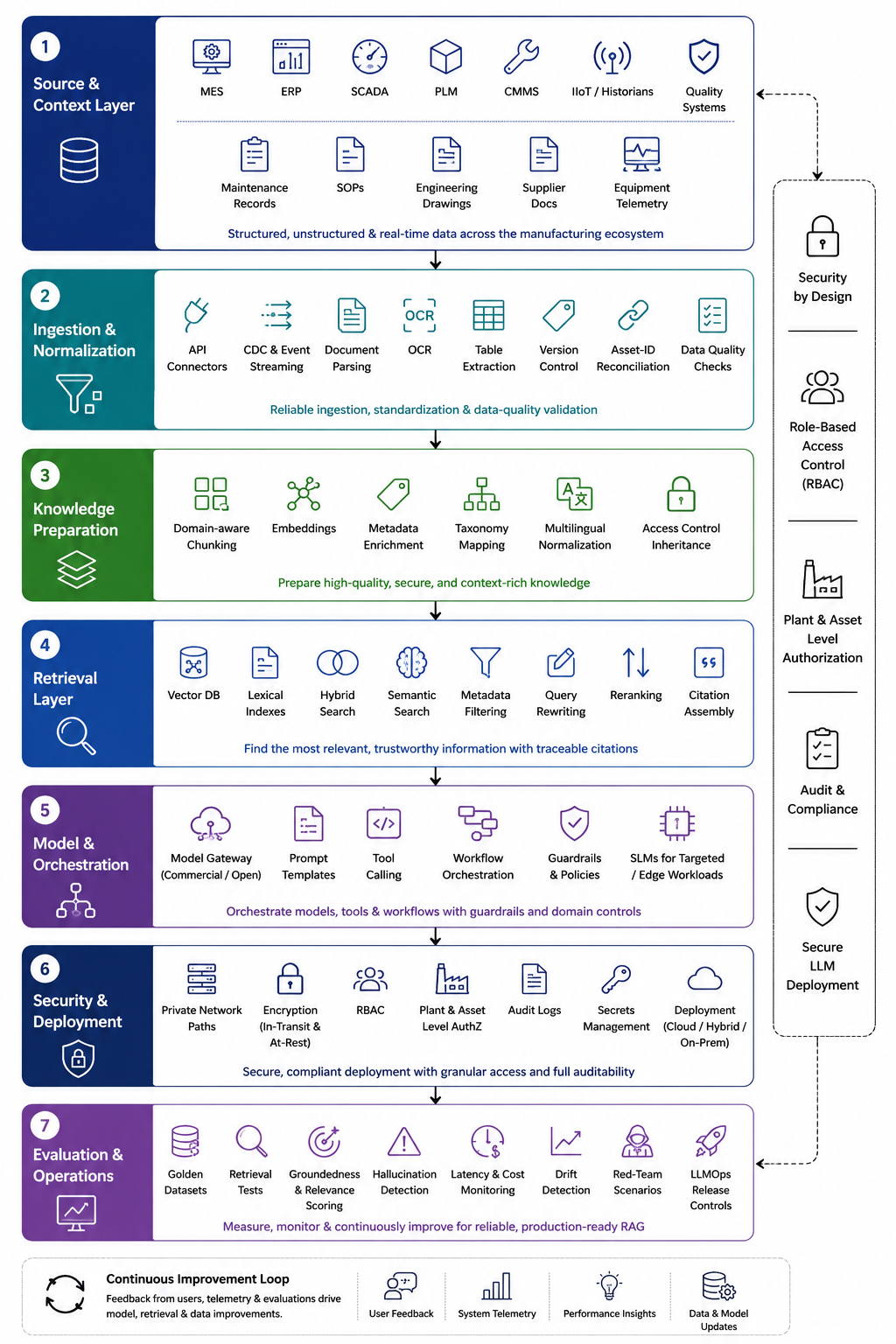
A production architecture for enterprise RAG for manufacturing
Production-ready RAG requires more than loading documents into a vector database. It is a multi-layer system that must reconcile industrial data, enterprise identity, retrieval quality, model behavior, operational reliability, and lifecycle governance.
|
Architecture layer |
Manufacturing design considerations |
|
1. Source and context layer |
MES, ERP, SCADA, PLM, CMMS, IIoT platforms, historians, quality systems, maintenance records, standard operating procedures, engineering drawings, supplier documentation, and equipment telemetry. |
|
2. Ingestion and normalization |
API connectors, change-data capture, event streaming, document parsing, OCR for scanned content, table extraction, version control, asset-ID reconciliation, and data-quality checks. |
|
3. Knowledge preparation |
Domain-aware chunking, embeddings, metadata enrichment, taxonomy mapping, multilingual normalization, and access-control inheritance. |
|
4. Retrieval layer |
Vector database plus lexical indexes, hybrid search, semantic search, metadata filtering, query rewriting, reranking, recency logic, and citation assembly. |
|
5. Model and orchestration |
A model gateway for commercial or open models, prompt templates, tool calling, workflow orchestration, guardrails, and small language models for targeted or edge workloads. |
|
6. Security and deployment |
Private network paths, encryption, role-based access control, plant- and asset-level authorization, audit logs, secrets management, and cloud, hybrid, or on-premises LLM deployment. |
|
7. Evaluation and operations |
Golden datasets, retrieval tests, groundedness and relevance scoring, hallucination detection, latency and cost monitoring, drift detection, red-team scenarios, and LLMOps release controls. |
Connecting AI to the systems that run the plant
A domain-specific LLM for manufacturing is only as good as the systems it can reach. How does RAG connect to MES, ERP, and SCADA? In practice, through a set of connectors and an integration layer that treats each system as a retrievable source rather than a black box:
- MES and ERP contribute work orders, production schedules, and inventory records, the operational backbone the AI needs to answer questions about what is running, where, and why.
- SCADA and OPC UA feeds bring in equipment telemetry and control-system data, giving the assistant visibility into real-time and historical machine behavior.
- PLM systems supply engineering drawings, bills of materials, and revision history.
- CMMS systems hold maintenance records, work history, and asset hierarchies.
- IIoT platforms stream sensor data that, combined with a digital twin, let the system reason about equipment condition rather than just retrieve static documents.
Can RAG analyze manufacturing manuals and drawings? Yes, with a document-processing pipeline that extracts text, tables, and figures from PDFs and CAD exports, and a multimodal retrieval layer that can match a technician's question to the right page of a wiring diagram, not just a paragraph of text. This is where manufacturing data integration becomes the real engineering challenge: less about the language model itself, and more about building reliable pipelines across systems that were never designed to talk to each other.
High-value use cases: From predictive maintenance to knowledge search
How is RAG used for predictive maintenance? By grounding failure-prediction outputs in the specific equipment's maintenance history, sensor trends, and manufacturer documentation, rather than generic failure statistics. A technician asking why a pump is trending toward failure gets an answer tied to that pump's actual service record, not an average across the fleet. Beyond maintenance, the highest-value applications for a manufacturing AI systems deployment tend to cluster around a few patterns:
- Quality control: retrieving relevant historical defect data and inspection criteria to help engineers root-cause recurring issues faster.
- Manufacturing knowledge management: turning years of tribal knowledge, SOPs, and engineering notes into a searchable assistant, so institutional expertise does not walk out the door with retiring engineers.
- Shop-floor support: an industrial AI assistant that lets operators ask natural-language questions about procedures, safety protocols, or troubleshooting steps and get an answer sourced from the actual manual.
- Supply chain and planning: grounding demand and disruption questions in real supplier and inventory data rather than generic market commentary.
Each of these is, at its core, AI for manufacturing operations: narrow, high-frequency questions that used to require finding the right person or the right binder, now answered in seconds with a citation back to the source.
Security, governance, and deployment
How do manufacturers secure proprietary data in an LLM? Through architecture choices made early, not bolted on later. Role-based access control ensures the retrieval layer only surfaces document a given user is authorized to see — a plant operator and a design engineer should not get identical search results from the same query. Data segregation between business units, plants, or customer programs needs to be enforced at the retrieval layer, not left to the model's discretion. Can manufacturing LLMs be deployed on premises? Yes, and for many manufacturers — particularly those in defense, automotive, aerospace, and other IP-sensitive segments — it is the default requirement rather than an option. An on-premises LLM or hybrid deployment keeps sensitive process data, drawings, and telemetry inside the corporate network, while still allowing the organization to draw on frontier model capabilities for less sensitive tasks through a controlled cloud pathway. Enterprise RAG for manufacturing programs that get this right treat deployment topology as a governance decision, not just an infrastructure one.
Measuring What Matters: Evaluation, Groundedness, and LLMOps
How do you evaluate a manufacturing RAG system? Not by how fluent its answers sound, but by whether those answers are grounded in the retrieved source material and whether the retrieval itself is precise. Groundedness — the degree to which a generated answer is actually supported by the retrieved passages — is the single most important metric for a plant-floor deployment, ahead of generic response quality scores. Hallucination detection needs to run continuously, not just during initial testing, since retrieval quality can drift as document sources change, new equipment is added, or SOPs are revised. Mature teams treat this as an LLMOps discipline: versioning prompts and retrieval configurations, running regression tests against known-good answers before every update, and monitoring production queries for cases where the system had to fall back on the model's own memory instead of a retrieved source. LLM evaluation frameworks built for manufacturing contexts increasingly include domain reviewers, actual engineers and technicians, scoring a sample of production answers, not just automated metrics.
The executive scorecard: what CEOs, CTOs, and manufacturing VPs should require
|
Executive lens |
Decision question |
Evidence to require |
|
CEO / business president |
Which operational constraint or customer outcome will this system change? |
Throughput, margin, service response, warranty exposure, time to competence, and scalability across plants. |
|
CTO / CIO |
Can architecture integrate with heterogeneous IT and OT estates without creating another data silo? |
Interoperability, deployment portability, identity, observability, reliability, and lifecycle cost. |
|
VP Manufacturing / COO |
Will the assistant fit the operator, engineer, and maintenance workflow under real plant conditions? |
Adoption, response time, first-time-fix rate, mean time to repair, scrap, rework, downtime, and safety escalation. |
|
CISO / risk leader |
Does every response respect source permissions and create a defensible audit trail? |
Least privilege, data boundary enforcement, prompt-injection resistance, source integrity, logging, and incident response. |
The strongest business case starts with a baseline. Before implementation, measure how long people spend finding information, how often they use obsolete instructions, how many escalations require expert intervention, where downtime or rework is linked to knowledge gaps, and which decisions are delayed by fragmented data.
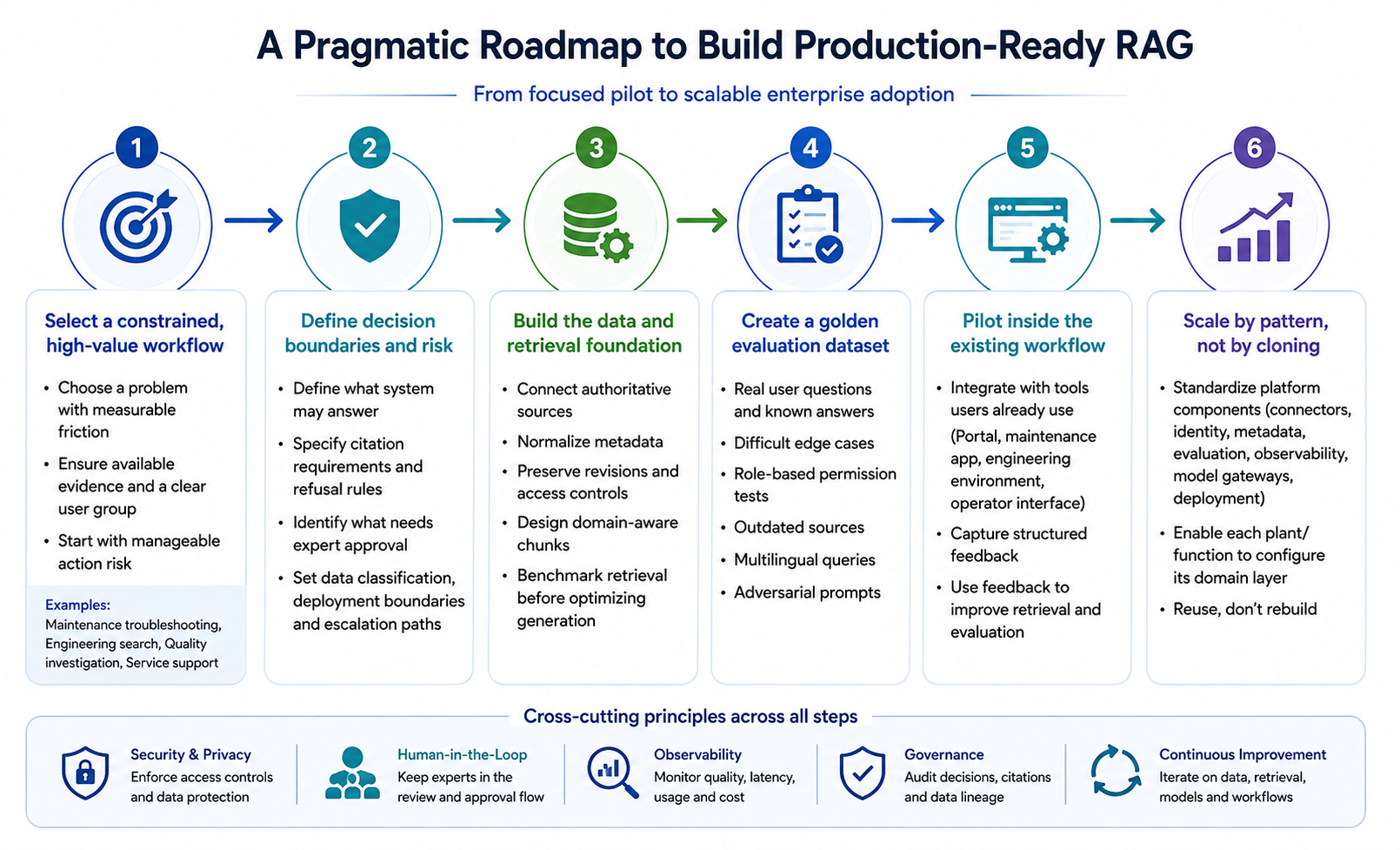
A pragmatic roadmap to build production-ready RAG
- Select a constrained, high-value workflow. Choose a problem with measurable friction, available evidence, a clear user group, and manageable action risk. Maintenance troubleshooting, engineering knowledge search, quality investigation, and service support are common starting points.
- Define decision boundaries and risk. Identify what the system may answer, what it must cite, what it must refuse, and what requires expert approval. Establish data classification, deployment boundaries, and escalation paths before selecting the model.
- Build the data and retrieval foundation. Connect authoritative sources, normalize metadata, preserve revisions and access controls, design domain-aware chunks, and benchmark retrieval before optimizing generation.
- Create a golden evaluation dataset. Include real user questions, known-answer cases, difficult edge cases, role-based permission tests, outdated sources, multilingual queries, and adversarial prompts.
- Pilot inside the existing workflow. Integrate with the portal, maintenance application, engineering environment, or operator interface people already use. Capture feedback in a structured form that improves evaluation and retrieval.
- Scale by pattern, not by cloning. Standardize connectors, identity, metadata, evaluation, observability, model gateways, and deployment templates. Allow each plant or function to configure its domain layer without rebuilding the platform.
Conclusion: build a trusted decision layer
RAG for manufacturing is most valuable when it turns fragmented industrial knowledge into evidence-backed decisions at the point of work. A Custom LLM for manufacturing adds value when it adapts the system to domain language, workflows, deployment constraints, and repeatable behavior. Neither succeeds without authoritative data, precise retrieval, permission-aware architecture, continuous evaluation, and accountable human oversight. For manufacturing leaders, the competitive advantage will not come from adopting the newest model first. It will come from building a durable system that can connect knowledge to operations, measure reliability, protect proprietary data, and scale useful AI across plants. That is the difference between an AI pilot and an industrial capability.
Frequently Asked Questions
How does RAG improve manufacturing operations?
It reduces the time required to locate and interpret trusted information across manuals, maintenance history, quality records, engineering content, and operational systems. The strongest implementations connect retrieval to an existing workflow and measure outcomes such as search time, mean time to repair, investigation cycle time, rework, or downtime.
How can manufacturers build a Custom LLM?
Start with the workflow and risk boundary, then choose the minimum customization needed. Most programs combine a suitable foundation model with domain prompts, RAG, enterprise connectors, access controls, tools, evaluation data, and deployment controls. Fine-tuning is added when consistent domain behavior or task specialization is required.
Does a manufacturing company need LLM fine-tuning?
Not always. Use RAG when the main requirement is fresh, traceable enterprise knowledge. Use fine-tuning when the model must learn a consistent task pattern, vocabulary, classification, or output format. Many production systems use both, but training a model from scratch is rarely the first choice.
How does RAG connect to MES, ERP and SCADA?
Through governed APIs, connectors, data services, event streams, or approved integration layers. Documents and slower-changing knowledge may be indexed, while live production or asset values are typically queried through tools at runtime. OT access should follow network, identity, and safety controls rather than exposing control systems directly to a language model.
Can manufacturing LLMs be deployed on-premises?
Yes. On-premises LLM and hybrid deployment patterns can keep sensitive data and inference within enterprise-controlled infrastructure. The decision should account for model size, GPU and memory needs, availability, observability, upgrade processes, security, and total lifecycle cost.
How do you evaluate a manufacturing RAG system?
Evaluate the complete system, not only the model. Measure retrieval quality, citation accuracy, groundedness, answer relevance, permission compliance, refusal behavior, latency, availability, and cost. Then connect those metrics to operational KPIs such as search time, first-time-fix rate, investigation time, downtime, scrap, rework, or escalation rate.
What data is needed to build a manufacturing AI assistant?
The answer depends on the use case, but common sources include approved manuals, standard operating procedures, maintenance records, work orders, quality documents, engineering drawings, ERP and MES records, PLM data, asset hierarchies, equipment telemetry, and user-role information. Data authority, revision, lineage, and permission metadata are as important as the content itself.