

Software delivery has accelerated dramatically. CI/CD pipelines, cloud-native architectures, and AI-assisted development allow engineering teams to build and release software faster than ever. But this speed creates a critical challenge: organizations have automated delivery faster than they have automated confidence.
A green CI/CD pipeline does not always mean a release is truly ready. Performance issues, security gaps, integration failures, and production risks can still escape, even when extensive automated testing is in place. Quality, therefore, can no longer remain a final checkpoint. It must become an engineering strategy embedded throughout the delivery lifecycle, from code commit and CI/CD testing to deployment, observability, and production feedback.
QAOps is an engineering approach that integrates quality assurance, automated testing, quality gates, and feedback into DevOps and CI/CD workflows so that quality is continuously validated rather than checked only before release.
For engineering leaders, the goal is not simply to run more tests. It is to build continuous quality engineering into every change and answer a more important question: Are we confident enough to release, and what evidence supports that decision? That is the shift QAOps brings to modern software delivery.
What is QAOps?
QAOps brings quality engineering directly into the delivery flow. Traditional QA often validates near the end; QAOps testing runs continuously. DevOps optimizes software flow and operations; QAOps makes quality signals first-class inputs to that flow. DevTestOps emphasizes testing within DevOps, while QAOps extends the model with risk-based quality gates, production feedback, and shared ownership. Quality engineering is the broader discipline; a QAOps strategy is how that discipline becomes operational inside CI/CD.
Why CI/CD Alone Does Not Guarantee Quality
A faster pipeline can deliver defects faster. Large automated suites can also create noise when every change triggers the same tests regardless of risk. Even a green pipeline may hide weak coverage, flaky tests, performance degradation, security gaps, or failures that appear only under production conditions.
For decision makers, this changes the question from “How much have we automated?” to “How confidently can we release?” DORA’s current software-delivery model balances throughput with instability measures such as change failure rate and deployment rework rate, reinforcing that speed and stability must be managed together.
What Does QAOps Add to a CI/CD Pipeline?
A mature QAOps pipeline combines continuous test execution, automated quality gates, risk-based test selection, security validation, performance and resilience checks, and production feedback. The goal is not to add more gates everywhere; it is to place the right evidence at the right decision point.
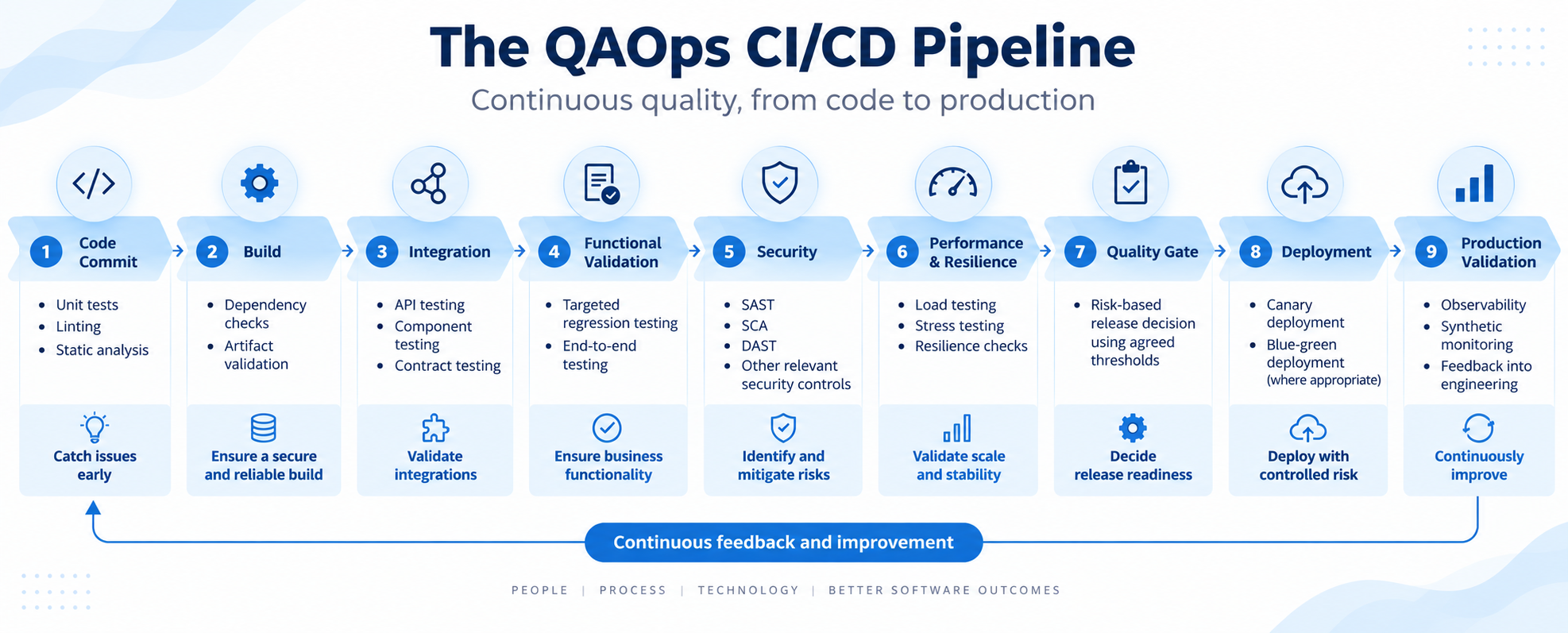
How Quality Gates Should Work
Quality gates should reflect business and technical risk. Critical security vulnerabilities, broken core journeys, contract failures, or unacceptable reliability thresholds may block a release.
- Lower-risk issues may generate warnings and tracked remediation.
- A payment change in FinTech, a patient-facing healthcare workflow, or a control-plane update in networking should not carry the same gate policy as a low-risk content change.
- Risk context is what turns CI/CD quality gates from bureaucracy into engineering control.
Shift-Left and Shift-Right Quality in QAOps
Shift-left testing catches defects earlier through code-level, API, security and automated validation. Shift-right testing uses telemetry, synthetic checks, canary signals and production observability to validate real behaviour. QAOps integration connects both: production evidence improves future test selection, while pre-production risk models determine what deserves deeper monitoring after deployment.
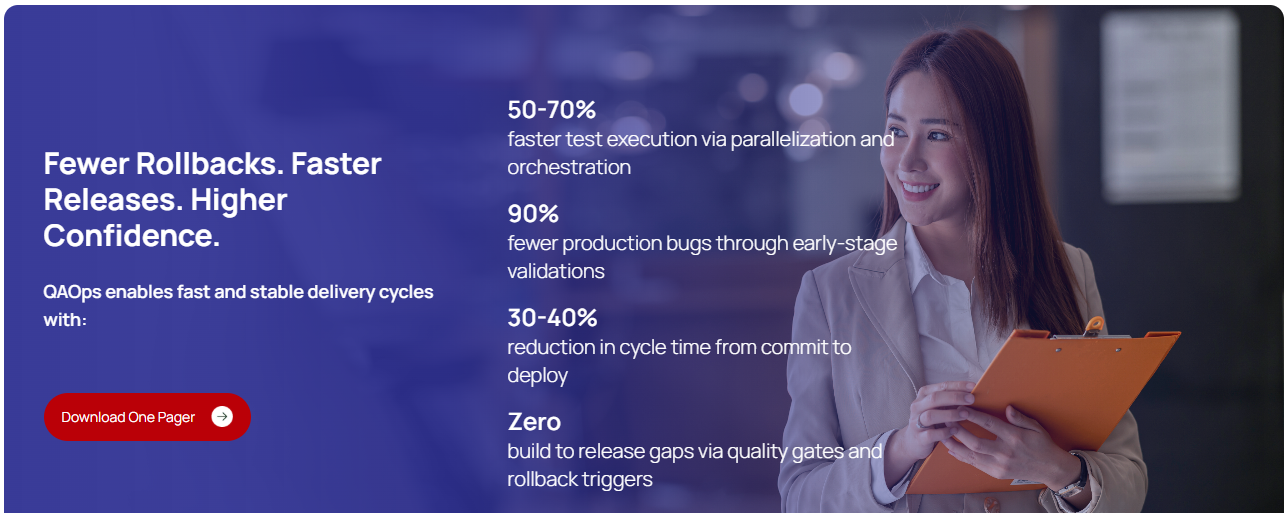
Calsoft helps enterprises embed continuous testing, intelligent test selection and QAOps into CI/CD workflows. Explore how CalTIA and Calsoft quality engineering services can help make every release faster, more focused and more dependable.
AI-Powered QAOps: From More Automation to Better Decisions
AI is making QAOps more selective and adaptive through intelligent test selection, AI-generated test cases, predictive defect detection, automated failure analysis, and AI-assisted quality gates. Human oversight remains essential for risk thresholds, exceptions, and release accountability.
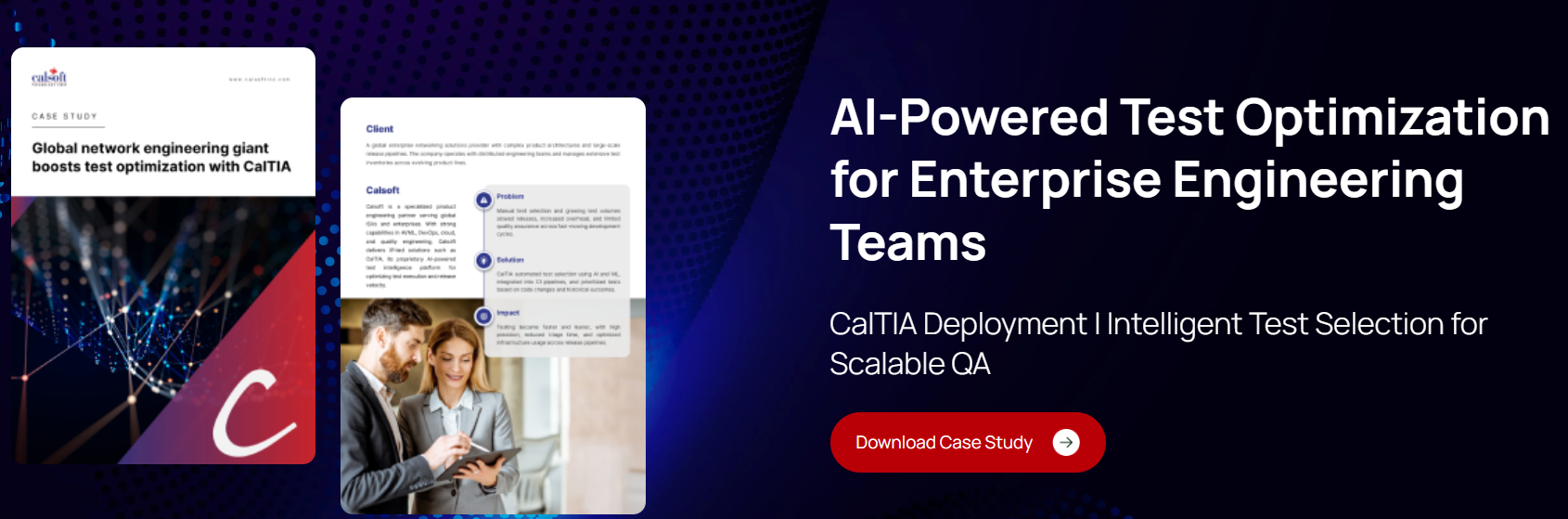
Calsoft's CalTIA applies AI/ML to test-impact analysis, risk-prioritized test selection, and CI/CD integration. It can correlate code changes with relevant tests, identify test-suite gaps, and support generation of missing tests, a practical example of using AI to reduce redundant validation without treating automation as the definition of quality.
QAOps Metrics That Matter
Leaders should track a balanced set of signals: defect escape rate, test effectiveness, meaningful automation coverage, pipeline failure rate, mean time to detection, recovery time, change fail rate, deployment frequency and release readiness. Test coverage alone is not a quality strategy; metrics should show both delivery flow and customer-facing stability.
The biggest obstacles are usually operational rather than tool-related: flaky tests, slow suites, unstable environments, poor test data, excessive quality gates, unclear test ownership, siloed QA teams and pipeline tool sprawl. Adding more automation on top of these problems can simply automate the bottleneck.
Start by assessing the current pipeline and mapping the risks that matter to the product and industry. Automate high-value tests first, then introduce risk-based gates instead of universal blockers. Connect production feedback to the QAOps pipeline, add AI where it improves selection or diagnosis, and continuously measure outcomes. The operating model should evolve with the product rather than become another fixed process.
A Practical QAOps Maturity Model
|
Stage |
Operating model |
Leadership focus |
|
Level 1 - Manual QA |
Late-cycle, human-heavy validation |
Visibility and baseline risk |
|
Level 2 - Automated Testing |
Repeatable automated suites in CI/CD |
Speed, stability and test debt |
|
Level 3 - Integrated QAOps |
Continuous testing, quality gates and shared ownership |
Release confidence and production feedback |
|
Level 4 - Intelligent Quality Engineering |
Risk-aware, AI-assisted, adaptive validation |
Business risk, resilience and continuous improvement |
Quality is No Longer a Final Check
For engineering leaders, QAOps is not a testing transformation alone. It is an operating strategy for balancing release velocity with risk. The organizations that gain the most will be those that stop measuring quality by how many tests they run and start engineering confidence into every change.
Frequently Asked Questions
What is QAOps?
QAOps embeds continuous quality assurance, testing, feedback and quality gates into DevOps and CI/CD.
How does QAOps integrate with CI/CD?
It adds automated and risk-based validation at commit, build, integration, release and production stages.
QAOps vs traditional QA?
Traditional QA can be a release-stage function; QAOps makes quality continuous and cross-functional.
QAOps vs DevOps?
DevOps focuses on delivery and operations flow; QAOps makes quality evidence and release confidence integral to that flow.
What should a QAOps CI/CD pipeline include?
Continuous testing, security, performance, resilience, quality gates, deployment validation and production feedback.
What are QAOps quality gates?
Automated or governed decision points that block, warn or permit progression based on defined risk thresholds.
How do you implement QAOps?
Assess the pipeline, map risks, automate high-value tests, add risk-based gates, connect production feedback and improve continuously.
What metrics should QAOps teams track?
Use quality, flow and stability metrics rather than relying on test coverage alone.
How does QAOps support shift-left and shift-right testing?
It links early engineering validation with production monitoring and feeds operational signals back into testing.
How can AI improve QAOps?
AI can prioritize tests, generate cases, detect likely defects, analyze failures and assist quality-gate decisions with human oversight.