

The data of any organization is of extreme value. But what happens when that data is not trustworthy or accessible to your teams? You face challenges due to data silos, insufficient information, and inconsistent records. These issues not only impact the bottom line but also stifle innovation, growth, and agility.
According to research reports, with an estimated value of $30.35 billion in 2023 and projected to reach $94.16 billion by 2036, the role of integrating and managing trustworthy data has never been more important. Therefore, Product Lifecycle Management (PLM) frameworks for software development are crucial for maintaining data integrity and maximizing efficiency.
This blog explores how PLM can transform software development, especially for products leveraging large language models (LLMs). Let’s walk through each stage of the PLM process—from planning and requirements gathering to development, testing, deployment, and maintenance.
PLM in Software Development for LLM-Based Products
Product Lifecycle Management (PLM) provides a structured approach to managing each phase of software development—from conception to retirement. When applied to software integrating LLMs, PLM becomes even more critical due to computational, data, and ethical complexities unique to AI systems.
These models perform advanced reasoning and generate unpredictable results, making PLM essential for aligning with business objectives, compliance, and user demands.
Key Elements of PLM in LLM-Based Software
- Customize PLM Stages: Adapt each PLM phase for LLM needs—covering iterative learning, data dependencies, and ethical safeguards.
- Manage Data Efficiently: Maintain diverse, high-quality datasets while ensuring privacy and compliance.
- Allocate Computational Resources: Provide sufficient processing power for model training and deployment.
- Prioritize Ethics and Compliance: Address bias and adhere to legal standards to maintain user trust.
- Continuous Monitoring and Maintenance: Detect model drift and retrain as necessary.
- Engage Stakeholders: Align development goals with business strategy for better ROI.
LLM-Based Software Development: Planning
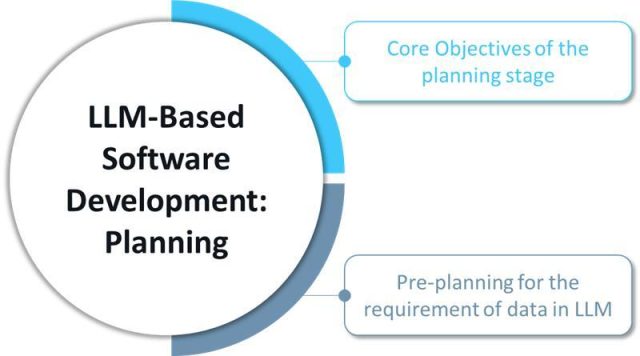
Planning is the foundation of any PLM strategy and is especially crucial for LLM-based software. This stage defines objectives, data requirements, technical specifications, and potential challenges, providing a clear roadmap for the entire lifecycle.
Core Objectives of the Planning Stage
- Specify data type, source, and compliance requirements.
- Define technical specifications, including architecture and compute resources.
- Identify potential risks such as model drift and bias.
- Set measurable KPIs like accuracy, latency, and compliance adherence.
Pre-Planning for Data Requirements
- Data Volume and Variety: Use diverse, large datasets for improved generalization.
- Quality and Preprocessing: Clean and preprocess data to remove noise and bias.
- Privacy and Compliance: Ensure all data collection complies with regional laws and regulations.
Requirements Gathering for LLM-Based Software
Requirements gathering defines what the LLM-based software must accomplish and how it should behave. This includes both functional and non-functional requirements, ensuring alignment between user needs, technical feasibility, and ethical considerations.
Functional Requirements
- Scope of Functionality: Define core functions like text generation, query analysis, or sentiment evaluation.
- User Scenarios: Capture real-world use cases (e.g., customer service chatbots).
- Legacy Integration: Ensure seamless interoperability with existing systems.
Non-Functional Requirements
- Performance & Scalability: Define expected workloads and response times.
- Security & Privacy: Detail encryption, access control, and data handling protocols.
- Ethical Standards: Establish guidelines to prevent model bias and misuse.
Model Development and Prompt Engineering
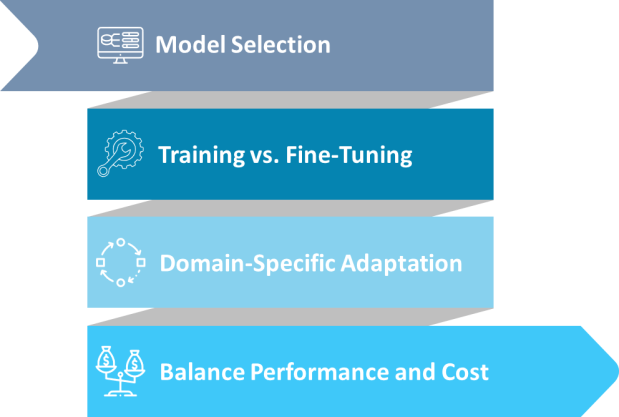
This stage transforms the documented requirements into an operational model ready for integration.
- Model Selection: Choose architectures that balance accuracy and efficiency.
- Training vs. Fine-Tuning: Decide between training from scratch or adapting pre-trained models.
- Domain Adaptation: Tailor models for specific industries for better relevance.
- Optimization: Use techniques like pruning or quantization to reduce computational costs.
Prompt Engineering
- Craft specific, contextual prompts for accurate responses.
- Include in-context examples for improved comprehension.
- Standardize prompt templates for consistent results.
- Iteratively refine prompts through testing and feedback.
Testing and Quality Assurance
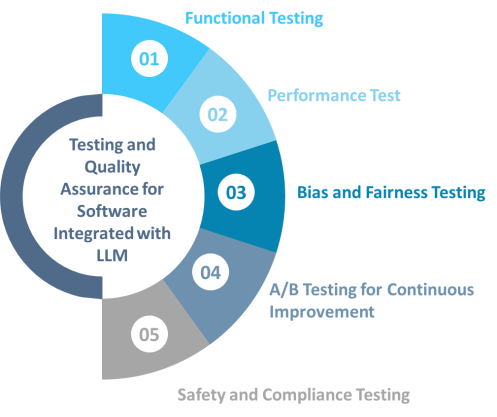
Testing ensures that the model meets business goals, performs consistently, and adheres to ethical and legal standards.
Testing Types
- Functional Testing: Validate accuracy and relevance of model responses.
- Performance Testing: Test latency and scalability under real-world workloads.
- Bias and Fairness Testing: Identify and mitigate biased outputs.
- A/B Testing: Compare model variations for continuous improvement.
- Safety & Compliance: Ensure data handling complies with GDPR, CCPA, and HIPAA.
Deploying LLMs within Software Products
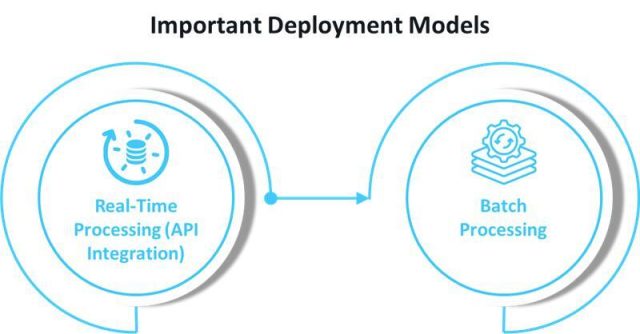
Deployment Models
- Real-Time (API-Based): Ideal for chatbots; requires low latency and high compute power.
- Batch Processing: Suitable for periodic data analysis; cost-efficient and scalable.
Cloud vs. On-Premises Deployment
- Cloud: Scalable, flexible, but dependent on providers and prone to latency.
- On-Premises: Offers control and security for sensitive data but requires high maintenance.
Maintenance and Model Updates
- Model Monitoring: Track accuracy, latency, and reliability.
- Retraining: Address model drift and update with fresh data.
- User Feedback: Incorporate feedback to refine model responses.
- Compliance: Maintain ethical and privacy standards.
- Version Control: Document model updates for traceability.
Conclusion
Product Lifecycle Management (PLM) for LLM-based software is vital in today’s evolving AI landscape. From planning and requirements gathering to testing and maintenance, PLM ensures structure, compliance, and efficiency across the development cycle.
Calsoft, a technology-first partner, has been driving innovation for over 25 years, helping enterprises harness AI, ML, and PLM to solve complex business challenges and accelerate growth.