

Did you know that at least half of GenAI projects are expected to overrun their budgets through 2028, according to Gartner? Most enterprises don't find this out until they're deep into a pilot and the invoice looks nothing like the business case. If your organisation is evaluating an open-source LLM, this is exactly the kind of thing to plan for before you start, not after.
Why enterprises are looking at open source LLMs
Enterprises adopt generative AI to speed up work such as drafting, summarising, answering customer queries, and writing code. The usual starting point is a proprietary API like GPT or Claude. It's fast to set up. No infrastructure to manage. But every request sent to a closed model also sends your data to that vendor's servers, under a retention policy most teams never fully read.
For regulated industries like banking, healthcare, and insurance, that's not a small detail. It's often the reason a pilot that looked good in week one gets frozen by legal in week six. This is where open source LLMs come in. Models like LLaMA, Mistral, and Falcon can be deployed inside your own environment. Your data stays with you. You're not paying per token to a third party, and you're not waiting on someone else's roadmap for the features you need.
Cost is part of the appeal too. Gartner's research on GenAI project failure points out that token, hosting, and inference costs climb quickly once usage scales, and teams without visibility into that spend are the ones that run over budget. Self-hosted infrastructure has upfront cost, but it doesn't scale linearly with usage the way an API bill does.

Why most in-house attempts stall
Getting an open source model to answer questions in a sandbox is the easy part. It can happen in a couple of weeks. What takes longer is everything around it: fine-tuning pipelines, a vector database for retrieval, GPU orchestration, and a serving layer with the access control and audit logging your security team will actually approve.
GPU cost is another factor teams underestimate. Running a high-end GPU instance around the clock adds up fast, and teams often size their hardware for a benchmark headline rather than their actual workload. When the bill comes in higher than planned, the project tends to get shelved; usually right when it was starting to work.
Gartner analyst Pankaj Prasad summed up the underlying issue: "As enterprises scale GenAI, the trust requirement grows faster than the technology itself." A model that runs in a demo and a model that a compliance team will sign off on are two different things, and most in-house builds only get to the first one.
To learn how Calsoft integrates open-source AI models to deliver scalable, customizable solutions, download our one-pager on open-source model integration below.
Download the One-page
Open source vs. proprietary, side by side
Numbers make this easier than opinions do.
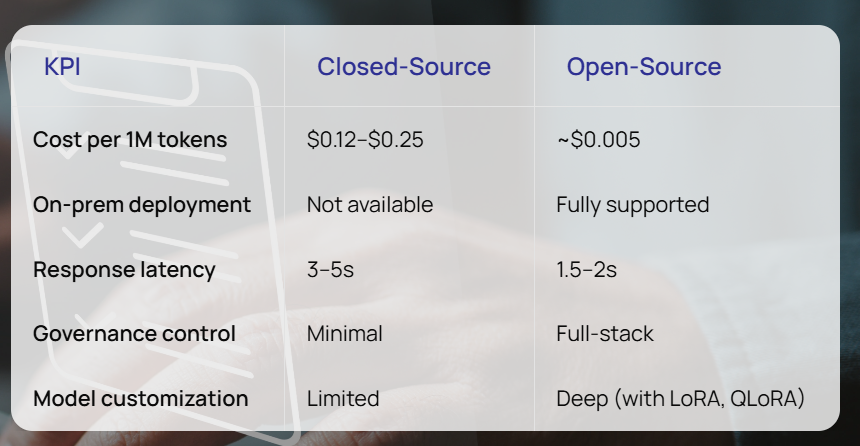
The pattern here is simple. A proprietary API is something you keep renting. A self-hosted open source LLM is infrastructure you own, and it gets more valuable to your organisation the more you use it.
How Calsoft helps with open source LLM integration
Calsoft's approach to open source model integration treats the model as one part of a larger stack, not the whole project. Model selection is benchmarked against your actual use case rather than a leaderboard score. Fine-tuning runs through LoRA and QLoRA, so the model learns from your data without that data leaving your environment. Embedding and retrieval layers connect it to your internal knowledge base for RAG-based workflows.
On the infrastructure side, serving runs on vLLM, TGI, or Triton, deployed inside a VPC or fully air-gapped depending on your requirements. Role-based access control, token-level audit logging, and red-teaming are built in before launch, not added afterward.
This is the kind of work an in-house team can eventually build on their own. Most do, by their second or third attempt. The first attempt, on production data, under a deadline, tends to be where the delays and rework happen the exact problems a specialist has usually already solved elsewhere.
The result isn't just a working model. It's an enterprise LLM your legal and security teams can actually sign off on, running on infrastructure you control, that improves every time you feed it more of your own data.
FAQs
Is open source AI as secure as proprietary models for enterprise use?
It depends on how it's deployed, not the license. A self-hosted open source LLM runs inside your VPC or on-premises, with role-based access and audit logging built in. Your data never has to leave your infrastructure to get an answer.
How long does open source LLM integration typically take?
A benchmarked pilot on one use case usually takes four to eight weeks. Full production deployment, including fine-tuning, RAG, and governance, typically takes three to four months, depending on your compliance requirements.
Do open source LLMs cost less than proprietary APIs?
Often, at scale. API pricing climbs with usage. Self-hosted infrastructure cost is mostly fixed once it's built. High-volume enterprise use cases usually recover that investment within months.