

Somewhere in your network operations center, an engineer is staring at a wall of alerts at 2 a.m., trying to decide whether a Border Gateway Protocol (BGP) route is down or the start of an outage. A network operations team does not need another chatbot that explains protocols such as BGP. It needs an AI system that can interpret live telemetry, understand network topology and policies, correlate incidents with recent configuration changes, and recommend the safest next action, without exposing sensitive operational data or making unauthorized changes.
This is the exact moment AI-Led Network Automation was built for. It is also where the risk becomes more serious. Once a Large Language Model (LLM) is connected to configurations, credentials, runbooks, ticketing systems, observability platforms, and automation APIs, a wrong answer can become a production event.
For enterprises in telecom, financial services, healthcare, manufacturing, government, and other security-sensitive sectors, On-Premise LLM Deployment offers a practical way to keep model inference, prompts, network data, and operational workflows within an environment the enterprise controls. But "inside the data center" is not the same as "secure." The architecture still needs identity controls, policy enforcement, model evaluation, observability, and strict separation between AI reasoning and network execution.
On-Premise LLM deployment: Securing AI-led network automation
Network automation was once largely deterministic: engineers defined templates, rules, and workflows, and systems executed known steps. LLMs introduce a reasoning layer that can interpret intent, summarize incidents, generate configuration options, retrieve troubleshooting guidance, and coordinate tools across domains—capabilities increasingly needed in complex, distributed networks. The shift is already underway. Cisco’s 2025 research found that 98% of leaders viewed AI-native autonomous networks as essential to future growth, yet only 41% had deployed intelligent capabilities.
For CTOs and network leaders, the challenge is balancing speed with control. AI can reduce alert fatigue, accelerate root-cause analysis, and simplify Network Automation with AI through intent-based interfaces. But without strong access controls, trusted context, and clear action boundaries, it can also scale errors across the network.
What is on-premise LLM deployment, and why deploy LLMs on-premises?
On-Premises LLM Deployment refers to running the complete LLM stack, including model weights, inference engine, orchestration layer, and retrieval pipeline, within infrastructure controlled by the enterprise. This may include an internal data center, private cloud, edge environment, or a fully air-gapped network with no external connectivity. Unlike a hosted API model, a Self-Hosted LLM keeps prompts, responses, operational telemetry, and sensitive network data within the enterprise security boundary. The organization retains control over model access, inference infrastructure, audit logs, data retention, updates, and failure handling. This level of ownership is fundamental to Secure LLM Deployment, particularly for regulated or mission-critical network environments. The distinction must remain clear, as the term is often used loosely. A deployment that requires external connectivity for license validation, telemetry collection, model updates, or core inference dependencies cannot be considered fully private. A true Private LLM Deployment operates without mandatory outbound dependencies in the inference path, enabling stronger data sovereignty, predictable security controls, and complete operational governance across the Enterprise LLM Deployment lifecycle.
How Calsoft Helps Enterprises Deploy Secure, Production-Ready AI
Calsoft works with enterprise network and infrastructure teams to design on-premise LLM deployment architectures that are secure by construction. Through its Custom LLM and RAG practice, Calsoft builds the gateway, access-control, and audit-logging layers that turn a promising proof of concept into a secure LLM deployment your security team will actually sign off on, whether the target environment is fully air-gapped, hybrid, or a private cloud footprint dedicated to your organization alone.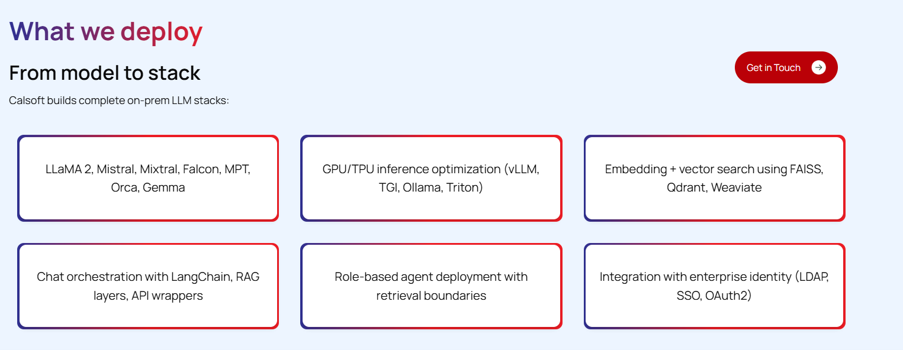
What CXOs Should Measure Before Scaling Enterprise LLM Deployment
For a CEO or business leader, the value of Enterprise AI in network operations should appear in service reliability, customer experience, release velocity, and risk reduction. For a CTO, VP of Engineering, or Director of Network Operations, the evidence must be more granular. Track mean time to detect and resolve, change failure rate, incident recurrence, percentage of recommendations accepted, percentage of actions auto-executed, rollback frequency, policy violations prevented, and engineering hours returned to higher-value work. Add AI-specific measures such as grounded answer rate, unauthorized data retrieval attempts, prompt-injection resistance, and model-serving availability. The infrastructure decision should also be based on total cost of ownership. Compare GPUs, power, cooling, platform engineering, support, model upgrades, and high-availability requirements against external inference costs and the business value of data control, latency, customization, and resilience. On-Premise LLM Deployment is strongest when the workload is steady, sensitive, deeply integrated, or latency-critical - not simply because on-premises sounds safer.
Enterprise LLM Deployment: Self-Hosted vs. Hybrid vs. Cloud
Most Enterprise LLM Deployment programs converge on one of three shapes, and the right answer depends on data sensitivity and workload volume rather than ideology.
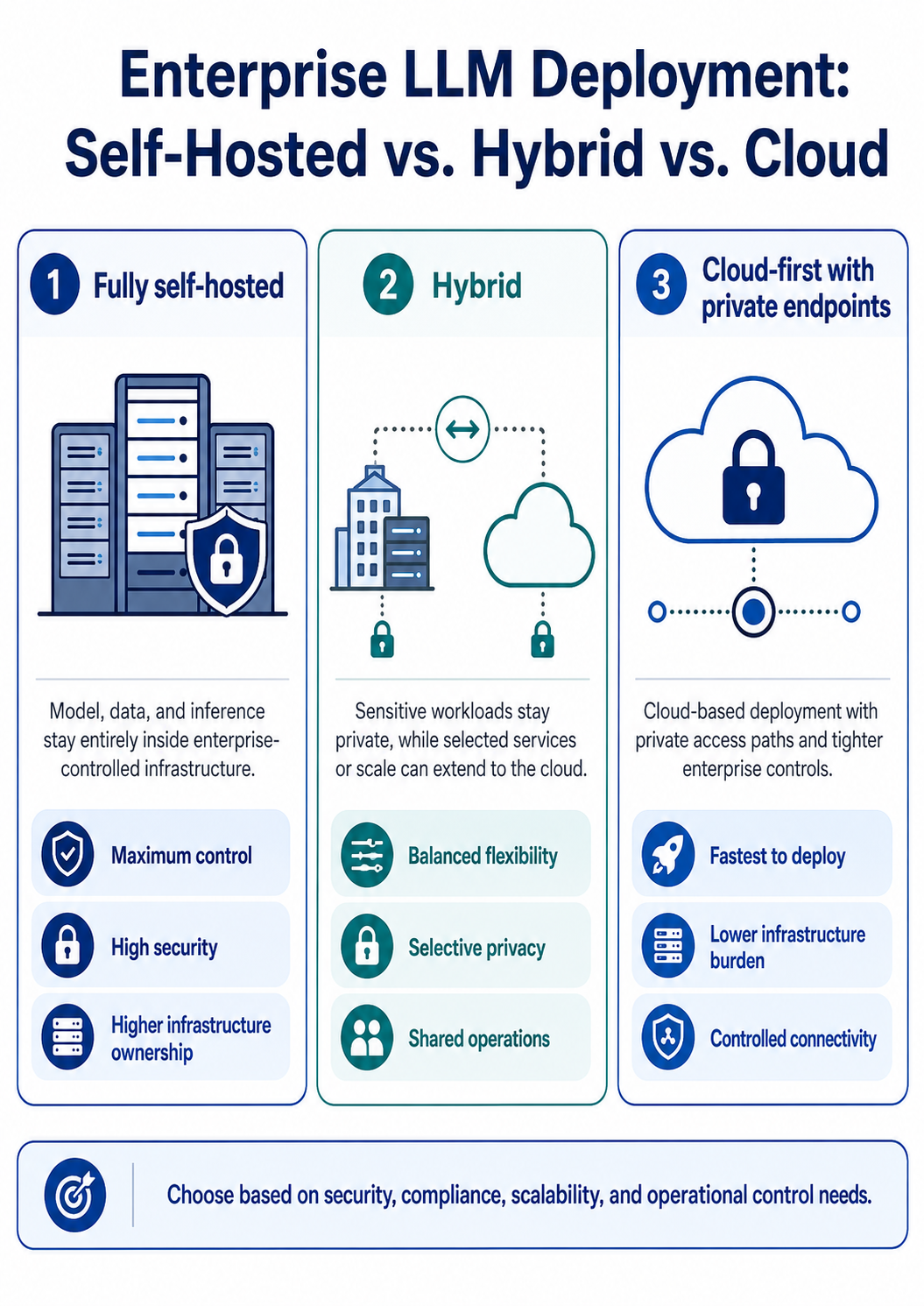
Fully self-hosted: A Self-Hosted LLM running on owned or colocated GPU infrastructure, serving 100% of inference internally. The standard for defense contractors, telecom carriers handling lawful-intercept data, and healthcare networks bound by HIPAA.
Hybrid: A compact, open-weight model handles the bulk of routine queries — config lookups, log summarization, ticket triage — on-premise, while a small share of non-sensitive, low-context tasks route to a cloud model when extra reasoning headroom is worth the trade-off.
Cloud-first with private endpoints: Acceptable for pilots and non-regulated business units, but rarely the end state once a network automation program touches production topology data.
The economics matter as much as the security posture. At sustained query volumes, self-hosted inference on owned hardware becomes meaningfully cheaper per token than metered API calls; industry benchmarking puts self-hosted inference at roughly an order of magnitude cheaper per token once volume clears a few tens of thousands of queries a month, which is exactly the range a busy NOC hits within weeks of go-live.
The executive decision should therefore be workload-led, not ideological. Some enterprises will use a fully on-premises model for high-sensitivity network operations and cloud models for low-risk productivity tasks. IDC found that 79% of organizations used multiple hyperscale platforms or a combination of hyperscale and on-premises platforms for GenAI workflows, reinforcing that Enterprise LLM Deployment is increasingly hybrid by design.
A Secure On-Premises LLM Deployment Architecture
The safest design principle is simple: the LLM should not become the network control plane. A production architecture should separate the reasoning plane, policy plane, and execution plane. The model can interpret intent and propose an action, but deterministic services should validate and execute that action through approved interfaces.
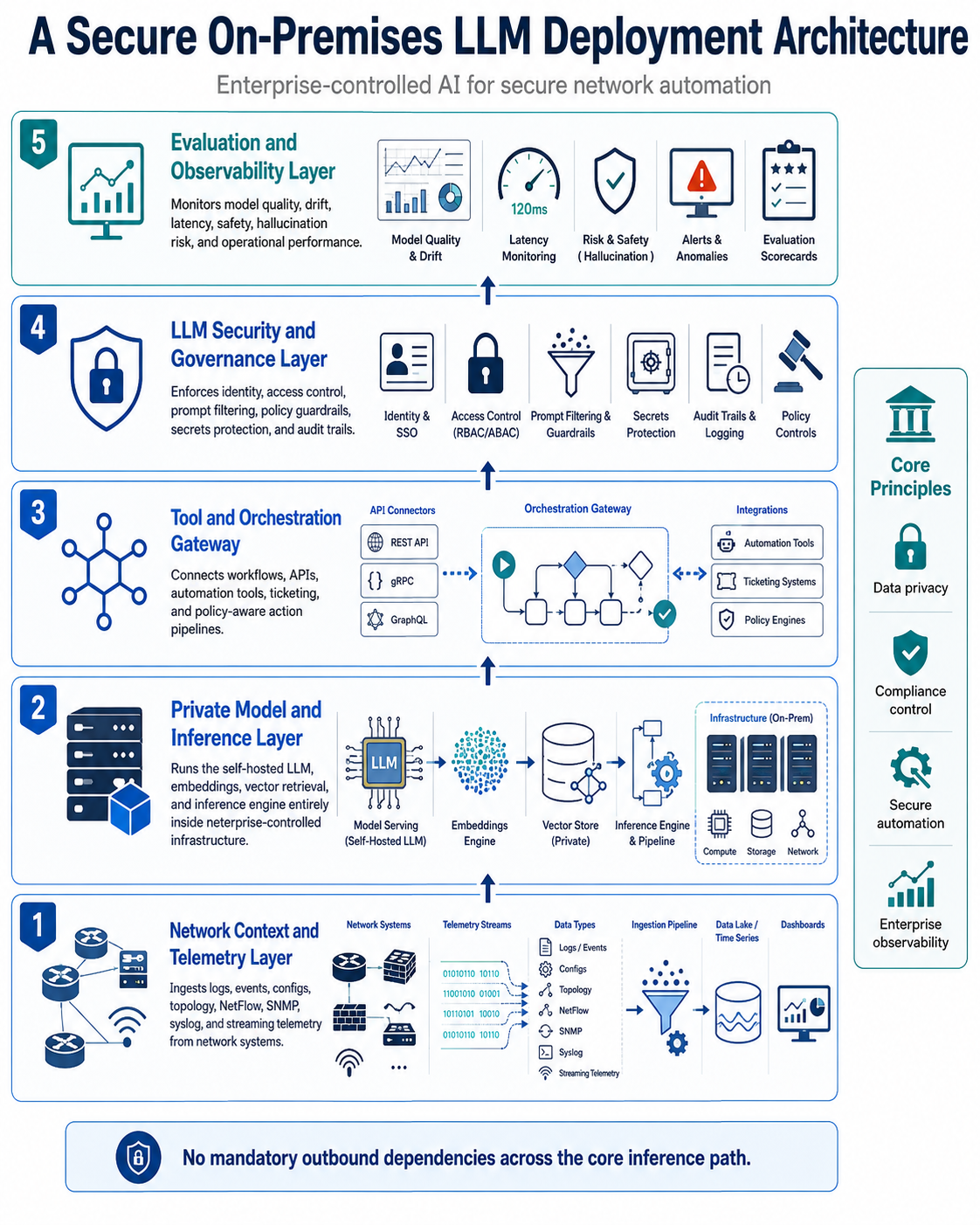
Network Context and Telemetry Layer The AI system needs current, authoritative context from streaming telemetry, SNMP, syslog, flow records, configuration repositories, topology services, CMDBs, incident platforms, and change-management systems. Data should be normalized, time-stamped, classified, and linked to the correct device, service, tenant, and policy domain. Retrieval should be permission-aware. A user who can view a branch network should not retrieve core-network credentials, customer-specific configurations, or restricted incident records. This is where RAG, metadata filtering, topology graphs, and role-aware retrieval become foundational to Secure LLM Deployment.
Private Model and Inference Layer The model-serving environment should include an approved model registry, signed artifacts, vulnerability scanning, controlled promotion between environments, and reproducible deployment manifests. GPU scheduling, tensor or pipeline parallelism, quantization, context caching, and request batching should be tuned against real concurrency and latency targets - not benchmark headlines. High availability matters because the LLM may become part of the operational workflow. Inference services need health checks, load balancing, capacity thresholds, fallback models, and a defined degraded mode when the AI layer is unavailable.
Tool and Orchestration Gateway The model should never receive unrestricted access to SSH sessions, controllers, or automation credentials. Tools should be exposed through a gateway that allowlists commands, validates schemas, enforces rate limits, and binds every action to a user, service identity, ticket, and approved purpose. Generated changes should pass through syntax checks, policy-as-code, dependency analysis, blast-radius estimation, simulation or digital-twin testing, and pre-change validation. For high-impact actions, the system should require human approval. For low-risk repetitive actions, it can use bounded automation with automatic rollback.
LLM Security and Governance Layer NIST's Generative AI Profile recommends integrating governance, pre-deployment testing, ongoing evaluation, and incident processes across the AI lifecycle. Every risks require layered controls: zero-trust access, least privilege, mTLS, encryption at rest and in transit, secrets vaulting, network segmentation, egress controls, signed containers, software bills of materials, and continuous vulnerability management. NIST's zero-trust guidance is especially important here: physical or network location should not create implicit trust.
Evaluation and Observability Layer LLM Security cannot be reduced to a firewall rule. Teams must evaluate whether the system retrieves the right evidence, respects permissions, produces valid configuration candidates, refuses unsafe requests, and stays within action boundaries. The evaluation stack should track groundedness, retrieval precision, policy violations, unsafe tool calls, false remediation recommendations, time to first token, end-to-end latency, GPU utilization, automation success, rollback rates, and operator overrides. Prompt and response traces should be redacted and routed to the enterprise observability and SIEM stack. Red-team testing should include indirect prompt injection through tickets, logs, documentation, and retrieved content.
From Copilot to Governed Network Automation with AI
For most organizations, the right path is staged. Stage one is read-only assistance: incident summaries, log interpretation, runbook retrieval, and natural-language search. Stage two adds recommendations, where the system proposes a remediation plan but cannot act. Stage three introduces guarded execution for predefined workflows, with approval gates and rollback. Stage four enables bounded closed-loop automation for narrow, high-confidence scenarios such as interface flaps, capacity thresholds, or known configuration drift. This maturity model gives engineering leaders a way to build trust through evidence. It also prevents a common mistake: connecting an impressive demo directly to production systems before the organization has defined ownership, risk tiers, and failure handling. The operational question is not, "Can the LLM generate the command?" It is, "Can the complete system prove that the command is authorized, contextually correct, policy-compliant, reversible, and observable?"

Secure AI-Led Network Automation Starts with Architecture Discipline
The next phase of AIOps will not be defined by larger models alone. It will be defined by how safely enterprises connect intelligence to action. A well-designed On-Premise LLM Deployment creates a controlled foundation for AI Infrastructure Security, private inference, domain-specific retrieval, and governed automation. It keeps sensitive operational context closer to the systems that generate it while giving engineering teams the freedom to tune models, integrations, and policies around real network workflows. The competitive advantage is not a chatbot that knows networking terminology. It is an auditable decision system that helps operators move faster without giving up control.
Frequently Asked Questions
What is an on-premises LLM?
It is a large language model that runs entirely within an organization's own infrastructure — on owned hardware, in a private data center, or air-gapped — rather than being accessed through a third-party cloud API.
Why deploy LLMs on-premises?
To keep sensitive data — network configs, customer records, proprietary telemetry — inside the organization's own perimeter, meet regulatory and data-residency requirements, and avoid the latency and unpredictable cost of cloud APIs at scale.
Is on-premises LLM more secure than cloud deployment?
It removes an entire category of risk — a third party in the request path — but security still depends on how the deployment is architected: access control, network segmentation, and audit logging matter as much as the hosting location.
What are the benefits of AI-led network automation?
Faster incident triage, root-cause correlation grounded in real topology and history, natural-language querying of network state, and a reasoning layer on top of existing monitoring and AIOps tooling.
How do enterprises secure LLM deployments?
Through an authentication gateway, role-based access control mapped to existing IAM, audit logging on every query, network segmentation around the inference cluster, and strict controls on outbound traffic and model updates.
What infrastructure is required for an on-premises LLM?
GPU capacity sized to the model and expected query volume, a serving engine, an authentication and logging gateway, and typically a vector database for retrieval — all sized and hardened for the organization's specific workload.
Can LLMs automate network operations?
Yes, typically in an AI-recommends, human-approves pattern: the model correlates telemetry and proposes remediation, and a human engineer authorizes execution, with full autonomy reserved for low-risk, well-tested scenarios.
What industries benefit from private LLM deployment?
Telecom, financial services, healthcare, defense, and any organization handling regulated, classified, or competitively sensitive data where cloud data residency is not an acceptable trade-off.