

Traditionally, testing was a manual and time-consuming task. Test engineers spent countless hours running tests by hand, searching for bugs, and documenting each result. Then came the 2000s, bringing automated tools that sped up processes and reduced errors. However, these tools required constant updates and often missed critical issues, leaving gaps in the testing process.
Fast-forward to today — testing has evolved significantly. The emergence of key technologies such as Machine Learning (ML) and Artificial Intelligence (AI) has transformed software development and testing. ML-powered test impact analysis now plays a pivotal role by predicting the impact of code changes, prioritizing critical tests, and streamlining workflows. This modern approach saves time and improves software reliability and robustness.
According to Grand View Research, the global AI-enabled testing market is projected to grow to USD 2,746.6 million by 2030, at a CAGR of 20.7%.
This blog explores how technologies like ML and AI influence testing and Quality Assurance (QA) processes.
Traditional Test Impact Analysis Methods
Traditional impact analysis methods help determine which tests to run after code changes. These methods improve efficiency by focusing on the most relevant tests, saving time and resources. However, as projects grow more complex, they face challenges in managing dependencies, maintaining coverage, and ensuring efficiency.
Dependency-Based Test Selection
Tests are selected based on dependencies between code and test cases. This works for small projects but becomes cumbersome as dependencies grow.
Selective Test Running
Only tests likely affected by recent changes are executed, saving time but requiring deep codebase knowledge and accurate criteria to avoid missing critical tests.
Manual Analysis
Engineers manually decide which tests to run. While flexible, this method is error-prone and inefficient for large projects.
Limitations of Traditional Approaches
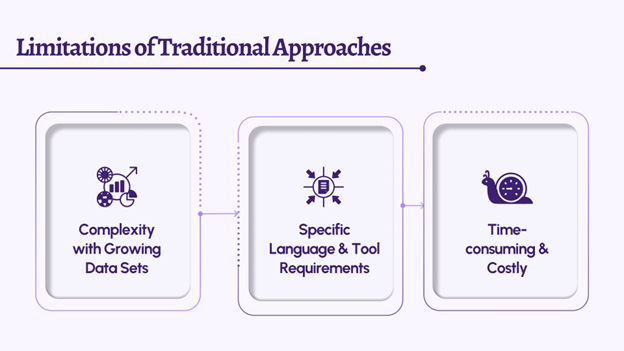
- Complexity with Growing Data Sets: More dependencies make managing tests harder.
- Tool and Language Constraints: Requires specific environments, reducing flexibility.
- Time-consuming and Costly: Manual testing scales poorly with project size.
What is ML-Powered Test Impact Analysis?
ML-powered test impact analysis uses data-driven models to predict which tests are most affected by code changes. Instead of running all tests, it analyzes historical data and identifies only those most relevant to recent updates. This saves time, resources, and improves software quality.
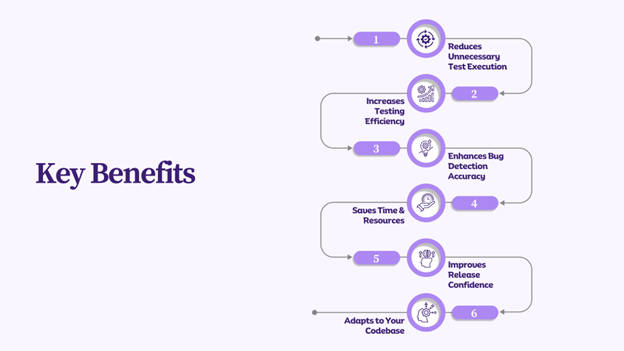
- Eliminates redundant test runs, speeding up execution.
- Identifies bugs earlier by prioritizing critical tests.
- Increases defect detection rate by focusing on risk-prone areas.
- Reduces time and resource usage.
- Ensures better coverage and release confidence.
- Improves continuously through learning from data.
Predictive Test Selection with AI/ML
Predictive test selection leverages ML/AI to forecast which tests are most relevant to code changes. This reduces redundancy and enhances test coverage efficiency.
Using Machine Learning to Select Valuable Tests
Historical test data is fed into an ML model that learns which changes typically cause failures. For example:
- If a change affects a known buggy module, related tests are prioritized.
- Minor UI changes trigger UI-specific tests; data-flow changes may trigger integration tests.
Dynamic Selection for Specific Code Changes
Unlike fixed test suites, ML models dynamically adapt test selection to the nature of each change.
Static vs. Predictive Test Selection
| Criteria | Static Test Selection | Predictive Test Selection |
|---|---|---|
| Test Basis | Manual, pre-defined | Data-driven, dynamic |
| Adaptability | Low | High, adapts per change |
| Efficiency | Runs unnecessary tests | Executes only relevant tests |
| Learning | None | Improves continuously |
| Implementation | Simple but limited | Requires setup but highly effective |
Machine Learning Model Training
Training ML models for test impact analysis involves learning from historical test data and code changes to predict future test relevance accurately.
Training on Test Results and Code Change Metadata
The model analyzes how specific changes affect test outcomes. For example, if database modifications frequently cause test failures, related tests are prioritized.
Predictive Patterns for Test Case Impacts
Trained models recognize which types of changes often lead to failures, allowing them to predict test impacts in future builds automatically.
Integration with Tools
Integrate ML models with CI/CD tools to dynamically select relevant tests and reduce testing overhead while maintaining coverage accuracy.
Challenges and Considerations
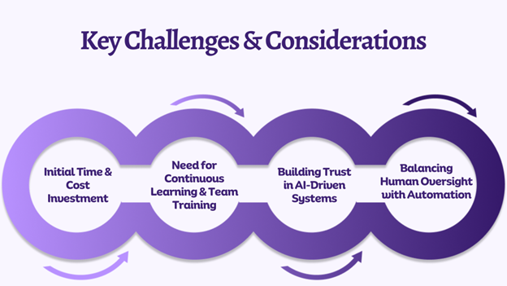
- Initial Investment: Requires setup, data collection, and model training.
- Continuous Learning: Teams must stay updated on ML advancements.
- Trust in AI: Explainable AI outputs help developers trust model predictions.
- Human Oversight: Balance automation with manual validation for accuracy.
CalTIA: Elevating Your Testing Efficiency
Calsoft’s Machine Learning-powered Test Impact Analyzer (CalTIA) redefines test optimization by focusing on critical code areas. It continuously analyzes code changes to recommend relevant tests, ensuring precision and efficiency.
- ML-driven proactive test recommendations per release.
- On-premise deployment for enhanced data security.
- Zero-touch, non-intrusive workflow requiring minimal input.
- Easy setup and smooth integration into existing pipelines.
- Support for multiple CI tools, repositories, and frameworks.
Future Trends in ML-Powered Test Impact Analysis
As ML and AI evolve, test impact analysis will become faster, smarter, and more adaptive. Cloud-based testing platforms will enhance scalability, while integration with DevOps and Agile workflows will deliver faster, more reliable releases.
Conclusion
Imagine a faster, smarter testing process seamlessly embedded in your development pipeline — that’s the potential of ML-powered test impact analysis. By adopting this approach, you enhance software reliability, reduce testing times, and gain a competitive edge.
As a technology-first partner, Calsoft accelerates digital transformation journeys with “just-in-time” quality checks and ready-to-use automation solutions that save time, effort, and costs.