

Technological advancements have been fundamentally driven by the growing demand for efficient, capable, and reliable data storage solutions. Data plays a critical role in every application that supports business processes, making it essential to ensure persistence in data storage. Developers must consider data persistence in application performance to guarantee a seamless user experience.
Data persistence refers to the permanence of data even after an application has been closed. It ensures that data is stored sustainably to automate business processes. That’s where the pioneering technology MicroStream comes into play!
The MicroStream framework has gained significant traction in recent years for its high performance and in-memory persistence capabilities that deliver ultra-fast applications. Let’s explore how MicroStream is transforming the future of data persistence.
What is MicroStream and Why is it Needed?
When the data structure in memory differs from the one in a database, developers often rely on complex and time-consuming query operations. While Object Relational Mapping (ORM) frameworks can reduce the need for direct database queries, they are often slow and inefficient.
MicroStream eliminates the need for a mapper to store data in memory. This allows developers to work directly with objects, increasing throughput, minimizing latency, and saving up to 90% of the power consumed during traditional data mapping processes.
The vision of MicroStream is to simplify and accelerate database development in the Java environment. Although Java is known for its “Write Once, Run Anywhere” (WORA) capability, data persistence in Java applications is often complex and costly. MicroStream offers an efficient solution for storing and retrieving complex Java objects.
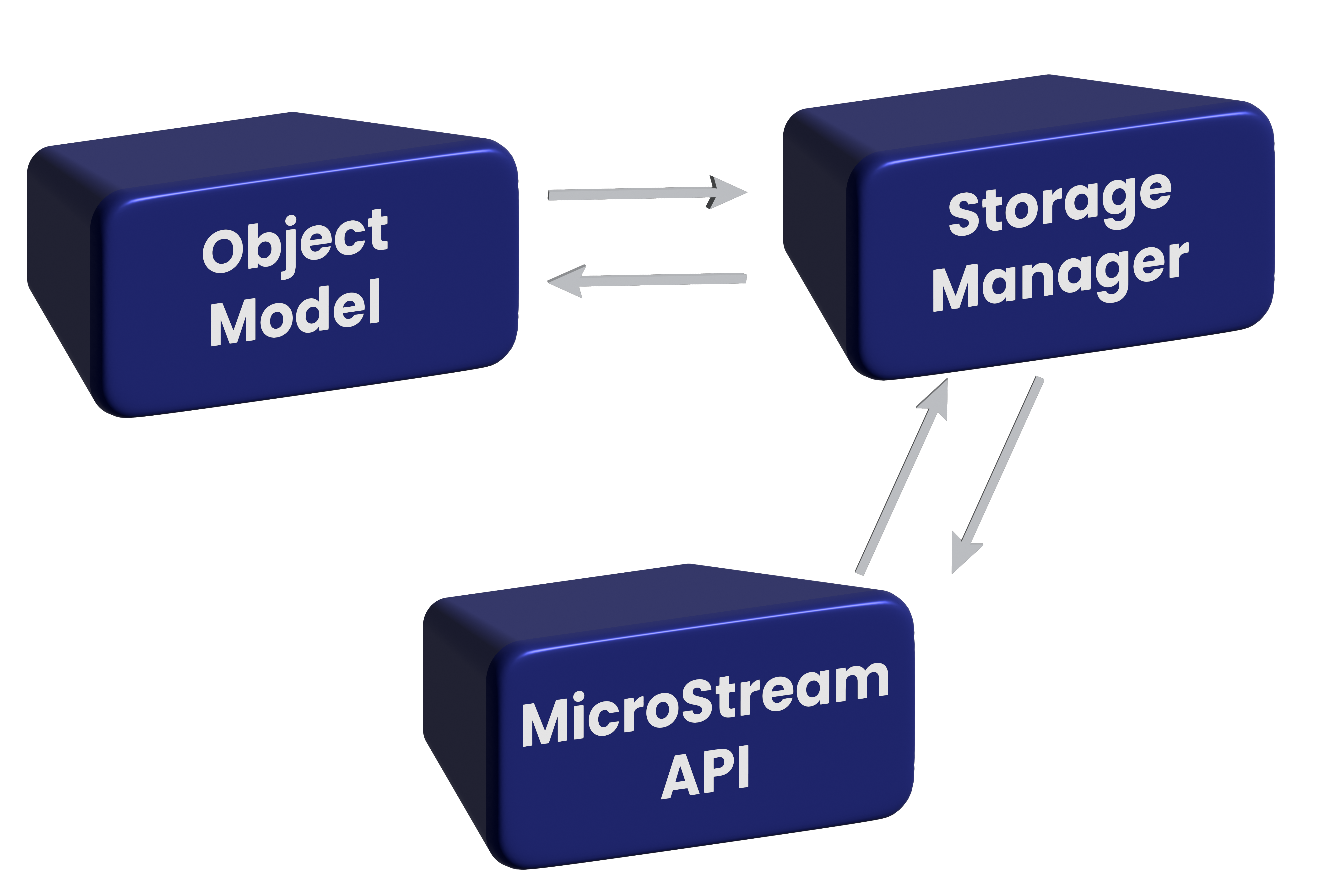
MicroStream is an open-source object graph persistence engine for the Java Virtual Machine (JVM) that uses a custom serialization model. It is not a Database Management System (DBMS). MicroStream supports storing any Java object and restoring them in memory (RAM) in a binary format. This persistence layer can be used in various environments such as cloud-native microservices, serverless architectures, IoT applications, and traditional monolithic systems.
In the MicroStream framework, data transactions are stored in an optimized serialization byte format known as the native-binary format. In Java, serialization refers to converting an object into a byte stream that can be transmitted across a network. MicroStream’s Storage Manager maintains the primary object graph, which can be accessed efficiently via MicroStream APIs.
Table I. Key Differentiators: Native Persistence vs MicroStream
| Differentiators | Native Persistence | MicroStream |
|---|---|---|
| Storage Location | Disk | Memory |
| Data Format | Relational | Native-Binary |
| Persistence Procedure | Delta | System Prevalence |
| Intricacies | Medium | Low |
| Performance | Good | Excellent |
| Maintenance | Medium | Low |
Key Advantages of MicroStream
- Ultra-fast in-memory storage: No ORM or database translation required.
- High scalability: Capable of storing and retrieving large object graphs in distributed environments.
- Efficiency and cost-effectiveness: Enables seamless storage of Java objects of any size or complexity into cloud or binary data stores in a compact binary format.
In Brief
MicroStream is a Java-based persistent data storage technology designed for high-performance and ultra-fast applications. Its innovative serialization mechanism allows developers to build responsive and efficient Java applications. With advantages like speed, simplicity, scalability, and reliability, MicroStream is emerging as a standard for modern application development. Integrating MicroStream with other database systems presents enterprises with opportunities for improved performance across industries.
As a technology-first company and pioneer in product engineering services, Calsoft specializes in storage engineering and optimization solutions. Calsoft’s offerings play a substantial role in supporting next-generation data persistence trends.
References
- Adrian Bridgwater, “MicroStream persistence framework open sourced,” TechTarget
- Why MicroStream
- Matthew Tyson, “Intro to MicroStream: Super-fast serialization in Java,” InfoWorld