
The merger of software and networking is one of the key drivers behind radical developments in modern network infrastructure. Software-Defined Networking (SDN) and virtualization are redefining how networks are managed and designed. Focused on delivering flexibility, efficiency, and scalability, these technologies are forming the foundation for future innovations. Among them, SDN stands out as a revolutionary approach to network administration, while virtualization remains the core enabler powering it.
Recently, SDN and virtualization have emerged as transformative forces, reshaping how network infrastructure is architected and managed. One notable innovation in this domain is VMware’s NSX series — a pioneer in network virtualization. However, to fully leverage the benefits of NSX-based infrastructure, organizations must proactively stay informed about the latest developments in the NSX ecosystem.
A common question enterprises face is: Why upgrade from NSX-V to NSX-T? VMware’s NSX platform is among the most popular SDN solutions, offering all essential capabilities to create complex virtual networks. As enterprises modernize their infrastructure to meet evolving business needs, migrating from NSX-V to NSX-T has become crucial — not only because of VMware’s end of support for NSX-V but also because NSX-T offers significant advancements. However, before migrating, it’s important to understand the differences between the two platforms. Let’s explore NSX-V and NSX-T and their key differentiating factors.
Brief Understanding of NSX-V and NSX-T
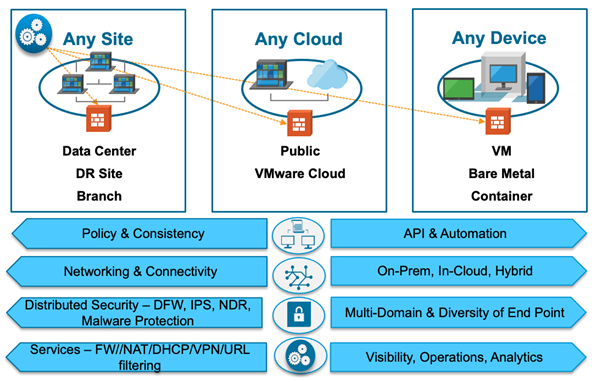
VMware NSX is a next-generation network virtualization platform that enables organizations to shift their networking operations to the cloud. It provides a unified network and security model that supports consistent policy enforcement, operations, and automation across hybrid and multi-cloud environments.
The image below illustrates the overall NSX architecture.
How Does NSX Work?
VMware NSX achieves end-to-end network virtualization through network encapsulation, which involves wrapping traffic in supported protocols like Generic Routing Encapsulation (GRE). This approach segments physical networks into independent virtual networks, eliminating the need for expensive on-premises hardware. At its core, NSX Data Center virtualizes essential networking elements such as VPNs, firewalls, and load balancers — enhancing agility, performance, and control.
NSX-V (for vSphere) was VMware’s flagship virtualization solution tightly integrated with VMware environments. With the release of NSX-T (Transformers), VMware introduced a modernized solution built for diverse, multi-hypervisor, and multi-cloud ecosystems.
Understanding the Transition and the Need to Migrate
Before exploring migration details, it’s essential to understand why transitioning from NSX-V to NSX-T is important. While NSX-V excels in VMware-based data centers, NSX-T extends its capabilities to containerized workloads, hybrid clouds, and multi-hypervisor environments. This flexibility makes NSX-T a more robust and scalable solution for modern enterprises.
Key reasons to migrate from NSX-V to NSX-T include:
- End of support for NSX-V
- Enhanced security and micro-segmentation features
- API-driven architecture supporting automation and DevOps
- Improved scalability and performance
- Comprehensive support for hybrid and multi-cloud environments
NSX-V vs NSX-T: Key Differentiating Factors
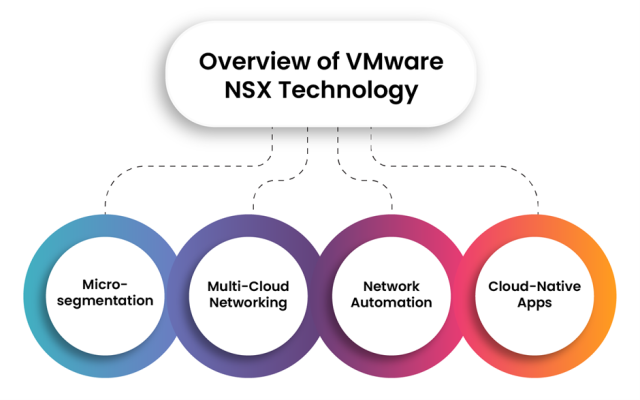
Overview of VMware NSX Technology
Architecture: NSX-V operates within the VMware vSphere ecosystem, tightly coupled with vCenter and ESXi hosts. NSX-T, however, has a decoupled architecture, supporting multiple hypervisors (KVM, ESXi), Kubernetes, and bare-metal environments — providing greater flexibility.
Networking Models: NSX-V uses VXLAN for overlay networking, while NSX-T employs the Geneve protocol for enhanced scalability and interoperability across diverse infrastructures.
Security Features: Both platforms prioritize security, but NSX-T expands micro-segmentation across containers, multi-cloud, and bare-metal systems. Its distributed firewall offers deeper visibility and control.
Automation and Orchestration: NSX-T embraces an API-first model, enabling seamless integration with automation tools and infrastructure-as-code workflows — ideal for DevOps environments.
Operational Considerations: Migrating from NSX-V to NSX-T requires planning and testing. NSX-T provides improved scalability but may require re-architecting workflows. Conducting end-to-end testing ensures smooth migration with minimal disruption.
Key Steps for Migration
Assessment and Planning: Evaluate existing infrastructure and dependencies. Develop a migration roadmap with rollback strategies and testing checkpoints.
Pilot Deployment: Start with a pilot project to validate migration processes and compatibility before full-scale deployment.
Incremental Migration: Migrate workloads gradually, starting with low-impact applications, while continuously monitoring performance and functionality.
Training and Knowledge Transfer: Ensure your IT teams are trained on NSX-T management and operations to optimize platform performance and adoption.
The following table provides a comparative view of NSX-V and NSX-T features:
| Feature | NSX-V | NSX-T |
|---|---|---|
| Basic Functions | Offers advanced network deployment, reconfiguration, and provisioning. Allows a single virtual switch to connect multiple hosts via vSphere Distributed Switch. | Provides an agile, software-defined infrastructure for cloud-native applications. Supports multiple clouds, hypervisors, and bare-metal workloads. |
| Origin | Introduced in 2012, built around VMware’s vSphere environment. | Developed from scratch to address multi-cloud and containerized use cases beyond NSX-V. |
| Hypervisor Support | Supports VMware vSphere environments. | Supports vSphere, Docker, Kubernetes, and OpenStack environments. |
| Migration | No migration path to NSX-T. | Includes a built-in migration utility for transitioning from NSX-V. |
| Deployment | Deployed within ESXi virtual machines. | Deployed as ESXi or KVM virtual machines, supporting multiple environments. |
NSX-V and NSX-T differ in several critical aspects, but transitioning requires proper planning — including assessment, pilot testing, incremental rollout, and training. Organizations must invest in testing and training to ensure a seamless migration and unlock NSX-T’s full potential.
Conclusion
As enterprises accelerate their digital transformation journeys, migrating from NSX-V to NSX-T marks a major step toward modern, software-defined networking. Understanding the differences between these platforms and adopting a strategic migration approach enables businesses to achieve agility, scalability, and security in their network operations.
Calsoft — a VMware partner for over 23 years and recently recognized as an official Broadcom-VMware vendor — brings extensive NSX expertise to guide your NSX-V to NSX-T migration with confidence.