
Do more with less. Scalable. Agile. Whatever you call it, cloud computing is a technology that comes with a plethora of benefits. Cloud computing enables businesses to drop mundane and routine tasks and focus more on strategic ones driving innovation and growth. Well, cloud computing is not just about efficiency but a lot about unlocking limitless possibilities opening up in the digital era.
As corroborated by Gartner, 85% of organizations will go for a cloud-first approach by 2025. Adding to this, a LogicMonitor Cloud 2025 survey states that by 2025, 28% of corporate workloads will be in the public cloud, and 30% will be in the private cloud. While many enterprises are opting for public cloud adoption, it is essential to note that if migration does not happen the right way, it can not only jeopardize data integrity and hurt the budget but tarnish your business’s reputation.
Here is our insight into this migration from the private onsite premise to the public cloud migration – the emergence of Generative AI (GenAI) and Large Language Models (LLMs)! According to McKinsey, the use of generative AI is cutting down cloud migration efforts by 30% to 50% when done correctly.
Another earlier cloudshifter factor was the pandemic of 2019 that saw many companies struggling to provide access to vital data that was locked in silos on-premises. The realization dawned that shifting certain data and applications to the cloud could be beneficial for easy accessibility across the geospatial spectrum. So it won’t be wrong to say, the future of the public cloud is already at our doorstep in 2024!
These are just the stimulants!
The biggest motivator is Data — something that every industry across the globe churns out daily – an estimated staggering 328.77 million terabytes of data come into existence daily. Thus far, organizations have been analyzing structured data for their business strategy or to meet customer demands. However, with the entry of GenAI and LLMs, data, both structured and unstructured, can now be analyzed in real time, resulting in better decision-making and bringing in creativity and innovation much faster.
Now for GenAI and LLMs to work on huge data sets, not all organizations can manage high-end servers on-premise or real-time access to clients or customers across the geo-temporal spectrum. Hence migrating to the public cloud becomes essential for easy accessibility along with a host of other benefits. Read the blog to understand the key factors enabling the private to public cloud migration.
Why Migrate to the Public Cloud?
Cloud migration, put simply, means moving all your digital assets from their physical space to the cloud space. This includes data, databases, software systems, or applications, which can be moved from on-premises servers to cloud platforms hosted by third-party providers like Amazon Web Services, Google, or Microsoft.
And here’s why we see the growing shift to hosting data and applications on the public cloud. The public cloud is far more scalable than most on-premises data centers. Its crucial support in terms of automation of large and complex workloads and its flexibility in response to user demand and quick access to data have proven its strong capabilities.
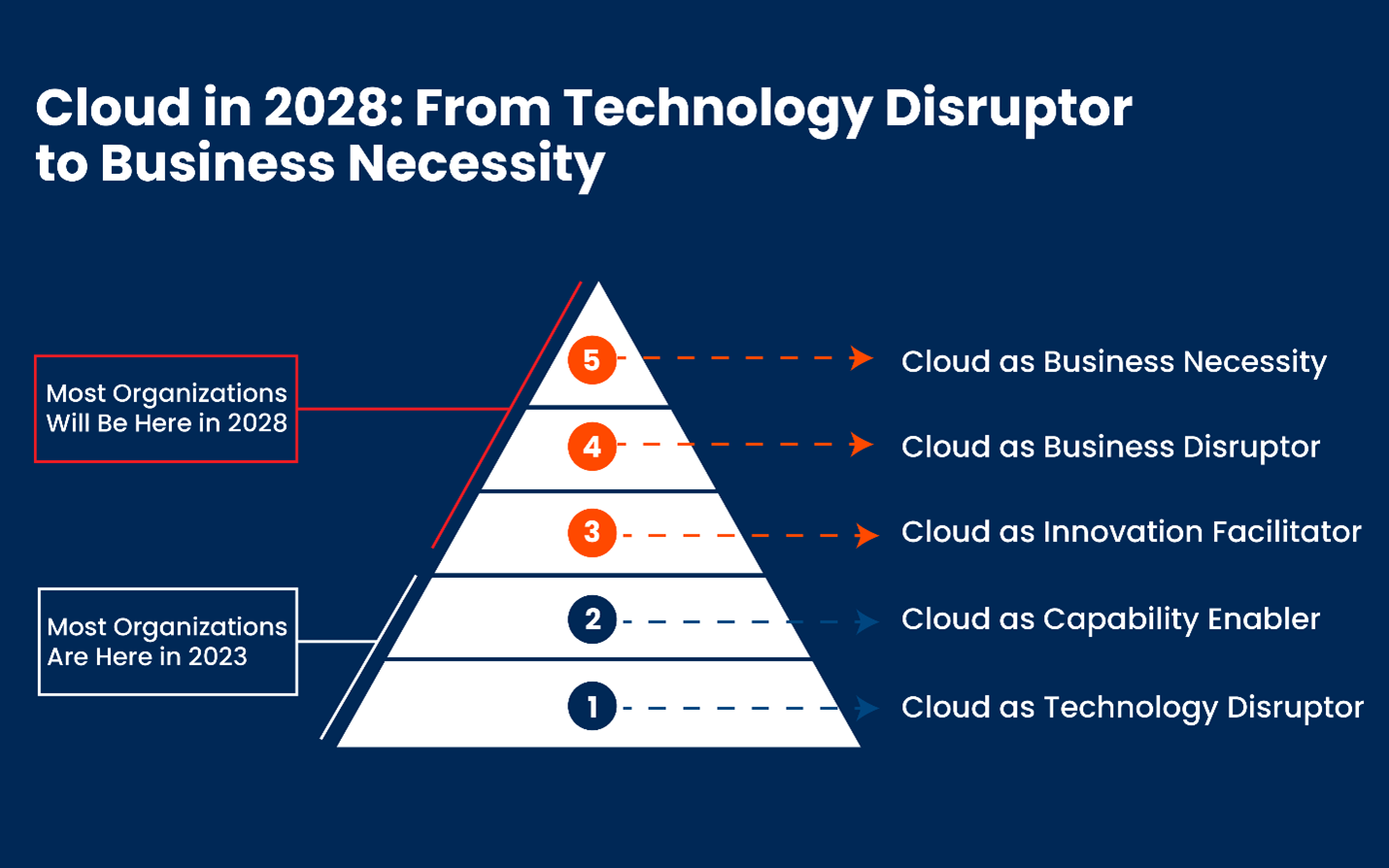
Cloud migration is gradually evolving from Cloud as a Technology Disruptor to Cloud as a Business Necessity, as explained in Figure 1.
Where do you see your organization in 2028?
Understanding the Basics of Private to Public Cloud Migration
Four words that define the migration from private to public cloud
FLEXIBILITY, SCALABILITY, EFFICIENCY, INNOVATION
If you have decided to shift from on-premises to cloud, to derive maximum benefits, three key considerations for a successful migration from private to public cloud need to be incorporated. A few foundational basic concepts need to be borne in mind.
The First Key Consideration: The 7Rs of Cloud Migration
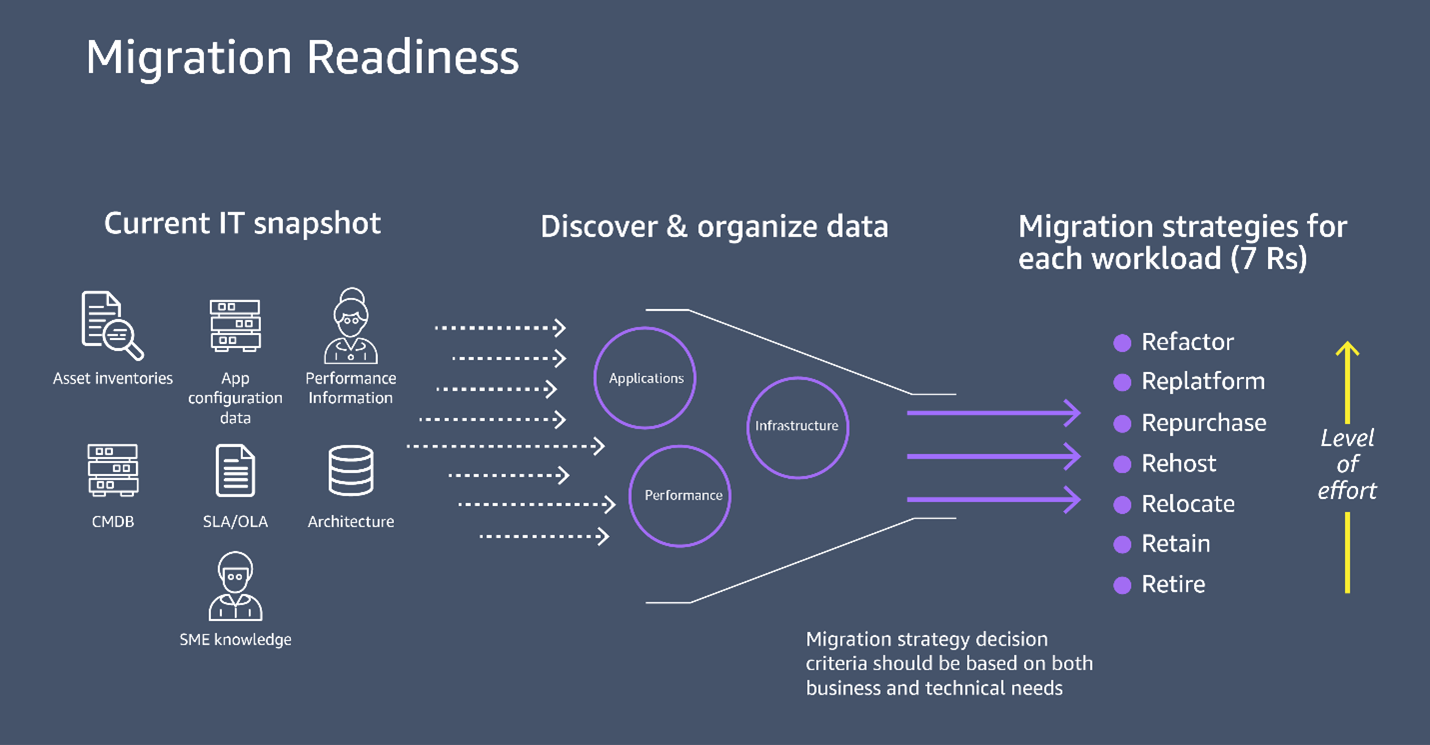
Employ the simple approach to understanding the 7Rs of cloud migration as shown in Figure 2, which is essential to the organization’s strategy based on the business needs, technical challenges, and the desired outcome of the migration.
| Rs of Cloud Migration | Description | Benefits |
|---|---|---|
| Refactor/Re-architect | Changing the application’s architecture to fully utilize cloud-native features. | Suitable for businesses that aim to add scalability, improve performance, or leverage advanced cloud capabilities. |
| Re-platform (Lift and Reshape) | Applications are moved to the cloud with minimal changes but optimized for cloud capabilities. | A middle ground between rehosting and refactoring. |
| Repurchase (Drop and Shop) | Moving to a different product, often a cloud-native solution. | Similar to switching to a cloud-based version of an existing program offering greater features and efficiency. |
| Rehost (Lift and Shift) | Simple method transferring current apps to the cloud without any changes. | Quickest migration method but doesn’t fully utilize cloud advantages. |
| Relocate (Hypervisor-Level Lift and Shift) | Migrating virtual machines to the cloud through hypervisors. | Used when the on-premises environment closely resembles the cloud environment. |
| Retain (Revisit) | Keeping certain applications on-premise rather than shifting to the cloud. | Depending on confidentiality and security requirements. |
| Retire | Eliminating redundant or unnecessary data. | Helps focus on critical applications and save resources. |
The Second Key Consideration: Identify the 5 Types of Cloud Options
There are five types of cloud options to choose from as shown in Figure 3.
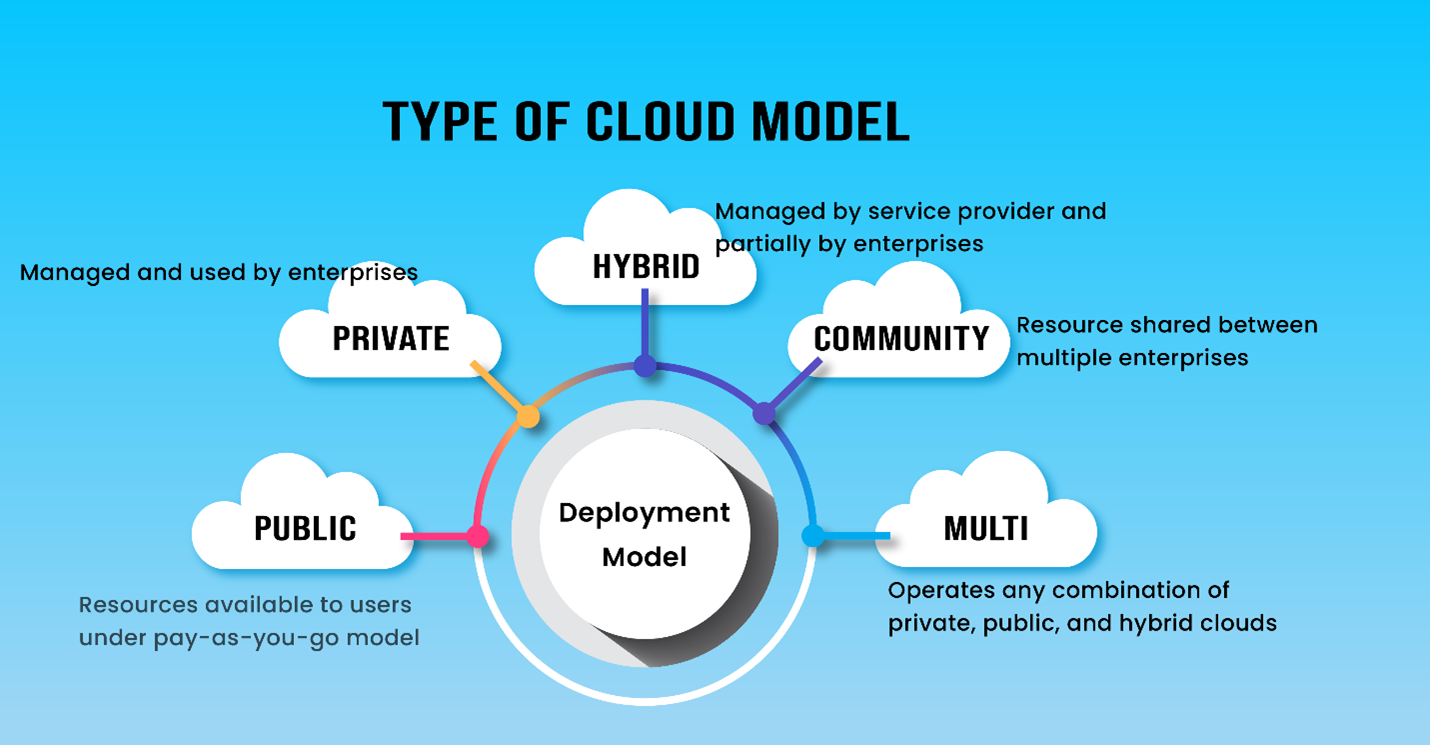
- Private Cloud: Enhanced security, customization, and improved performance.
- Public Cloud: Scalability, flexibility, cost efficiency, and global accessibility.
- Hybrid Cloud: Flexibility, data control, compliance, and resource optimization.
- Multi-cloud: Redundancy, vendor diversification, and optimized workload placement.
- Community Cloud: Cost-effective, flexible, scalable, and shared infrastructure.
Third Key Consideration: Choosing the Right Cloud Services
Understanding the major cloud services for deployment models based on business needs is important:
- Infrastructure as a Service (IaaS): Provides virtualized infrastructure for on-demand storage and networking. Examples: AWS EC2, Rackspace, Google Compute Engine.
- Platform as a Service (PaaS): Offers a platform for applications maintained by the business. Examples: AWS Elastic Beanstalk, Heroku, Azure services.
- Software as a Service (SaaS): Delivers cloud-based applications for business users. Examples: Salesforce, Dropbox, Slack, MailChimp.
How to Migrate: The Roadmap
- Decide on a Business Model
- Define Migration Strategy
- Estimate Costs
- Choose Cloud Type
- Choose Deployment Type
- Design the Architecture
- Define and Run Migration Steps
Planning
- Define objectives and business goals to select the right provider and model.
- Assess current IT infrastructure and dependencies.
- Manage costs effectively and avoid vendor lock-in.
- Employ a phased approach for smoother transition.
Implementation
- Choose the right hosting partner (AWS, Azure, or Google Cloud).
- Conduct rigorous testing before production.
- Plan and execute data migration carefully.
- Address networking requirements and security concerns.
Maintenance
- Ensure secure data storage and encryption.
- Maintain compliance and privacy policies.
- Develop a disaster recovery and business continuity plan.
- Optimize cloud spending through monitoring and automation.
Be Aware of the Challenges
- Lack of Strategy: Without a solid plan, migration can fail.
- Technical Considerations: Address compute, performance, and scalability issues.
- Costs: Pay-per-use can impact budget unpredictably.
- Vendor Offers: Verify vendor reliability and exit strategies.
- Security & Compliance: Ensure data safety and regulatory adherence.
- Cybersecurity: Implement ongoing monitoring and optimization.
Benefits of Migration
- Reduces operational burdens and hardware investments.
- Reduces hosting costs and downtime.
- Enhances ROI through cost optimization.
- Improves network latency and security.
Every organization using the public cloud must scale cloud resources to match business growth, integrate new tools, and refine strategies continuously. Successful migration depends on thoughtful planning and strategic alignment.
In a Nutshell
For a streamlined and successful migration from private or on-premises to public cloud, organizations should partner with experienced technology providers.
We, at Calsoft, a Technology-First company and a pioneer in software product engineering services, act as trusted partners with expertise in assessing, evaluating, and implementing the right fit for your cloudification and migration needs.