
.jpg)
In today’s competitive marketplace, customer experience (CX) stands out as a key business differentiator. Customers now expect seamless and personalized interactions across every channel. As a result, businesses are increasingly relying on AI-powered CX solutions to not only improve their CX quotient but also gain a sustainable competitive edge.
We’ve previously explored how the power of CX Engineering can impact business growth and revenue. In this article, we’ll delve into how integrating Artificial Intelligence (AI) and Machine Learning (ML) into CX engineering enhances customer interactions. But first, let’s understand where these technologies can make the most difference—by identifying key customer touchpoints and stages in the customer journey that benefit most from intelligent automation.
What AI-Powered CX Looks Like
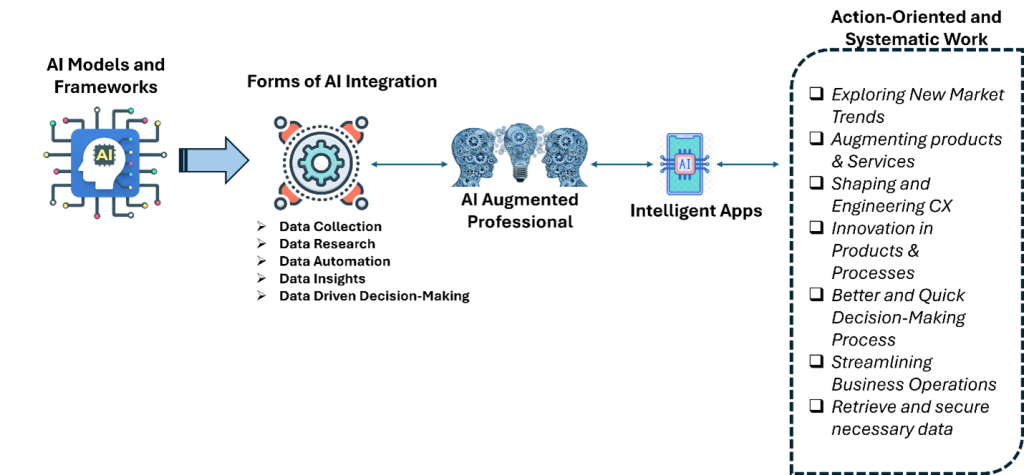
Customer experience (CX) has become the top business differentiator. Modern customers expect personalized, seamless experiences across every touchpoint. To meet these expectations, organizations are adopting AI-powered CX systems that integrate AI, ML, and Natural Language Processing (NLP) to deliver data-driven insights and exceptional customer interactions.
These technologies help businesses anticipate customer needs, analyze behavior patterns, and deliver personalized interactions at scale. Applied strategically in CX engineering, AI and ML automate repetitive processes, improve service quality, and strengthen customer loyalty.
Imagine a virtual assistant that not only answers “Where is my order?” but also detects frustration in tone and intelligently escalates the issue when necessary. Or an AI engine that predicts what your customer wants before they even ask.
However, real-world systems are rarely clean. Data often resides in silos across CRMs, social platforms, and email tools. Powering AI in CX requires a robust framework to consolidate data, train sentiment and churn models, deploy them in real time, and monitor performance continuously.
Building an effective customer experience architecture—spanning design, testing, insights, and marketing—requires collaboration between customers, marketers, platform providers, and regulators. This ensures secure, scalable, and interoperable AI-driven services aligned with evolving market demands.
Benefits of AI in CX Engineering
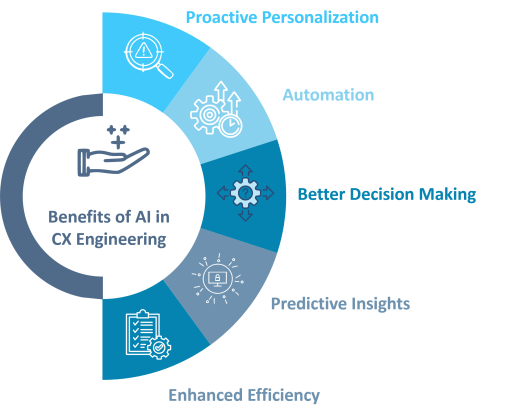
- Personalization at Scale: AI algorithms analyze vast datasets to create hyper-relevant recommendations, offers, and experiences.
- Predictive Insights: ML models forecast trends, detect churn risks, and guide proactive engagement strategies.
- Automation: AI-driven automation streamlines workflows, reduces costs, and ensures consistent, high-quality service delivery.
- Omnichannel Integration: AI enhances customer experience across voice, chat, email, social, and in-store interactions—creating a unified brand experience.
Key Challenges in AI & ML Adoption for CX
While integrating AI and ML into CX offers tremendous benefits, several challenges must be addressed for successful implementation.
- Data Quality and Accessibility: AI models depend on accurate, clean data. Poor data leads to inaccurate insights and weak personalization.
- Data Privacy and Security: Implementing generative AI in CX requires robust cloud or hybrid infrastructure with strong compliance and security controls.
- Integration with Legacy Systems: Ensuring interoperability is crucial for smooth AI adoption without disrupting existing CX platforms.
- Model Training and Optimization: Using AutoML and ensemble learning techniques can accelerate and improve AI performance.
- Explainable AI (XAI): Transparency in AI decision-making fosters customer trust and regulatory compliance.
- Continuous Monitoring: CX AI systems must evolve with changing customer behavior and market trends through regular retraining and oversight.

Making AI in CX Successful
For AI and ML to deliver true value in customer experience engineering, organizations should:
- Map the customer journey and identify high-impact touchpoints for AI intervention.
- Implement strong data governance policies to maintain data accuracy, privacy, and compliance.
- Use AI-powered CX analytics to track engagement, satisfaction, and conversions in real time.
- Blend human empathy with AI-driven insights for context-aware, emotionally intelligent experiences.

How Calsoft Makes AI in CX Real
At Calsoft, we go beyond consulting—we enable digital transformation through practical, scalable AI solutions. Here’s how we make it real:
- Start with Reality: We begin with an AI/ML maturity assessment to identify gaps in data, infrastructure, and process readiness—setting a foundation for realistic outcomes.
- Build a Unified Roadmap: We design production-ready pipelines covering model development, deployment, monitoring, and compliance to ensure sustainable scalability.
- Create Smarter Bots and Assistants: From chatbots that detect sentiment to AI copilots that summarize interactions, we build context-aware automation. Explore our Intelligent BoT whitepaper to see how Calsoft is redefining CX automation.
- Tame Large Language Models: Managing GPT-powered systems at scale is complex. Our guide on LLM Integration in Enterprises shares practical solutions for building secure, reliable, and high-performing AI systems.

What’s Next for AI in Customer Experience?
AI in CX is evolving rapidly. What happens when Voice AI understands tone and emotion? How will hyper-personalization evolve as AI anticipates intent from behavior, location, and voice? Can emotion AI soon adapt responses in real time?
As customers move seamlessly between WhatsApp, chat, and email, the next frontier is truly omnichannel customer experience—a unified system that tracks, understands, and engages across every touchpoint.
Ultimately, success in AI-powered CX isn’t about flashy demos—it’s about creating experiences that feel effortless, intelligent, and human. That’s the future of CX engineering.
FAQs
Q1: What are the key components for successfully integrating AI into CX workflows?A: Success depends on three pillars: unified data pipelines, clearly defined use cases, and production-grade deployment systems with feedback and monitoring.
Q2: How can AI enhance customer interactions beyond automation?A: AI enables real-time personalization, emotion-aware responses, and predictive engagement—helping businesses resolve issues proactively and empathetically.
Q3: What challenges do companies face when scaling AI in CX from pilot to production?A: Common challenges include fragmented data, inconsistent governance, and lack of model monitoring. Adopting structured MLOps and continuous optimization solves these issues.