

In today’s data-driven IT industry, reliable and advanced storage solutions are essential for managing vast amounts of data, ensuring quick access, robust security, and efficient data processing. High Availability (HA) is a vital feature in advanced storage solutions. The HA feature provides enterprises with an important security layer against performance degradation, helping to enhance data-driven applications. To stay competitive in the evolving digital landscape, enterprises should eliminate costly downtime, low productivity, and revenue losses. The HA feature ensures operational efficiency and continuous accessibility to applications, helping enterprises meet Service Level Agreements (SLAs), unlock better revenue streams, and enhance customer experience.
Moreover, HA is necessary for scaling storage solutions, enabling enterprises to quickly enhance storage capacity or processing power on demand. The scalability in HA can address the increasing volume and intricacies of data generated by modern enterprises and applications. Continue reading to explore more details on HA, its architecture, and key benefits in modern enterprises.
High Availability Architecture in Storage
The incorporation of High Availability in any system ensures that it works uninterruptedly for a long time and can adapt to failures using redundant elements. HA enables the system to manage and prevail over single points of failure, assuring consistent and continuous operation. Such performing systems become inevitable for growing enterprises.
In the IT industry, HA is a key feature to be included in resources such as data centers, clusters, servers, computing, and networking devices. Inclusion of this feature helps these devices perform with zero downtime, as they are optimized, secure, and time-tested to operate continuously.
The integration and implementation of the key steps as shown in the image below pave the way to realize an HA architecture. This helps enterprises manage various workloads and failures with minimal downtime.
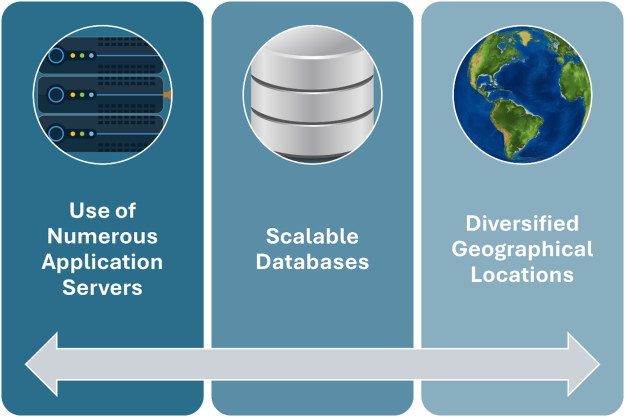
- To address sudden surges in network traffic, enterprises should utilize multiple servers to ensure continuous service and minimal downtime.
- To store and manage massive volumes of data, databases become crucial. Databases running on isolated servers are vulnerable to crashes or failures, resulting in data loss. The redundancy technique using slave servers can overcome database failure challenges. Redundancy identifies failures and replaces failed servers with slave servers to ensure seamless operations. To scale databases, sharding techniques can also be implemented, allowing workloads to be distributed across multiple servers for reliable and seamless data management.
- It is highly risky to place all servers in a single location. Unpredictable natural disasters may impact data centers and servers, leading to extensive downtime. This risk can be alleviated by distributing servers across various geographical locations. This supports high availability and ensures continuous accessibility of services. In storage, a storage system is based on clusters. A cluster is a set of multiple storage servers using commodity hardware to store data. A user can use these clusters directly to store data.
The storage servers/computers are referred to as nodes. A cluster can contain single or multiple nodes depending on business demands and operational data. For small organizations needing periodic data backups, a single-node cluster is sufficient. However, for businesses where data manipulation and frequent access are core objectives, multi-node clusters are essential to ensure continuous data access.
If frequent data processing is required (e.g., database functionality), data must be guaranteed to customers. Hence, data is mirrored across multiple nodes to eliminate unavailability in case of node failures.

The High Availability feature comes into play when a cluster contains more than one node. In short, a cluster implies a group of servers integrated to be a unified unit operating as per a set of instructions. These servers are also called failover clusters as they can replace failed servers with operational ones, ensuring continuous operation. The following image shows the important functions of an HA cluster.
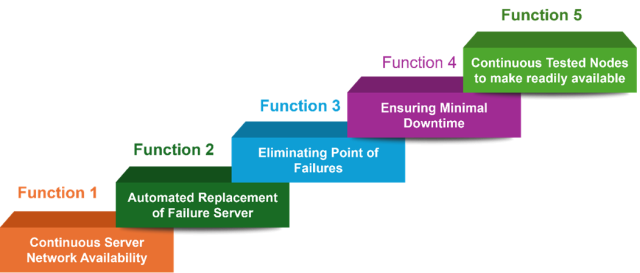
Let us now understand the workflow of an HA cluster and the concept of a two-node HA cluster.
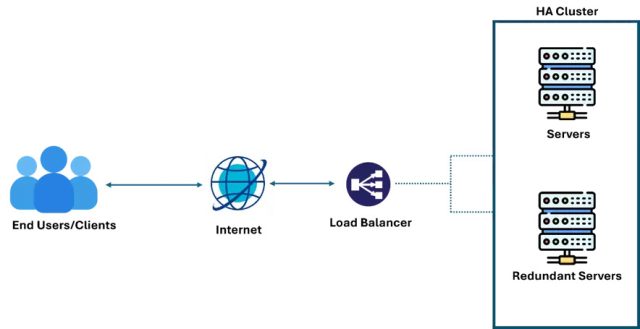
The above image depicts the basic workflow of an HA cluster. The functionality of HA can be explained in three steps:
Step 1: HA keeps hardware and software resources beyond standard requirements to utilize them as backups in case of failures.
Step 2: To ensure minimal downtime and uninterrupted services, HA continuously monitors the system’s health status.
Step 3: A reliable and automated failover strategy is built, ensuring functional backups are readily available.
A Load Balancer is vital in HA architecture. It distributes user traffic uniformly across multiple servers instead of a single one, ensuring distributed and continuous operation while avoiding single points of failure.
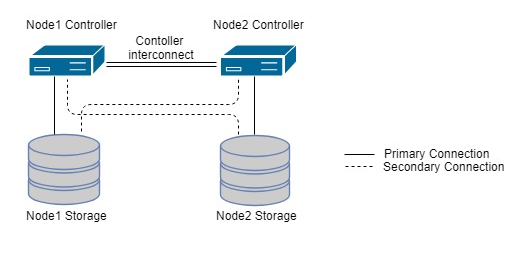
The above image shows a typical HA pair, where both nodes are connected to each controller and each controller is connected to the other directly. In case of a node failure, the other node takes charge and provides data service until the failure is fixed.
HA in Multi-Node Cluster Environment with Switches
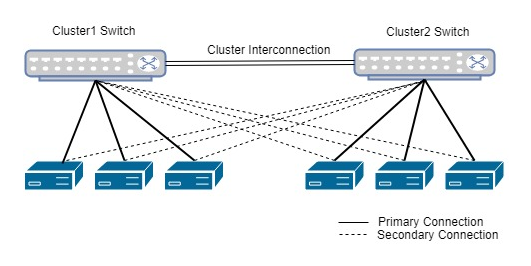
When a storage cluster requires more than two nodes, additional nodes can be added using switches. In this case, a minimum of two clusters is required to achieve High Availability, and each node should connect to more than one switch.
Following best practices can help realize many benefits from the HA feature. The section below details its key benefits.
Key Benefits of HA Feature
- High data availability: HA pairs in storage systems ensure data remains accessible at all times, mitigating downtime risks due to hardware failures. This ensures seamless operations, higher productivity, and reliable access to critical business data.
- Automatic failover and restoration: Each node in an HA pair has a partner node ready to take over during failures. Once the failed node recovers, control is smoothly handed back, ensuring continuity and reliability.
- Uninterrupted service during maintenance: HA allows maintenance, upgrades, or repairs without disrupting ongoing operations. Redundancy ensures continuous service delivery even when individual components are offline.
- Preserves data integrity: HA configurations use data mirroring and redundancy to safeguard against data loss or corruption. This ensures consistent and reliable data access for applications and end users.
- Disaster recovery: HA plays a vital role in disaster recovery systems by interconnecting clusters located in different geographical locations. If one site fails, another can take over seamlessly.
Conclusion
HA is a crucial feature in modern storage systems, ensuring continuous access to data, seamless service, and robust data integrity. As businesses increasingly depend on data for their operations, maintaining high data availability, managing failovers efficiently, and performing maintenance without service interruptions become essential. HA configurations not only enhance reliability but also support business continuity and operational efficiency. By investing in HA storage solutions, businesses can safeguard data assets, minimize downtime, and maintain application integrity—ultimately fostering a resilient and reliable IT infrastructure.
Calsoft, being a Technology-First company, has been helping its customers solve business challenges using technologies in Storage, virtualization, networking, security, cloud, AI/ML, IoT, and telecommunications domains.