
A water utility company in the US Midwest spent eighteen months building a predictive maintenance model. The model was solid. The training data was not. Half came from the warehouse, clean, structured, and three months stale. Half came from the lake, fresh, raw, inconsistently labeled. The model shipped. It underperformed. The problem was never the algorithm. It was the gap between two systems that were never designed to trust each other.
According to Gartner, as cited on Calsoft's data lake service page, by 2026, 50% of enterprises will have migrated from traditional enterprise data warehouses to lakehouse-based architectures. That migration is not just a storage upgrade. It is a forced reckoning with how poorly most enterprises have integrated their lake and warehouse layers in the first place.
That gap is where most enterprise AI initiatives quietly fail.
The architecture problem no one budgets for
Every enterprise above a certain scale operates both a data lake and a data warehouse, typically built by different teams, on different timelines, and for different purposes. The warehouse serves Business Intelligence (BI) and reporting, while the lake absorbs everything the warehouse cannot: unstructured logs, sensor streams, clickstreams, and raw API feeds. Together, these platforms form the foundation of a modern enterprise data management strategy.
The problem surfaces the moment you try to train an AI model or run a real-time analytics workload. You need governed, query-ready data from the warehouse and high-volume, fresh data from the lake, simultaneously. If the two systems do not share a unified metadata layer, access policy, or ingestion contract, your data engineers spend their days reconciling schemas instead of building pipelines.
A hybrid data strategy built on unified data lake and warehouse architecture is not a luxury for large enterprises. It is the precondition for AI workloads that actually deliver.

What most enterprises get wrong
The most common mistake is sequential thinking: build the lake first, modernize the warehouse later, and integrate them eventually. ‘Eventually’ becomes a multi-year backlog item.
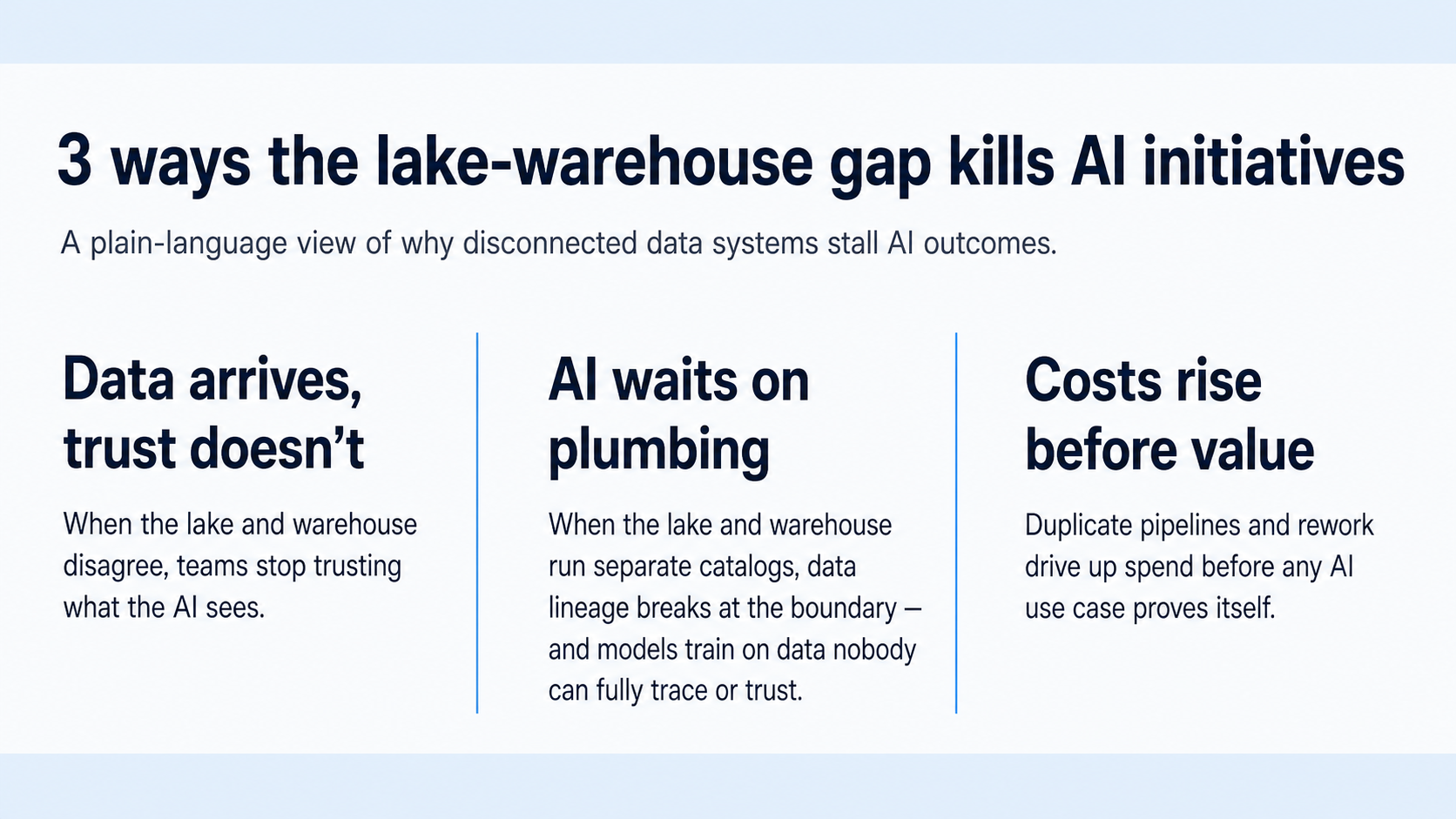
Three specific failure patterns show up repeatedly:
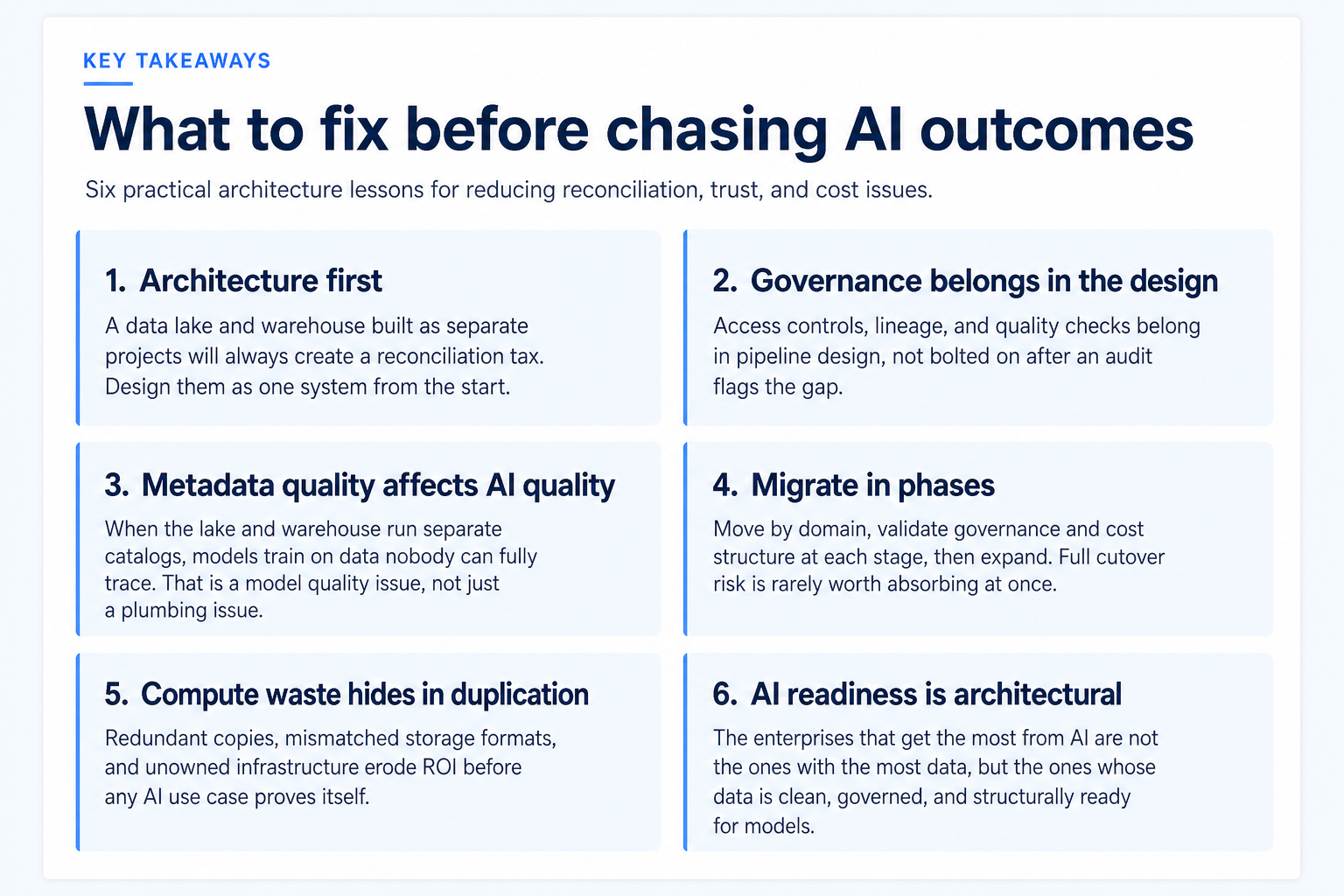
- No shared metadata layer: The lake and warehouse each maintain their own catalog. Data lineage breaks at the boundary. Governance teams cannot trace a field from source to model without manual reconstruction.
-
Governance applied after the fact: Access policies, retention rules, and data quality and governance controls get bolted on after ingestion. By the time a compliance audit arrives, lineage is incomplete and field-level controls are inconsistent.
- Compute costs that compound silently. Without auto-scaling and storage format unification, redundant data copies accumulate. Query costs rise. Nobody owns the problem until a cloud bill forces the conversation.
These are not technology failures. They are architecture decisions made too early, by teams with incomplete context, under deadline pressure.
How a governed lakehouse architecture changes the equation
A lakehouse, the architectural pattern that merges lake-scale storage with warehouse-grade governance and query performance, addresses the integration problem at the design layer, not after deployment.
A governed lakehouse architecture embeds unified security, lineage, and quality controls.
Calsoft engineers lakehouse ecosystems with unified ingestion via Kafka, Kinesis, and Debezium; storage in Delta, Parquet, and Iceberg formats on S3, ADLS, or GCS; metadata cataloging via Unity Catalog, AWS Glue, or Hive Metastore; and processing through Spark, Databricks, or BigQuery. Access governance, role-based controls, row and column masking, and tokenization are configured at the architecture layer, not added later. This matters for AI readiness specifically.
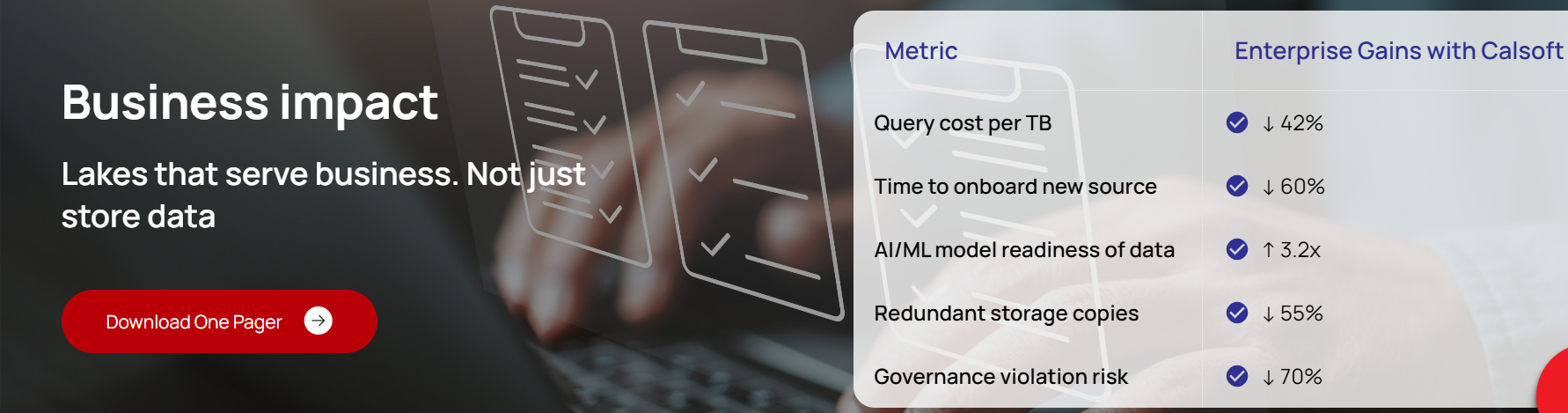
Calsoft's approach delivers a 3.2x improvement in AI/ML model readiness of data, a 42% reduction in query cost per TB, and a 60% faster time to onboard new data sources, numbers drawn directly from their published service benchmarks.
Governance is not a compliance layer in this model. It is an engineering constraint that gets enforced at ingest, not discovered at audit.
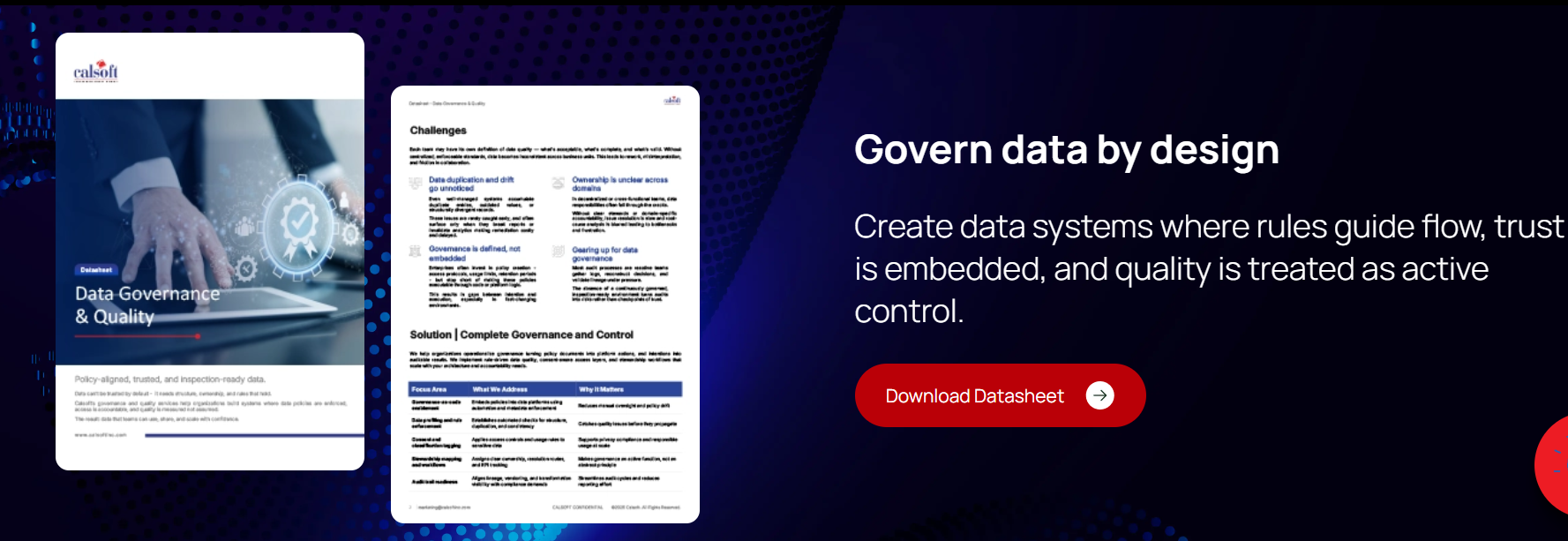
This datasheet shows how Calsoft embeds policy and quality control directly into data pipelines, and what that means for enterprises managing sensitive data across multiple domains. The specifics of how those controls interact with AI ingestion workflows are worth a close read before your next architecture review.
Download the full Datasheet below
Where to start without rebuilding everything
The practical question for most CTOs is not ‘should we do this,’ it is ‘how do we migrate without stopping the business?’
Calsoft's engagement model starts with a workload assessment of the current EDW, storage, and access models, followed by lakehouse blueprinting that covers ingestion, processing, and metadata layers, then a governed rollout, secure by design, and finally an incremental migration phased by domain, usage, or risk priority.
Legacy warehouse migrations from Teradata, Oracle DW, Netezza, or SAP BW are explicitly supported. Cloud warehouse targets include Snowflake, BigQuery, Redshift, and Azure Synapse, with table format unification across Delta, Iceberg, and Hudi.
The phased model matters. It means a manufacturing company can migrate its IoT telemetry domain first, validate governance and query performance, and only then move transactional data, rather than committing to a full cutover upfront.
The enterprises that will get the most from AI in the next two years are not the ones with the most data. They are the ones whose data is clean, governed, and architecturally positioned to feed models at speed.
FAQs
What is the difference between a data lake, a data warehouse, and a lakehouse?
A data lake stores raw, unstructured data at scale, is cheap, flexible, but hard to query directly. A warehouse stores clean, structured data optimized for SQL queries and BI. A lakehouse merges both: lake-scale storage with warehouse-grade governance and query performance, using open table formats like Delta or Iceberg to enable both use cases from a single layer.
How do we know if our current data architecture is ready for AI workloads?
The clearest signal is friction at the model training stage, where data engineers spend more time cleaning and reconciling data than analysts spend using it. If your lake and warehouse maintain separate catalogs, lack shared lineage, or apply governance inconsistently across domains, your architecture is creating a ceiling on AI model quality before the data scientist writes a single line of code.
Can we migrate incrementally, or does a lakehouse require a full cutover?
Incremental migration is the recommended approach. Moving by domain, starting with a lower-risk workload like analytics or IoT telemetry, lets teams validate the governance model, query performance, and cost structure before committing to a full migration. A full cutover introduces coordination risk that most enterprises do not need to absorb at once.