

Enterprise data landscapes are changing. Enterprises are under pressure to process data faster, closer to where it originates, and in ways that meet both business and regulatory requirements. This pressure is coming from multiple directions. They emerge quietly, in fragments across reports, meetings, and systems.
Data issues in most organizations don’t exhibit as a single big failure. The first driver is operational speed. The second driver is cost. The third driver is compliance and data sovereignty.
For many organizations, this creates a strategic challenge: the need to move faster is held back by brittle processes, inconsistent data, and systems that struggle to scale efficiently. Before chasing smarter outputs, organizations need to focus on stabilizing inputs:
- What data exists, and where is it stored?
- How is it structured, transformed, and governed?
- Who can access it, and how reliable is the information?
This is often where a shift begins. That’s why data and AI are no longer future investments; they are business necessities. When used effectively, they help organizations respond faster, reduce delays, and adapt ahead of the competition.
Download the industry report | REAL guide for data -powered AI implementation
The global enterprise data management market sits at around $124 billion in 2025 — and it's heading toward $350 billion by 2034 (Precedence Research). Companies know their data infrastructure is not ready for what's coming next.
The real problem isn't data volume, it's data discipline. The AI promise of speed, foresight, and automation only becomes practical with clean, structured, and governed data.
Every organization works with data, but how that data is structured, governed, and used varies widely. The gap between data presence and data maturity is significant. Reliable intelligence starts with reliable information. Data and AI used properly help enterprises solve specific friction points in the data-to-intelligence journey.
What a Modern Enterprise Data Management Strategy Looks Like
As enterprise data management evolves, AI-ready data has become a top priority for organizations building reliable, scalable AI systems. Businesses are now focusing on active metadata management, data quality frameworks, continuous data observability, and stronger governance to improve AI accuracy and reduce bias.
A modern enterprise data management strategy is not a single product. It is a series of intentional architectural and operational decisions that turn your data from a liability into a genuine business asset.
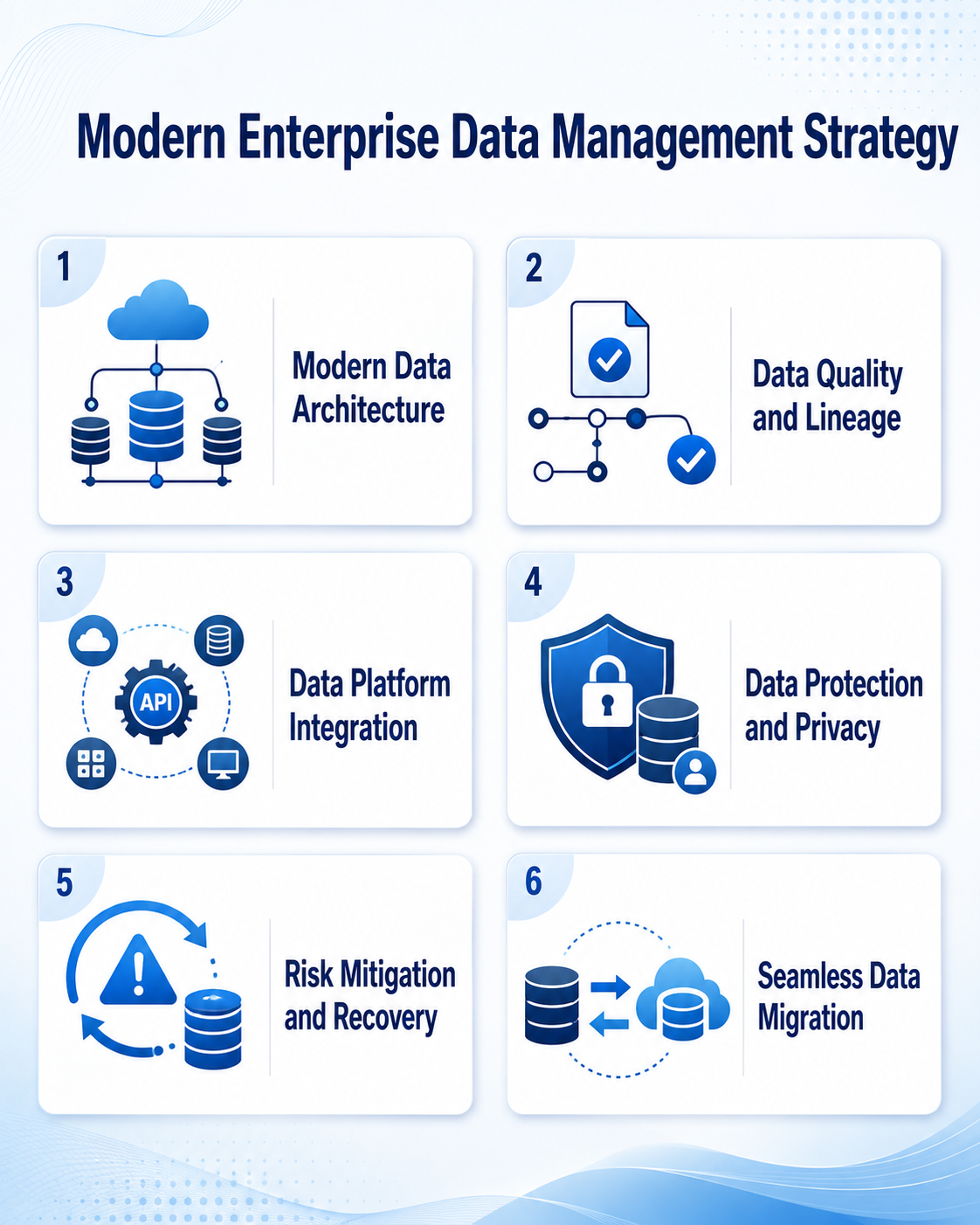
Modern Data Architecture: A centralized or federated data system that standardizes how data is modelled, stored, and served, built to scale with your business and ready for AI workloads.
Data Quality and Lineage: End-to-end visibility into where your data comes from, how it moves, and whether it can be trusted
Data Platform Integration: Bringing all data tools and systems together so teams can access, manage, and use data more easily.
Data Protection and Privacy: Role-based access, encryption, real-time anomaly detection, and alignment with GDPR, HIPAA, and CCPA.
Risk Mitigation and Recovery: Backup strategies, replication, and testing the disaster recovery plan
Seamless Data Migration: Moving data across clouds, systems, or architectures without losing integrity or grinding operations to a halt.
Download whitepaper | Reliable edge data enablement
Every organization’s path to intelligent systems is different. Some are still organizing their data, while others are modernizing platforms, strengthening governance, or testing early AI use cases. Most do not need to start from scratch; they need a partner who can help them move with clarity, control, and minimal disruption.
That's where Calsoft fits in.
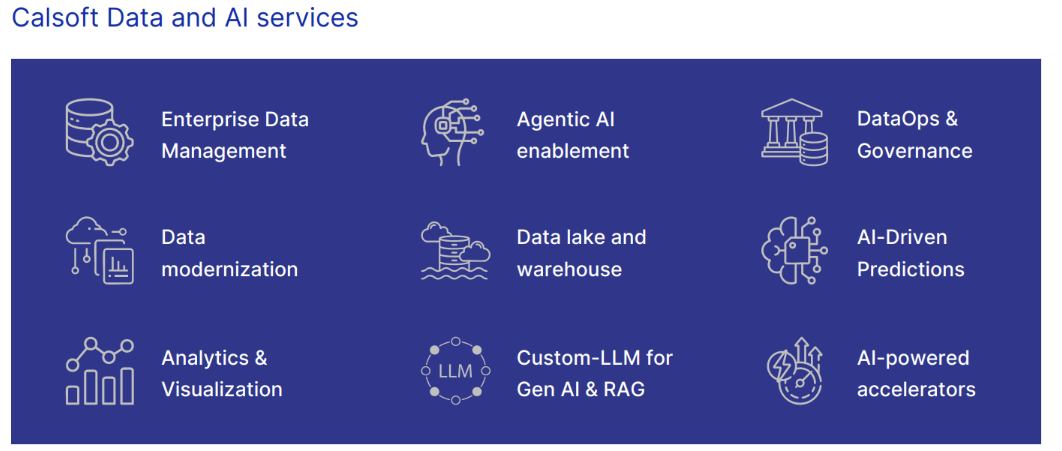
Calsoft's data & AI services cover the full stack from modern data architecture to risk mitigation and recovery. We are always up for a practical conversation.

Calsoft’s Enterprise Data Management services help businesses build a trusted, scalable, and AI-ready data foundation for better governance, analytics, compliance, and business continuity. From modern data architecture, data quality and lineage, platform integration, data protection, risk mitigation, and seamless data migration, Calsoft enables enterprises to reduce data silos, improve visibility, secure sensitive information, and create a reliable data backbone for future-ready AI and analytics initiatives.
Where to Start
Enterprise data management does not need to begin with a complete overhaul. The smarter approach is to start small, fix what matters most, and scale with clarity.
Start with a data health audit: Identify where your data sits, who owns it, and whether teams trust it before investing in new tools.
Pick one domain and prove the model: Begin with customer, financial, or operational data. Improve quality, ownership, and lineage there, then apply the same model elsewhere.
Design for AI-readiness from day one: Every data architecture decision should support reliable AI use. If AI systems cannot use the data confidently, the foundation still needs work.
Treat data governance as a business priority: Data governance should not sit only with IT. It needs clear ownership, measurable goals, and leadership attention.
Summary
Organizations that invest early in AI-ready data, agent-ready infrastructure, data governance, and modern data platforms will be better positioned to move faster and operate smarter. As data products, lakehouse architecture, observability, and augmented data management become essential, enterprises that act now can improve decision-making, reduce operational costs, and build a stronger foundation for AI-driven growth.
FAQs
1. What is an enterprise data management strategy?
An enterprise data management strategy helps businesses organize, govern, secure, and use data effectively for analytics, compliance, and AI.
2. Why is enterprise data management important?
Enterprise data management improves data quality, reduces silos, strengthens governance, and enables faster, more reliable business decisions.
3. How do you build an AI-ready data strategy?
Build AI-ready data by improving data quality, metadata management, governance, platform integration, and data observability.