

IT infrastructure is the invisible foundation of modern digital enterprises. From servers and storage networks to cloud platforms, keeping everything efficient and reliable has become increasingly complex. With hybrid and multi-cloud environments expanding rapidly, traditional tools and processes are reaching their limits. Enter Generative AI in IT operations — an innovative solution helping IT teams automate routine tasks, detect issues faster, and make better decisions through AI-powered infrastructure management.
IDC forecasts that the worldwide infrastructure market (server and storage) for all types of AI is expected to reach $632 billion between 2024 and 2028. This surge reflects the growing potential of GenAI in IT infrastructure management. Let’s explore how this technology is transforming infrastructure from the ground up.
Before diving into transformation, let’s revisit the basics — the three pillars of IT infrastructure. These core components work together to power every modern organization, as shown in the image below:
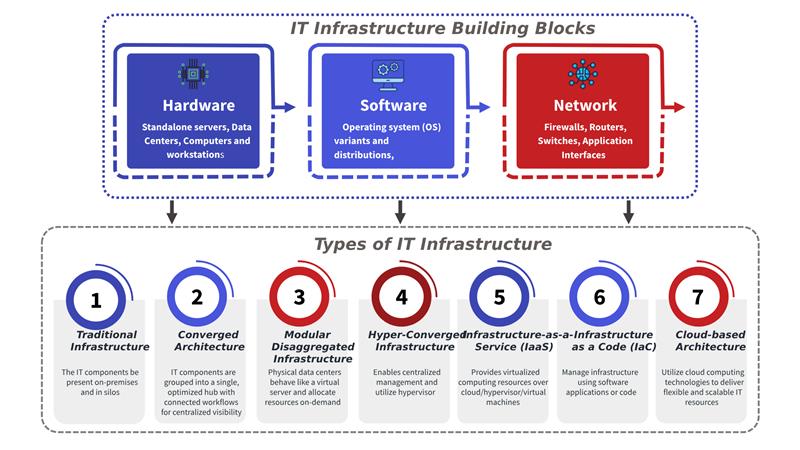
Here’s a closer look at how GenAI is transforming core areas of infrastructure management — from storage and network operations to compute management.
GenAI is Transforming the Operations Workflow
- Incident Response Gets an Upgrade
When a problem occurs, engineers often sift through mountains of log files, dashboards, and monitoring tools to diagnose the issue — a time-consuming and sometimes inconclusive process. GenAI transforms this workflow by scanning logs, identifying error patterns, and summarizing probable root causes within minutes. Instead of spending hours diagnosing, teams can move straight to remediation. AI-powered incident response tools can even recommend fixes based on historical resolutions, freeing engineers from repetitive triage.
- Unlocking Tribal Knowledge
Many IT teams rely on scattered internal documentation, Slack threads, or a few senior experts to solve recurring issues. GenAI helps centralize this knowledge by training models on your internal documents, runbooks, and configuration files. These models then act as intelligent assistants that can answer queries like “How do I add a new node to a Kubernetes cluster?” or “What ports should be open for this service?” — pulling accurate, contextual responses from your environment. This is where Retrieval-Augmented Generation (RAG) plays a key role.
- Predicting Failures Before They Happen
System failures often show early warning signs — CPU spikes, disk errors, or network latency. GenAI can analyze telemetry data to detect patterns that predict failures before they escalate. Trained on historical system data, these models can alert engineers about probable issues and explain the reasoning behind predictions. Predictive maintenance powered by GenAI offers not just alerts, but insights into which components are at risk and why.
- Smarter Capacity Planning
Traditional capacity planning often relied on static reports or experience-based estimates. GenAI introduces intelligence by analyzing usage trends, growth projections, and even external factors like product launches or seasonal spikes. The result? Dynamic, data-driven capacity forecasts that reduce over-provisioning while ensuring workloads remain adequately supported — marking a new era of AI-powered capacity planning.
- Better Control Over Configuration Drift
Configuration drift occurs when system changes aren’t reflected in infrastructure-as-code templates, causing risk and inconsistency. AI-powered tools can compare live configurations against approved baselines and flag mismatches instantly. Some systems even suggest updates or create pull requests to correct drift automatically. Engineers can now quickly review and approve AI-suggested remediations instead of manually scanning for inconsistencies.
- ChatOps that Actually Help
Modern IT teams depend on chat platforms, but frequent alerts can quickly create chaos. GenAI integrates directly into these channels, acting as a real-time assistant that classifies alerts by severity, suggests responders, drafts replies, or creates tickets automatically. This transforms noisy communication channels into structured, actionable collaboration hubs — a prime example of AI in IT operations at work.
How Calsoft Can Help
Calsoft brings over 26 years of technology expertise and was an early adopter of Generative AI. We help enterprises blend legacy systems with innovation, enabling faster transformation and better customer experiences. Our GenAI services cover product development, UX design, testing, and integration. With deep model expertise, we customize AI solutions that fit your unique business context.
For instance, we built an AI code generator using GPT-3 and GPT-4, which helped our CSP client accelerate product development dramatically. Investing in AI-driven engineering helps your teams innovate more while spending less.
If you’d like to explore how this can work in your environment, connect with Calsoft’s innovation team to design and execute your GenAI-driven IT infrastructure management strategy.
To build a truly AI-enabled infrastructure, it’s crucial to leverage technologies such as big data analytics, intelligent computation, AI/ML-based algorithms, visualization tools, and automation frameworks. Here’s a quick overview:
| Systems | Purpose | GenAI Tools & Techniques |
|---|---|---|
| AI Models & Algorithms | Predictive maintenance, anomaly detection, and AI-driven capacity planning | Machine Learning (ML) models |
| Automating documentation, chatbots, and virtual assistants | Natural Language Processing (NLP) | |
| Configuration generation, code generation, and automated documentation | Generative AI models | |
| Automation & Orchestration Tools | Deployment, management, and scaling of AI models | Ansible, Puppet, Chef |
| CI/CD pipelines | Jenkins, GitLab CI, Azure DevOps | |
| Container orchestration and workflow coordination | Kubernetes, Docker Swarm | |
| Intelligent Monitoring & Analytics | Real-time monitoring | Prometheus, Nagios, Zabbix |
| Log analysis and visualization | Splunk, ELK Stack, Grafana | |
| Security Tools | Threat detection | IDS/IPS systems, SIEM tools |
| Vulnerability management | Nessus, Qualys, OpenVAS | |
| Knowledge Management | Documentation systems | Confluence, SharePoint |
| Knowledge bases | ServiceNow, Jira Service Desk |
Making It Work for Your Organization
Adopting GenAI doesn’t mean replacing everything at once. The best approach is to start small — for instance, automate root cause analysis for one application or enable smart knowledge retrieval for your SRE team. The key requirement is structured internal data — logs, configurations, dashboards, and playbooks. Retrieval-Augmented Generation (RAG) is ideal for this, as it allows AI models to access your internal knowledge without retraining, ensuring accuracy and speed.
GenAI is not a replacement for IT teams — it’s a powerful partner. Let AI suggest fixes or optimizations, while engineers retain control over approvals. This ensures both trust and operational safety.
With GenAI, organizations benefit from faster incident resolution, better resource utilization, and more consistent configurations — all without compromising security. It frees engineers to focus on innovation rather than routine maintenance.
Parting Thoughts
IT infrastructure remains the backbone of digital operations, and poor management can trigger significant risks — from downtime to compliance violations. As AI evolves, its role in IT infrastructure management will only grow stronger, paving the way for intelligent, self-healing systems. The partnership between human expertise and AI-driven insights will define the future of IT infrastructure.
FAQs
Q1: What are the benefits of using GenAI for IT infrastructure management?A: GenAI automates tasks like incident response, capacity planning, and predictive maintenance — improving efficiency and reducing manual workload.
Q2: How does Retrieval-Augmented Generation (RAG) help in IT operations?A: RAG enables GenAI models to retrieve relevant information from logs and configs without retraining, providing precise, environment-specific responses.
Q3: Can GenAI integrate with existing DevOps and monitoring tools?A: Yes, GenAI integrates seamlessly with CI/CD pipelines, configuration management, and real-time monitoring tools to enhance automation and decision-making.