

The server room was clean. Racks aligned. Lights green. The team had spent eight months migrating to HCI and called it a success. Six months later, the storage engineer was manually reconciling policy conflicts between the on-premises cluster and the cloud workloads, every Tuesday, like clockwork. The infrastructure was newer. The problem was the same.
HCI, a hyperconverged infrastructure, a software-defined architecture that merges compute, storage, and networking into one operational layer, was supposed to end that. Often it does, inside the data center. The integration boundary is where things go quiet before they go wrong.
The infrastructure debt nobody talks about
Nobody designs a hybrid cloud to become a coordination problem. But three-tier architecture- compute, storage, and networking managed as separate silos-was built for a world where workloads stayed put. It doesn’t fail loudly. It just adds friction to every decision made on top of it, until that friction becomes the cost of doing business.
According to Gartner, 90% of organizations will adopt a hybrid cloud approach through 2027. What that projection doesn’t show is the gap between adoption and coherence. Moving a workload takes an afternoon. Running it consistently- same governance, same performance behavior, same visibility- across on-premises and cloud is a different problem entirely.
When storage policies, network configurations, and compute behavior operate under different management planes, a change in one layer triggers manual reconciliation across the others. At scale, that isn’t overhead. It becomes the reason AI deployments stall before they start, compliance reviews turn expensive, and infrastructure plans drift from the business strategy they were built to serve.
.jpg)
Why most HCI projects underdeliver
Most HCI deployments finish on schedule. Most also fall short. Not at the hardware layer; the platform usually works. At the integration layer, which most teams treat as a post-deployment concern rather than the core design problem.
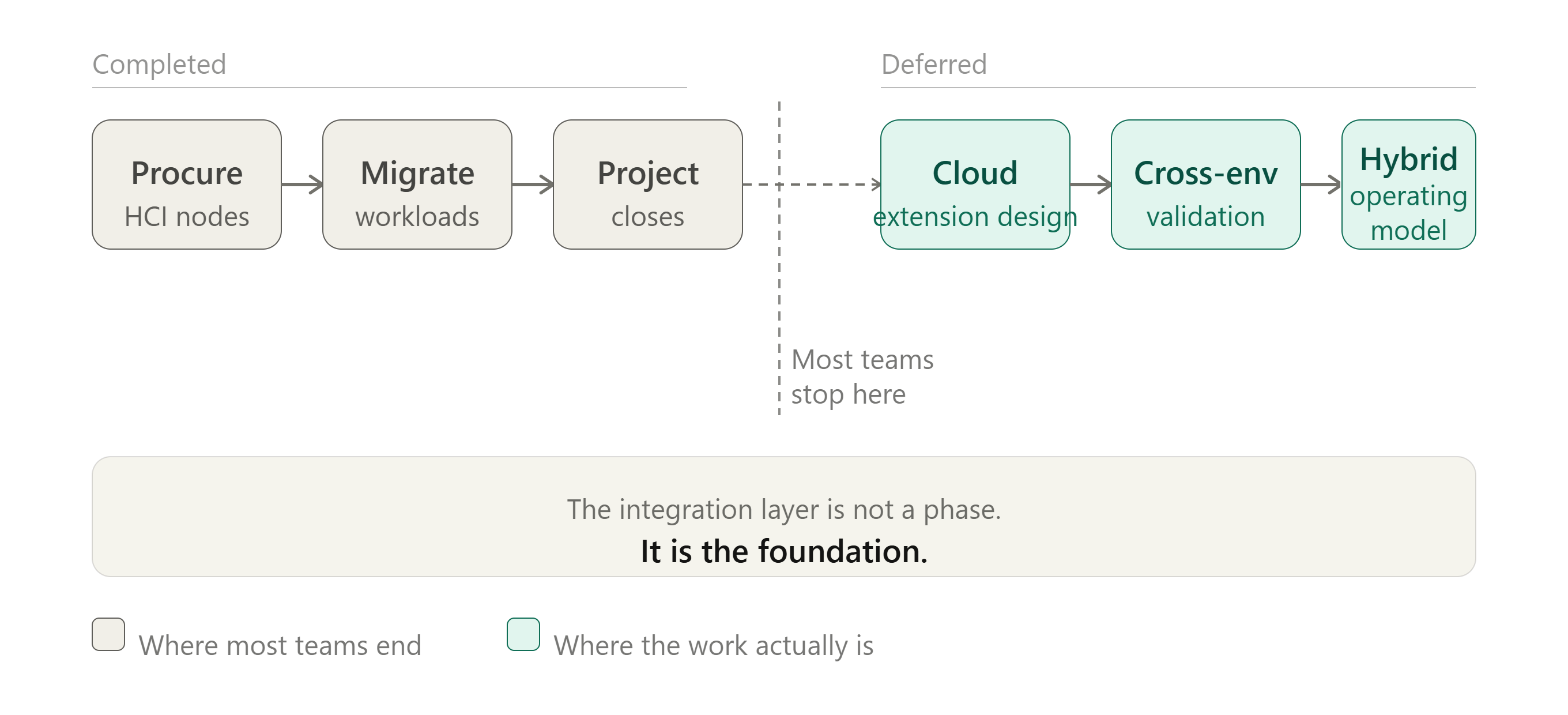
The pattern is consistent. Nodes are procured. Virtual machines migrate. The project closes. The cloud-native enablement layer, the architectural piece that keeps on-premises HCI behavior consistent when workloads extend into cloud environments, gets deferred. It goes on a backlog. The backlog ages.
HCI deployed without a coherent cloud extension strategy is a cleaner version of the same siloed infrastructure. Less physical sprawl. Same operational fragmentation.
“Cloud use cases continue to expand with increasing focus on distributed, hybrid, cloud-native, and multi-cloud environments supported by a cross-cloud framework,” said Sid Nag, Vice President Analyst at Gartner. That expansion doesn’t wait for integration debt to be cleared. It arrives before the architecture is ready for it.
Public cloud tooling doesn’t close this gap. Azure Arc and AWS Outposts are built around the hyperscaler’s operating assumptions. Governance policies, data residency rules, and workload-specific latency requirements need an integration design that starts from the enterprise environment, not from a vendor’s preferred deployment pattern.
Where integration depth actually matters
Before any HCI platform decision is finalized, the right question isn’t which vendor wins the evaluation. It’s what happens at the operational boundary. Where on-premises storage policies meet cloud-native workloads. Where network configurations that hold in the data center break silently during migration. Where licensing assumptions create budget surprises long after go-live.
Calsoft’s HCI integration services are built around that boundary- platform selection, architecture design, cross-vendor interoperability across Nutanix, VMware, and Azure Local, and validation under production conditions. The work sits inside Calsoft’s Storage and Networking practice, which means integration decisions are grounded in the same environment where storage and networking design happens.
In-house teams building this capability for the first time are not underskilled. They haven’t seen these failure modes before, because those failures surface only after the architecture is committed. Explore Calsoft’s HCI Integration Services to understand what a boundary assessment looks like before that commitment is made.
The VMware displacement is already underway
The timeline here is specific. According to Gartner’s Magic Quadrant for Distributed Hybrid Infrastructure, September 2025, by 2028, 55% of enterprises will initiate proofs of concept for alternative DHI products to replace their VMware-based deployments, up from just 15% in 2025. The enterprises that waited are now evaluating platforms under renewal pressure. That is not the right condition for architectural clarity.
The ones navigating this well share a single characteristic. They treated platform migration as an integration design exercise, not a replacement. They mapped workload behavior before touching infrastructure. They validated consistency before cutover. They built a hybrid operating model, not just a hybrid cloud estate.
Cloud-native enablement is not a hypervisor decision. It is a question of whether the full environment- on-premises, cloud, edge - behaves as one operational layer under real conditions.
The Calsoft HCI Integration One-Pager maps common enterprise deployment scenarios to specific integration design choices: stack options, validation sequencing, and where most projects encounter unexpected complexity.
The next platform decision will either reduce operational debt or compound it. That outcome is determined at the architecture stage, not at procurement.
FAQs
What is HCI integration, and how does it differ from standard HCI deployment?
HCI bundles compute, storage, and networking into a software-defined layer. Integration ensures that layer behaves consistently when extended across cloud environments — with storage policy alignment, network governance, and operational visibility across the full hybrid estate, not just on-premises nodes.
Why do hybrid cloud projects fail even when HCI is part of the design?
Most failures occur at the integration boundary, not the hardware layer. Teams deploy HCI nodes competently but defer the cloud-extension architecture. When workloads move, management planes misalign, governance breaks, and remediation costs exceed the original deployment budget.
How does Calsoft’s HCI Integration service differ from a vendor-led deployment?
Vendor-led deployments are optimized for their own platform. Calsoft works across Nutanix, VMware, and Azure Local, with a focus on the cross-environment consistency most deployments ignore until something fails. The value is knowing where the failure points are before the architecture is finalized.