

Global Capability Centers (GCC) are entering their next phase. The opportunity is no longer to adopt AI; it is to engineer, govern, and operate the intelligent systems that will increasingly run the enterprise. India's Global Capability Center ecosystem has reached a remarkable inflection point.
According to the Zinnov & NASSCOM. (2026). Zinnov-NASSCOM India GCC Landscape Report 2026, India now has 2,117 GCCs, generating approximately $98.4 billion in revenue and employing 2.36 million professionals. The ecosystem includes GCCs from 506 Forbes Global 2000 companies. But scale is only part of the story. The more consequential change is happening inside these centers.
GCCs that were once established primarily for cost efficiency increasingly own global products, engineering platforms, data estates, cybersecurity, cloud infrastructure, research and development, and enterprise transformation. Agentic AI could dramatically accelerate that evolution.
The question for GCC leaders is therefore changing from:
“How can we use AI?” to: “Can our GCC become the engineering and governance engine through which AI operates across the enterprise?” That is a much bigger mandate.
Agentic AI Is Moving Faster Than Most Enterprise Operating Models
Generative AI largely began as an assistant. For instance,
A developer asks for code.
An analyst requests a summary.
A service agent drafts a response.
A marketer generates content.
The human still initiates, evaluates, and executes most of the work.
Agentic AI changes that model.
An AI agent can be given an objective, reason through the steps required to achieve it, access relevant enterprise data, invoke tools and APIs, interact with other agents, execute actions, evaluate the result, and escalate when human intervention is required.
Consider a product-support scenario.
Instead of simply suggesting an answer to an engineer, an agent could potentially:
1. Interpret an incoming support incident.
2. Retrieve previous incidents and product documentation.
3. Query observability and telemetry platforms.
4. Correlate logs with known defects.
5. Determine a probable root cause.
6. Verify the customer's entitlement and configuration.
7. Recommend or execute an approved remediation.
8. Update the ticketing system.
9. Notify the customer.
10. Escalate the incident when confidence falls below a defined threshold.
This is no longer just conversational AI.
It is AI operating within a business process. And adoption is accelerating.
The EY GCC Pulse Survey 2025 found that 58% of India-based GCCs are already investing in Agentic AI, with another 29% planning to scale investments over the following year. EY also reported that 83% of GCCs are investing in Generative AI, while 67% are creating dedicated innovation teams and incubation programs to develop and globalize ideas from India.
This makes Agentic AI particularly relevant to the GCC model.
GCCs already sit at the intersection of the enterprise's data, applications, products, engineering talent, cloud platforms, cybersecurity, operations, and domain knowledge. Those are precisely the ingredients autonomous systems require.
From Delivery Center to Enterprise Intelligence Layer
The GCC mandate is moving from labor arbitrage toward global product ownership and, increasingly, the engineering of autonomous enterprise systems. The GCC journey can increasingly be viewed through four stages:
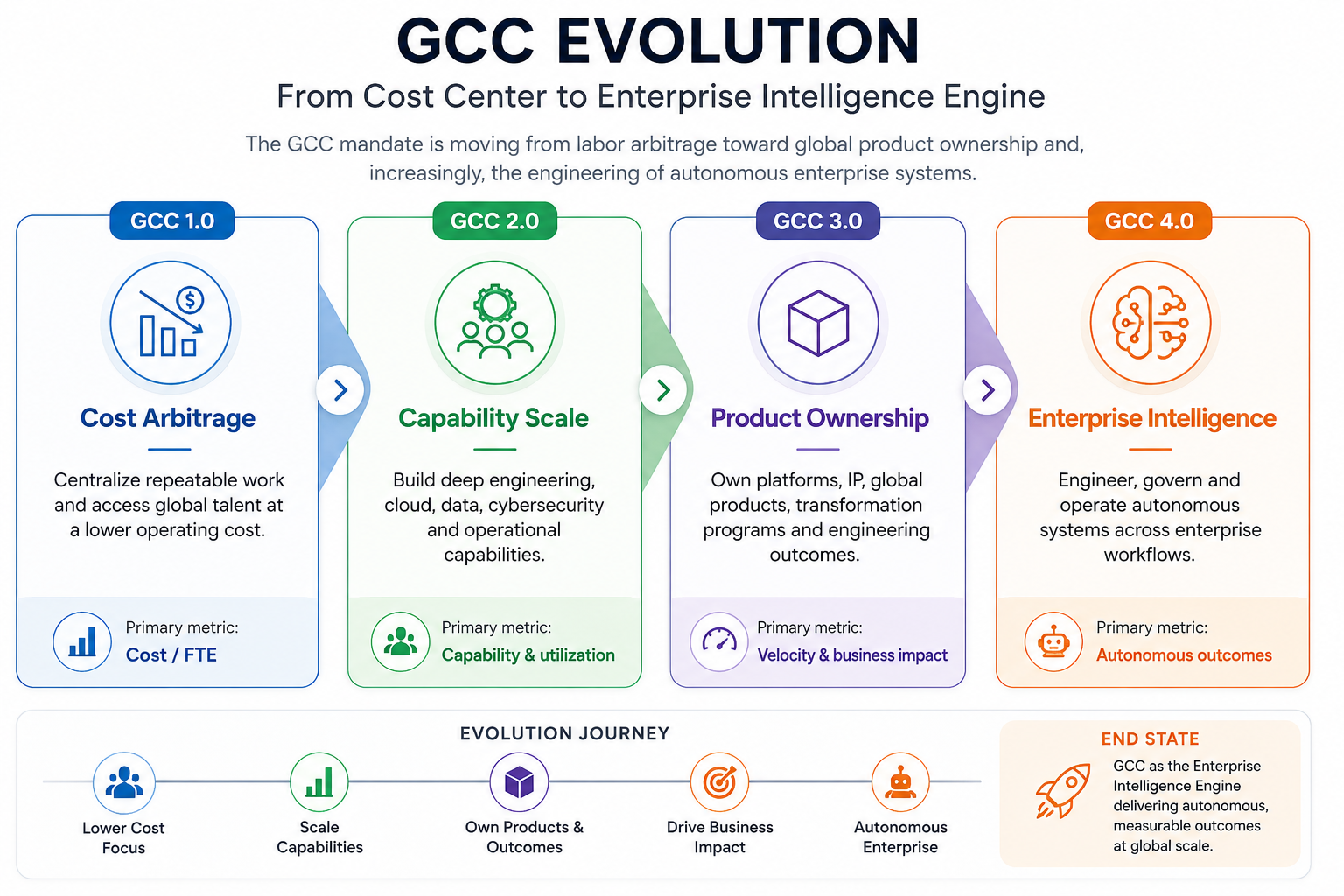
The opportunity is not to build hundreds of agents. The opportunity is to establish an enterprise Agentic AI platform through which trusted agents can securely access data, applications, tools, workflows, and business processes. That requires far more than selecting an LLM. It requires an engineering foundation.
1. Agentic AI Starts with Data—Not with the Model
An AI agent can only make decisions based on the context available to it. That context may come from:
- customer records
- transactional databases
- product telemetry
- knowledge repositories
- contracts
- CRM and ERP systems
- code repositories
- operational platforms
- product catalogs
- supply chains
- or external information.
If those sources are inconsistent, stale, poorly governed, or semantically ambiguous, adding a more sophisticated model does not solve the underlying problem. It may simply produce unreliable decisions faster.
This is why the move toward Agentic AI must also accelerate the move toward data products, data contracts, lineage, ownership, and observability.
A production-grade data contract should define, among other things: Schema | Semantics | Ownership | Quality | Freshness | Access | Lineage | Change Policies
Consider a revenue-management agent deciding whether a customer qualifies for a retention offer. It may need to combine CRM information, billing history, product consumption, contractual commitments, support interactions, and customer-health metrics.
If five systems maintain five definitions of an “active customer,” the fundamental issue is not AI. It is enterprise data architecture.
Agentic AI will expose enterprise data debt faster than almost any previous technology wave. That makes data engineering one of the most important foundations of the agentic GCC.
2. APIs Become the Hands of the AI Enterprise
Data allows an AI agent to understand the enterprise. APIs allow it to act.
That distinction is critical. For decades, enterprise systems have largely been designed around human interaction: screens, forms, workflows, dashboards, and approval chains. Agentic systems need programmatic interfaces.
An enterprise agent may need to: Read → Reason → Recommend → Execute → Verify
This fundamentally raises the importance of API engineering. An agent may be authorized to retrieve an invoice.
Should it be allowed to generate one?
Could it issue a refund?
Could it modify a production configuration?
Could it approve a multimillion-dollar transaction?
The answer depends on policy, identity, risk, and context. Enterprise Agentic AI therefore needs capabilities including:
- fine-grained authorization,
- machine identities,
- policy-based access,
- transaction boundaries,
- idempotent operations,
- API rate controls,
- audit trails,
- rollback capabilities,
- secrets management,
- and zero-trust security.
This is why API modernization and Agentic AI cannot be treated as separate transformation programs.
Agents cannot autonomously operate an enterprise that was never architected for machines to safely act.
3. Move From AI Demonstrations to AI SLOs
A proof-of-concept answers one question:
Can the agent perform the task?
Production engineering asks a much harder question:
Can it perform the task reliably, economically, securely, and repeatedly?
That requires moving from demonstrations to measurable Service Level Objectives (SLOs).
For conventional platforms, engineering teams monitor metrics such as uptime, latency, throughput, and error rates. Agentic systems require another layer.
|
Agentic AI Dimension |
Potential Production Metric |
|
Task success |
Percentage of workflows completed |
|
Decision quality |
Accuracy against validated outcomes |
|
Autonomy |
Percentage completed without human intervention |
|
Escalation |
Percentage requiring human review |
|
Latency |
End-to-end workflow completion time |
|
Reliability |
Failed tool/API invocation rate |
|
Safety |
Policy or guardrail violation rate |
|
Recovery |
Successful retry or rollback rate |
|
Economics |
Cost per successful workflow |
|
Business impact |
Revenue, productivity, SLA or CX improvement |
This is where AI engineering begins to converge with Site Reliability Engineering (SRE). A production environment should eventually be able to trace:
User/Trigger → Agent → Model → Retrieval → Tool → API → Data → Action → Outcome
Without this traceability, diagnosing autonomous system failures becomes extraordinarily difficult. And AI agents will fail. The enterprise advantage will come from knowing when, where, why, and with what business impact.
4. Observability Becomes Runtime Governance
Most enterprise AI governance discussions focus on subjects such as model risk, privacy, bias, hallucination, security, and regulatory compliance.
Agentic systems introduce another requirement:
Governance while the system is operating.
An enterprise needs to know:
- Which agent initiated an action?
- What identity and authority did it have?
- Which model did it use?
- What data was retrieved?
- Which tools and APIs were invoked?
- What decision path was followed?
- What action was taken?
- Did a human approve it?
- What did the transaction cost?
- Was the business outcome successful?
This looks increasingly like distributed tracing for intelligent systems. The infrastructure foundation for this shift is already well developed.
The CNCF Annual Cloud Native Survey 2025, published in January 2026, reported that 82% of container users run Kubernetes in production and that 66% of organizations hosting Generative AI models use Kubernetes for some or all inference workloads.
Cloud-native engineering has spent the past decade building systems around observability, CI/CD, policy-as-code, GitOps, resilience, and automation.
Agentic AI needs those disciplines extended to a new unit of operation: the autonomous decision.
5. AI Economics Will Require a New FinOps Discipline
Agentic AI also introduces a less glamorous—but strategically important—question:
What does autonomy cost? A conventional software transaction may invoke a database and a handful of services.
An autonomous workflow might invoke:
- multiple LLMs,
- retrieval systems,
- vector databases,
- search APIs,
- specialist agents,
- SaaS applications,
- workflow platforms,
- inference infrastructure,
- and enterprise APIs.
The cost profile becomes variable. Consider a simple illustration.
10 million autonomous workflows per month at $0.05 each = $500,000
At $0.50 each = $5 million
The customer experience could appear identical. The unit economics would not.
Agentic platforms therefore need an AI FinOps model covering:
- inference cost,
- token consumption,
- model routing,
- caching,
- GPU utilization,
- workload placement,
- API consumption,
- cost by agent,
- cost by business unit,
- and cost by workflow.
The metric that matters most may ultimately be: Cost per successful autonomous outcome.
This creates a direct bridge between AI architecture and enterprise economics.
A more expensive model may be economically superior if it produces materially higher task completion rates. A cheaper model may be preferred for low-risk classification or retrieval tasks. The architecture should make that choice dynamically and measurably.
6. Human-in-the-Loop Is Not a Strategy
Organizations frequently describe their AI governance strategy with a reassuring phrase:
“There will always be a human in the loop.”
That is not sufficiently precise for enterprise-scale Agentic AI.
The better question is:
At what point does human judgment add enough value to justify intervention?
A mature autonomy framework might look like this: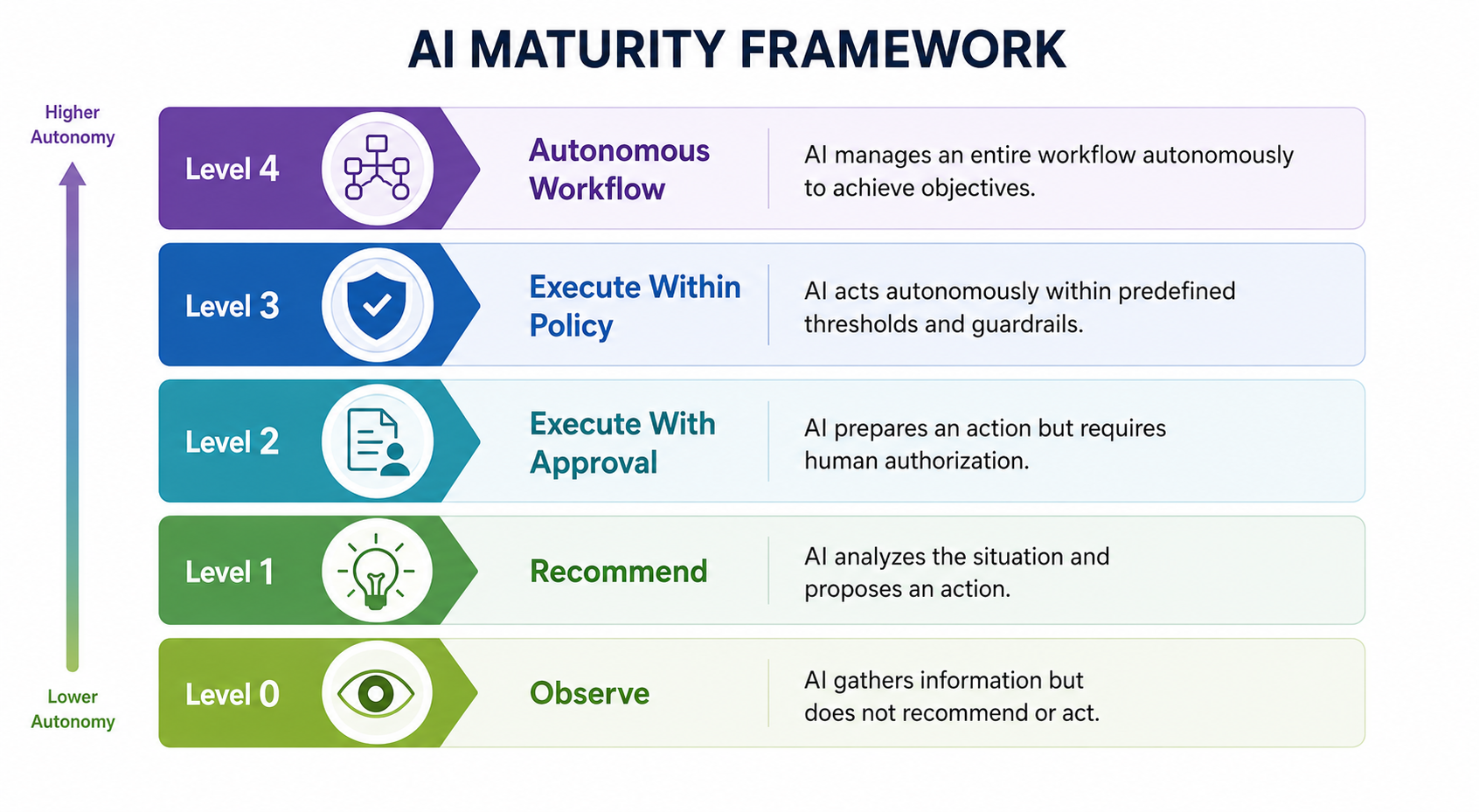
Different processes should operate at different levels. A low-risk password reset might reach Level 3. A production database schema change may remain at Level 2. A substantial financial transaction might require multiple approvals regardless of AI confidence.
This transforms governance from a static compliance framework into an engineering control system for autonomy.
Reality Check: Many Agentic AI Projects Will Fail
The excitement around Agentic AI should not obscure the execution risk.
Gartner predicts that more than 40% of Agentic AI projects will be cancelled by the end of 2027, driven by escalating costs, unclear business value, and inadequate risk controls. At the same time, Gartner expects 33% of enterprise software applications to include Agentic AI by 2028, up from less than 1% in 2024, and projects that 15% of day-to-day work decisions could be made autonomously by 2028. Those numbers are not contradictory. They describe a market where adoption will grow rapidly, while poorly designed initiatives are eliminated equally quickly. Deloitte's India research illustrates the same gap between experimentation and scale.
More than 80% of Indian organizations are exploring autonomous agents, and 70% reported that their AI integration efforts met or exceeded ROI expectations. Yet only 29% reported being able to fully scale even 30% of their AI proofs of concept. Data quality, hallucinations, real-world errors, and governance remain important barriers.
The lesson for GCCs is straightforward: Do not measure Agentic AI maturity by the number of pilots.
Measure it by the number of production workflows producing repeatable business outcomes within defined engineering and risk boundaries.
What Should an Agentic GCC Architecture Look Like?
Agentic AI becomes an enterprise capability only when models are connected to trusted data, governed APIs, production observability, and measurable business outcomes. A mature enterprise architecture could ultimately resemble this:
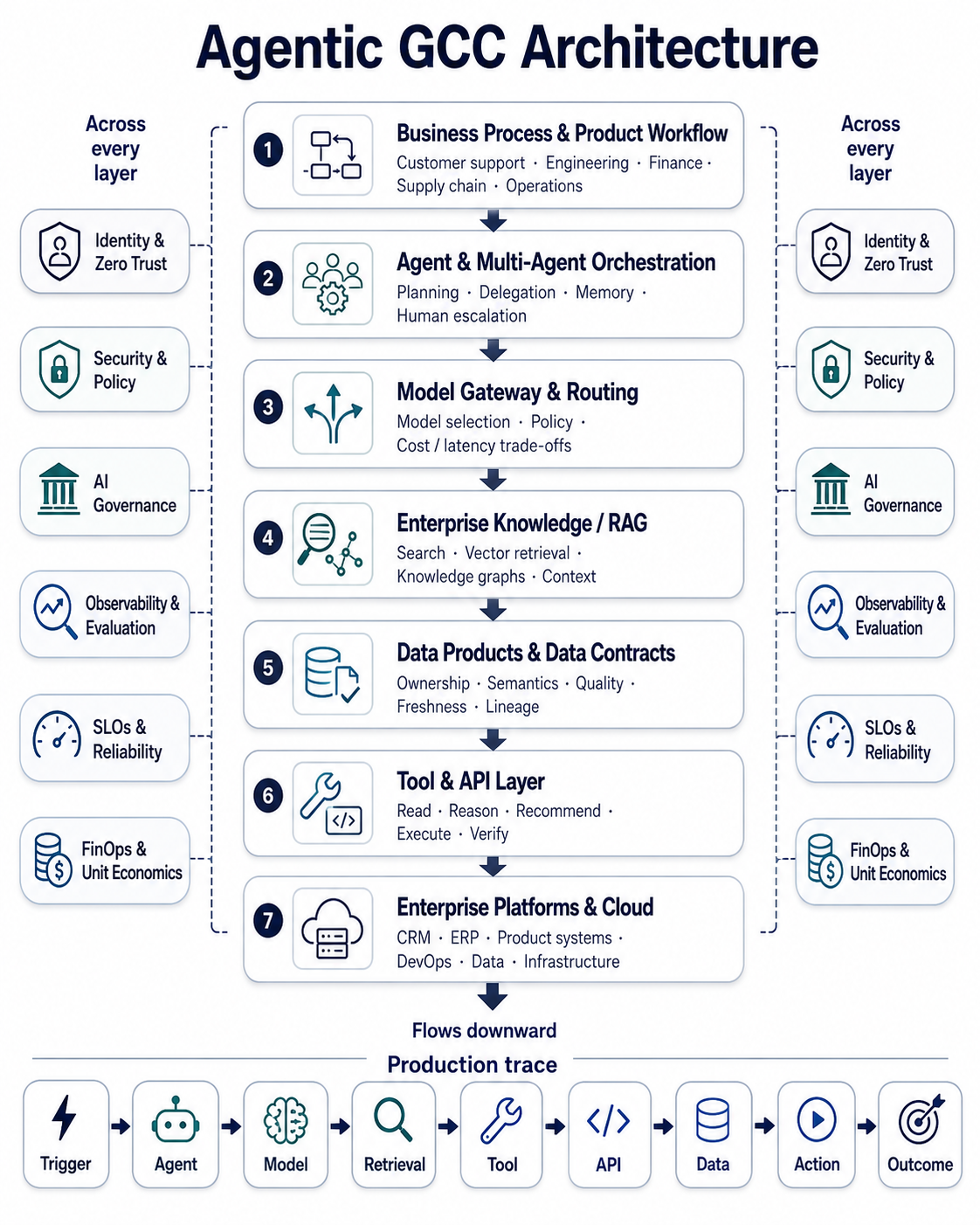
The strategic value of this model is reuse.
Without a common platform, every business function begins constructing its own AI stack—different models, retrieval pipelines, security patterns, APIs, evaluation methods, and governance controls.
Technical debt begins before the technology has even matured.
A GCC can prevent that fragmentation by providing shared enterprise capabilities while allowing individual product and business teams to innovate at the workflow level. This is very similar to the evolution of cloud engineering. Organizations initially gave teams direct access to cloud infrastructure.
As complexity grew, mature enterprises built platform engineering organizations, paved roads, reusable services, policy controls, observability standards, and FinOps disciplines. Agentic AI is likely to follow the same trajectory.
The GCC Scorecard Must Change
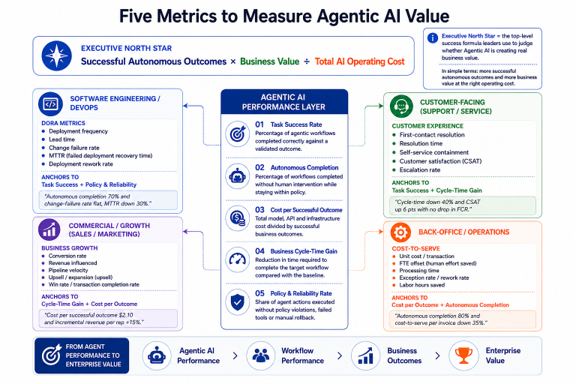
As GCCs take greater responsibility for enterprise intelligence, success must shift from activity and efficiency metrics to autonomous business outcomes.
|
Traditional GCC Measure |
Agentic GCC Measure |
|
Headcount |
Business capability augmented |
|
Utilization |
Autonomous workflow completion |
|
Cost per FTE |
Cost per successful outcome |
|
Tickets handled |
Issues autonomously resolved |
|
Applications supported |
Products and platforms owned |
|
SLA adherence |
SLO + business outcome |
|
Automation scripts |
End-to-end autonomous workflows |
|
Cloud spend |
AI/cloud unit economics |
|
Engineering output |
Engineering velocity and DORA improvement |
|
Innovation pilots |
Production AI adoption |
The goal is not more AI deployment, but measurable gains in cycle time, engineering velocity, customer experience, reliability, revenue, cost-to-serve, risk, and time-to-market.
Five Questions GCC Leaders Should Ask Now
Before launching the next Agentic AI initiative, leadership teams should answer five questions:
1. Which workflows deserve autonomy? Prioritize high-value, measurable, digitally mature workflows.
2. Can agents trust the data? Validate quality, ownership, lineage, freshness, semantics, and access.
3. Can systems safely expose actions? Ensure APIs, identity, authorization, policies, and rollback mechanisms are ready.
4. Can autonomous decisions be observed and governed? Establish SLOs, traces, security, auditability, evaluation, and escalation.
5. Can we prove the economics? Measure cost per outcome, human effort avoided, cycle-time gains, revenue impact, and risk.
If these questions cannot be answered, the enterprise may be ready for AI experimentation—but not AI autonomy.
The Next GCC Advantage: Enterprise Context
As AI tools commoditize, enterprise context becomes the differentiator. GCCs can connect deep knowledge of products, data, systems, processes, and regulations with AI execution.
The advantage lies in integrating Trusted Data + APIs + Engineering + SRE + Cybersecurity + AI Governance + FinOps into an enterprise intelligence operating model. GCCs can evolve from executing work to engineering how humans, software, and intelligent agents work together.
The key question: Will your GCC consume autonomous intelligence—or engineer it?
Next Step: Start with one high-value workflow. Map its data, APIs, decisions, risks, SLOs, and economics, then define what should be human-led, AI-assisted, or autonomous.
This determines whether the GCC is ready to scale Agentic AI beyond experimentation.