

Recently, we collaborated with a team preparing to fine-tune a domain-specific Large Language Model (LLM) for their product. While the base model architecture was ready, they lacked a critical asset: a high-quality golden dataset tailored to their industry and use case. Fine-tuning requires large volumes of realistic, domain-specific data to ensure the model performs reliably in production.
Manually curating such a dataset at scale would have taken weeks and introduced compliance risks. To solve this, we deployed a curated pipeline of LLM agents to generate the golden dataset synthetically. This approach enabled the team to fine-tune quickly and safely, without compromising on data quality, scalability, or governance.
Why Real Data Falls Short and Fast
In theory, data-hungry AI models should thrive in the enterprise, where systems generate logs, transactions, and user interactions by the second. But in practice, this data often hits limits:
- Privacy and compliance concerns block direct access.
- Sparse edge cases don’t occur frequently enough to train or test models reliably.
- Time-to-curate is often weeks longer than the AI build cycles themselves.
- Manual QA loops slow down delivery and introduce subjectivity.
Enterprise AI teams need structured, context-rich datasets. Approval chains, redacted inputs, and cleaning pipelines often cause delays. By the time data is available, the model requirements have already evolved.
This is where synthetic data, when generated and validated intelligently, isn’t a fallback — it’s a necessity. Recognizing this, we at Calsoft re-evaluated our approach to synthetic data generation to address these enterprise challenges.
What We Set Out to Build at Calsoft
At Calsoft, we didn’t approach synthetic data generation as a one-shot LLM prompt. We treated it like a systems engineering problem.
We built a closed-loop orchestration model using LLM agents, where each agent plays a specialized role — similar to how an engineering team would operate in a human workflow.
Here’s how it works:
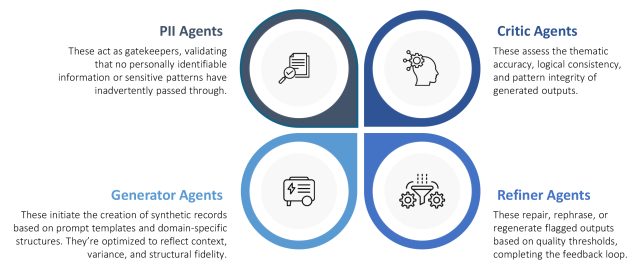
This multi-agent architecture isn’t just scalable — it’s auditable and domain-adaptive, making it ideal for enterprise needs where data quality is non-negotiable.
The Results: What We’ve Seen So Far
In early engagements across finance and life sciences, we’ve observed measurable improvements in delivery velocity and data usability. Specifically:
- Data preparation timelines reduced by up to 70%
- Thematic accuracy exceeding 95% in domain-aligned synthetic datasets
- Deployment-ready datasets delivered in under 72 hours, including validation steps
This shift isn’t cosmetic. In one case, a financial services client used our pipeline to simulate fraud-like transaction sequences and stress-test their compliance engine without touching production data.
Another client in life sciences used it to generate controlled, research-aligned datasets for internal benchmarking, enabling their models to generalize better across unseen scenarios.
Why LLM Agents — Not Just LLM Prompts
A common question we hear is: “Why not just use GPT to generate some data with the right prompt and move on?”
The answer lies in two words: consistency and control.
Prompt-only approaches lack the structure and accountability needed for enterprise-grade use. LLM outputs are probabilistic, and without orchestration, you’ll either spend hours filtering junk or ship data that doesn’t meet audit standards.
By introducing role-specific agents, we enforce specialization and rigor. Generator agents create. Critics review. Refiners iterate. PII filters gate. And this happens without manual intervention on every batch.
It’s not just faster — it’s safer, more consistent, and easier to plug into downstream ML pipelines.
What Synthetic Data Enables Practically
Let’s ground this in use cases. With a curated synthetic data pipeline, AI teams can:
- Simulate rare, high-risk scenarios in finance or IT systems
- Accelerate model retraining when datasets shift
- Avoid handling sensitive user data during development
- Conduct regression testing of AI outputs across multiple simulated inputs
- Build balanced datasets for underrepresented classification labels
This shortens the iteration loop. What previously required a month of data extraction, masking, labeling, and cleanup can now be generated, reviewed, and deployed within days.
Where This Fits: The Industries That Need It Most
We’re seeing traction across three core clusters:
- Regulated industries – Finance, insurance, and life sciences, where compliance constraints restrict access to training or testing data.
- Data-intensive operations – Log analytics and eCommerce, where models need long-tail scenarios that rarely occur.
- Emerging adopters – Teams piloting AI in R&D, education, or automation, where synthetic datasets enable safe experimentation.
The common thread? These teams aren’t lacking ideas or models — they’re bottlenecked by data, or more precisely, by the risk of using the wrong data.
Synthetic Data Is Now Infrastructure
Here’s the mindset shift that’s overdue: synthetic data isn’t a workaround — it’s part of modern AI infrastructure.
If your ML models depend on consistent, representative inputs, and your real-world data can’t keep up, then synthetic pipelines aren’t optional — they’re core to your architecture.
At Calsoft, we treat them as such — with agent-level audit trails, domain-tuned generation loops, and compliance-grade output handling.
Final Thought
You don’t need infinite data to build great AI systems. But you do need the right data, at the right time, in the right format — without the regulatory drag or operational delays. That’s what this new class of curated synthetic data pipelines is designed to provide.
We’re not replacing real data — we’re complementing it where it falls short, making AI development faster, safer, and more scalable.
If your team is stuck waiting on datasets, blocked by approvals, or missing edge cases — it might be time to rethink the pipeline.
Let’s build data you can actually use.
FAQs
Q1: What exactly is synthetic data and how is it used in AI development?A: Synthetic data refers to artificially generated information that mimics real-world data patterns without exposing actual user or enterprise data. It’s used to train, test, or validate AI models — especially when real data is scarce, sensitive, or incomplete.
Q2: Why not use prompts directly with an LLM like GPT to generate data?A: Prompt-based generation lacks control, consistency, and auditability. Our multi-agent architecture ensures domain fidelity, eliminates sensitive information, and maintains high quality through a closed feedback loop.
Q3: Is this synthetic data safe for use in regulated industries?A: Yes. The pipeline includes built-in PII-scrubbing, bias detection, and domain adaptation, making it suitable for finance, healthcare, and life sciences use cases.