

A few months ago, an operations leader at a large enterprise noticed a pattern that didn’t show up clearly on dashboards.
Orders were coming in on time. Systems were running. Automation pipelines were technically ‘working.’
Yet, teams were still spending hours every day fixing orders by hand.
The reason wasn’t system downtime or broken integrations.
It was addresses.
Company names slightly misspelled.
Street numbers formatted differently.
Suite numbers missing or misplaced.
Individually, these looked like small data issues. At scale, they were quietly breaking automation.
This blog walks through how address correction using Generative AI helped eliminate a major hidden bottleneck in order processing, without replacing existing validation systems, and why operations and IT leaders are now treating address intelligence as a priority, not an afterthought.
Why address errors break automation more than you expect
Most enterprise order workflows rely on a simple assumption:
If the address matches what’s in the system, the order moves forward.
In practice, this assumption fails more often than teams realize.
Addresses are extracted from documents like purchase orders, contracts, or PDFs. These documents are often created by humans, scanned from different sources, or formatted inconsistently. Even when OCR and extraction work correctly, the resulting address text may not exactly match what downstream validation systems expect.
Traditional address validation tools are designed for precision, not interpretation. They check whether an address matches an existing record, not whether it means the same thing.
As a result:
-
Orders fail validation
-
Automated workflows stop
-
Orders are pushed to manual review queues
-
Operations teams intervene to “fix” something that was logically correct all along
In one client environment, approximately 20–30% of orders required manual handling due to address mismatches (client-observed). Not because the orders were wrong, but because systems couldn’t reconcile variations in how addresses were written.
Also Read: QA engineers must think like adversaries
The hidden cost of manual address fixes
From an operations perspective, manual address correction seems manageable at first.
Someone reviews the order.
They search for the correct address.
They update the record.
The order moves forward.
But over time, this creates compounding issues:
-
Slower order turnaround
-
Increased operational costs
-
Higher dependency on human availability
-
Greater risk of inconsistency and errors
-
Reduced confidence in automation ROI
From an IT perspective, the response is often to add more rules, more checks, more exceptions, more conditions.
That approach quickly becomes difficult to maintain and still doesn’t solve the core problem: systems lack contextual understanding of address data.
Why rule-based validation wasn’t enough
Addresses don’t fail because they’re incorrect.
They fail because they’re expressed differently.
For example:
-
Legal entity suffixes may be truncated or missing.
-
Street abbreviations vary by region.
-
Address formats differ across countries.
-
Minor typos still refer to the same physical location.
Rule-based systems treat these as errors. Humans don’t.
The gap between how systems validate addresses and how humans interpret them is exactly where Generative AI becomes useful, not as a replacement for validation, but as an intelligent layer before it.
Introducing address correction using generative AI
Instead of asking, “Does this address exactly match?”
The new approach asks, “What address is this most likely referring to?”
Calsoft designed a Generative AI–powered address correction system that sits within the existing order processing workflow.
The system takes an incorrect or inconsistent address as input and performs three critical tasks:
-
Understands the intent of the address
-
Finds the closest valid address from a trusted database
-
Returns a corrected address with an explanation
This allows automation to continue without sacrificing accuracy or compliance.
How the solution works (in simple terms)
While the underlying architecture uses advanced components like Large Language Models (LLMs), the logic is straightforward.
Step 1: Address comes in (messy and imperfect)
An address is extracted from a document—just as before.
Step 2: Intelligent retrieval
Instead of failing immediately, the system searches an internal address database using similarity-based retrieval. This narrows down likely matches even when the text doesn’t align perfectly.
Step 3: LLM interpretation
A Large Language Model analyzes:
-
The input address
-
The retrieved candidates
-
Context, such as entity names, locations, and formatting
The model determines which stored address the input most closely represents.
Step 4: Validation and guardrails
Before returning a result, the system applies validation checks to ensure the correction is reliable and compliant.
Step 5: Explained output
The system outputs:
-
The corrected address
-
A clear explanation of how the match was determined
This explanation is critical for trust, auditing, and operational confidence.
Real examples from the workflow
When an input address contained spelling issues or formatting differences, the system successfully mapped it to the correct, validated record in the database, without manual intervention.
The key outcome wasn’t just accuracy.
It was continuity.
Orders no longer stalled because systems could interpret intent instead of rejecting variation.
Download the complete use case here
What changed for operations teams
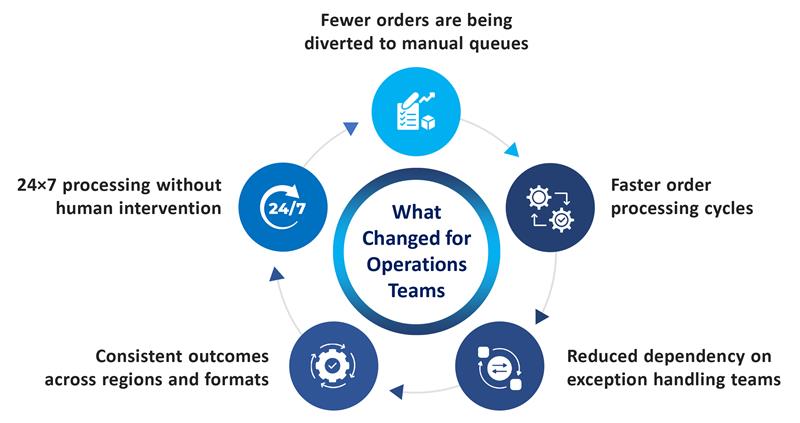
From an operations standpoint, the shift was immediate and measurable:
-
Fewer orders are being diverted to manual queues.
-
Faster order processing cycles
-
Reduced dependency on exception handling teams
-
Consistent outcomes across regions and formats
-
24×7 processing without human intervention
Instead of reacting to failures, teams could focus on optimizing throughput.
What changed for IT and digital leaders
For IT leadership, this approach avoided a common pitfall: rebuilding or replacing existing systems.
The GenAI layer worked with existing validation tools, not against them.
Benefits included:
-
Minimal disruption to core systems
-
Clear separation of intelligence and validation
-
Easier governance and explainability
-
Scalable architecture across regions and formats
Most importantly, it delivered a tangible return on automation investments that were already in place.
Why this matters now
As enterprises expand globally and automate more document-driven workflows, address variation isn’t going away.
In fact, it increases:
-
More suppliers
-
More regions
-
More document formats
-
More data sources
Address correction using Generative AI is not about futuristic AI experimentation. It’s about fixing a very real, very practical problem that quietly erodes automation efficiency.
A practical pattern we see repeatedly
In large-scale enterprise workflows, address validation failures are rarely caused by incorrect data. They are caused by variation; differences in how addresses are written, formatted, or extracted across documents and regions.
In these environments, rule-based validation alone becomes increasingly difficult to scale. Introducing an AI-based interpretation layer before validation allows systems to handle real-world variation without increasing operational risk or complexity.
Take-away
Automation doesn’t fail loudly.
It fails quietly; one exception, one manual fix, one workaround at a time.
Address correction using Generative AI is about fixing that quiet failure before it becomes an operational habit.
FAQ’s
1: What is address correction using Generative AI?
Address correction using Generative AI refers to applying Large Language Models (LLMs) to interpret, correct, and validate inconsistent or incorrect address data by understanding context rather than relying only on exact string matches.
2: Why do traditional address validation systems fail in enterprise workflows?
Traditional systems depend on exact matches against stored records. Even minor differences in spelling, formatting, or abbreviations can cause valid addresses to fail validation, leading to manual intervention and workflow delays.
3: How does an LLM improve address correction accuracy?
An LLM analyzes the intent behind an address, compares it with similar validated records, and determines the most likely correct match. This allows systems to resolve variations that rule-based logic cannot handle reliably.